
Twin Vee PowerCats Faces Financial and Operational Challenges amid Software Impairment and Dealer Network Reliance
Recent Q2 2026 disclosures reveal significant non-cash impairment and ongoing liquidity concerns within a seasonal, capital-intensive boat manufacturing environment.
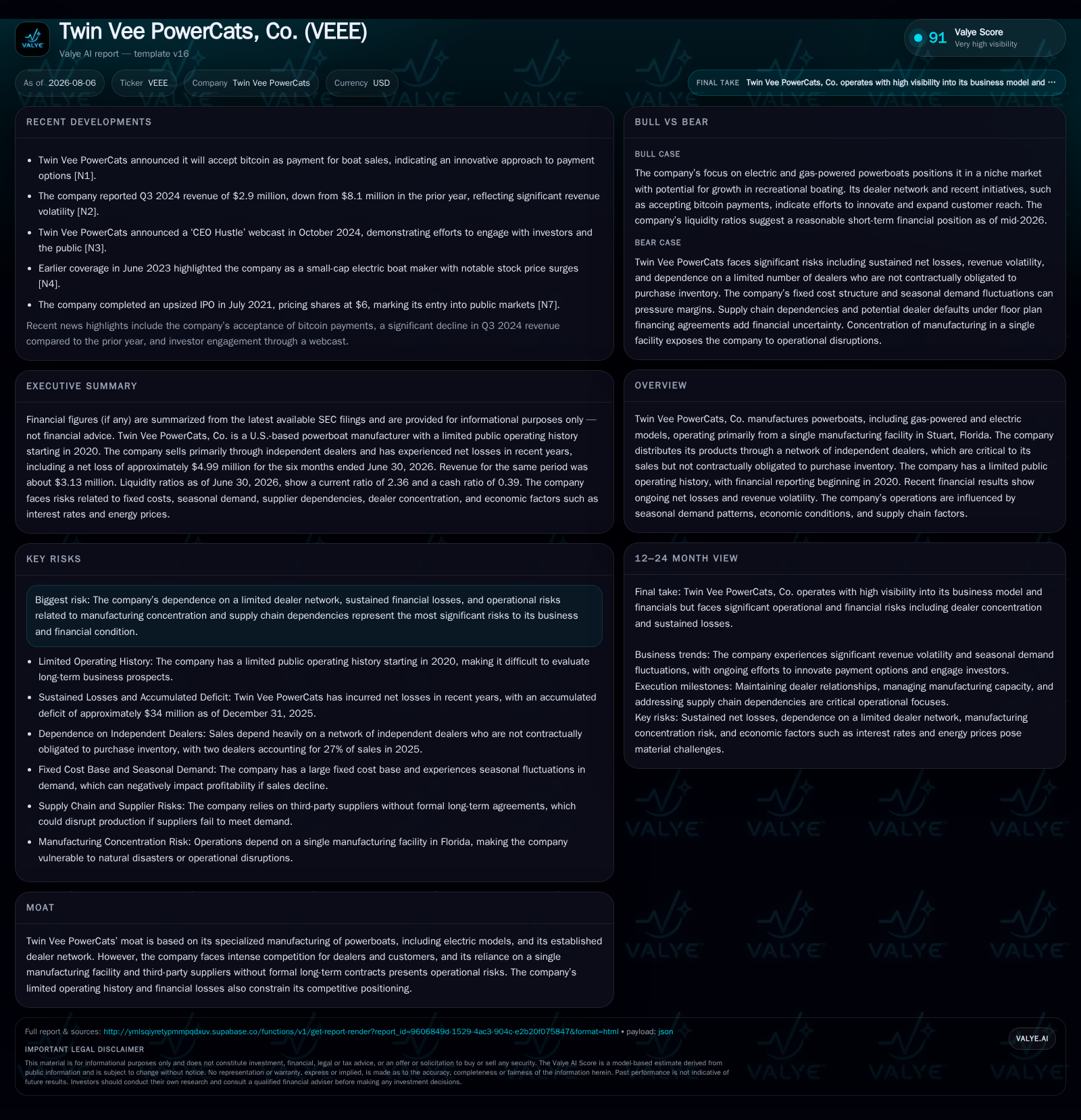
Twin Vee PowerCats Co. reported a $701K impairment on its software platform in Q2 2026, highlighting challenges in monetizing new tech ventures alongside its core powerboat manufacturing business. Despite slight revenue growth and dealer network expansion, the company continues to operate at a loss with liquidity constraints raising substantial doubt about its going concern status. The firm’s reliance on a single Florida manufacturing facility and independent dealers exacerbates operational risks amid fluctuating demand influenced by seasonality and economic factors. Near-term execution hinges on improving customer adoption of technology offerings, stabilizing revenues, and securing capital to weather fixed cost pressures intrinsic to marine vessel manufacturing.
Recent Operating Update
Twin Vee PowerCats Co.'s latest Q2 2026 filing unveiled a significant non-cash impairment charge of approximately $701,223 related to its capitalized software development costs [S2]. This software platform was commercialized during 2025 to generate future licensing, subscription fees, and other monetization opportunities. Despite management's active pursuit of customer adoption and strategic partnerships, the impairment suggests substantial challenges in realizing expected revenue streams from this initiative. The event underscores the difficulty in diversifying revenue beyond core boat manufacturing into technology-driven products within this sector.
Moreover, the company continues to grapple with financial sustainability concerns. This reflects persistent revenue insufficiency relative to expenses despite recent initiatives.
Business Model Analysis
Twin Vee designs, manufactures, and sells powerboats—both gas-powered and electric varieties—from its primary manufacturing facility located in Stuart, Florida [S1]. Its revenue is principally derived from wholesale sales to independent dealers distributed across target markets. These dealers are not contractually obligated to maintain purchase volumes or inventory levels which introduces volatile order flows impacting production planning and revenue visibility [S1,S21]. Payments typically occur shortly after shipment when control transfers to carriers destined for dealers.
The company also invested in an internally developed software platform envisioned as a future recurring revenue driver via licensing/subscription models—uncommon but increasingly relevant in marine vessel ecosystem management. Nonetheless, initial monetization attempts have proven disappointing enough to warrant impairment recognition [S2]. The dual-model approach underscores efforts to balance traditional boat sales—which are capital intensive with high fixed costs—and scalable technology products that could improve margins if adopted successfully.
Operationally, Twin Vee relies heavily on its Stuart facility equipped for composite lamination, CNC tooling, and assembly processes tailored for powercat designs. Labor availability remains a critical factor given low unemployment rates in Florida leading to competition for skilled hourly workers; wage inflation risk persists which could strain profitability if not offset by scale or pricing [S1]. Supply chain reliance on third-party component vendors lacking long-term contracts further complicates production stability.
Industry Structure & Competitive Positioning
Positioned within the marine vessels and boats manufacturing industry focused on recreational powerboats, Twin Vee faces structural challenges typical of this sector: considerable fixed manufacturing overheads needing scale leverage; seasonal sales patterns heavily influenced by weather cycles; sensitivity to fuel prices impacting gas-powered model demand; and dealer network dependence affecting sales fluctuations.
Peers such as Brunswick Corporation or Correct Craft illustrate scale advantages through larger product suites, broader dealer relationships with contractual purchase obligations or floor plans facilitating dealer commitments. Twin Vee’s small-scale footprint, limited dealer binding agreements, and modest operating history since initiating public reporting circa 2020 place it behind more entrenched competitors in market reach and process stability [F1,S1]. The non-contractual nature of dealer purchases generates unpredictability in order backlog making capacity utilization volatile. Fixed production costs mean dips in order volume disproportionately depress margins undermining cash flow sustainability. Supply chain dependencies for specialized components intensify vulnerability especially amidst inflationary pressure or logistic disruptions.
Financially, repeated net losses ($8.6 million net loss for FY 2025) increase dependency on external capital infusions which may dilute equity holders due to frequent equity offerings including recent rounds netting $5.8 million after reverse stock splits at ratios up to 1-for-37 designed similarly for Nasdaq compliance [F1,S4,S5]. Corporate governance lapses like the invalid Nevada reincorporation expose managerial oversight weaknesses potentially distracting focus and investor confidence [S3,S5]. Macro headwinds such as rising interest rates increase borrowing costs for dealers and end consumers reducing discretionary spending on high-ticket leisure items like boats; concurrently higher energy/fuel prices elevate ownership costs negatively impacting demand curves especially for gas-powered lines
What To Watch Next
Key near-term milestones involve stockholder votes necessary to ratify prior reverse stock splits legitimizing prior governance actions that have legal implications until approved retroactively [S3], crucial for Nasdaq listing eligibility stability.
Operationally monitoring order backlog trends quarter-over-quarter will signal whether dealer inventory levels align with demand projections especially post-seasonal swings. Tracking new customer adoption or partnership announcements related to software platform commercialization could indicate whether impairment trajectory reverses.
Financially, success or failure in raising additional capital under reasonable terms will determine ability to fund working capital needs and product development imperatives mitigating going concern risks flagged repeatedly by management amid persistent negative cash flows from operations [S2]
Financial Profile Discussion
Twin Vee’s latest balance sheet indicates cash, cash equivalents, and restricted cash totaling approximately $3.9 million as of June 30, 2026 alongside total debt just under $500 thousand maintaining a net positive cash stance [S2,F1]
Despite improved gross margin trends noted previously indicating some operational leverage gains from increased unit sales or pricing discipline, prior quarters have consistently showed operating losses exceeding $8 million annually highlighting structural profitability hurdles linked mainly to volume shortfalls against sizeable fixed expense bases inherent in marine manufacturing facilities [F1,S1,S4]
Capital raising activities have been frequent reflecting market acceptance challenges with dilutive consequences from equity issuances alongside reverse stock splits designed solely for listing compliance rather than strategic value creation—signaling caution regarding shareholder returns absent meaningful turnaround progress [F1,S4,S5].
Given Twin Vee's ongoing net losses combined with capital market dependency juxtaposed against an evolving product portfolio integrating both traditional gas-powered catamarans with electric propulsion options plus software licensing ambitions places it at an operational crossroads requiring substantial execution improvement backed by functional governance stabilization before credible financial self-sufficiency is achievable.
This analysis is based exclusively on information publicly filed with the SEC through August 6, 2026 () supplemented by XBRL financial data ([F1]) without speculative forecasts or market positions beyond stated evidence. It reflects careful integration of industry context pertinent to marine vessels manufacturers emphasizing operational KPIs such as dealer network dynamics, production fixed-cost leverage challenges, seasonal demand impact on revenues, supply chain exposures relevant to this segment.
Disclaimer: This is research-only, informational analysis and not investment advice. It may include AI-generated interpretation and general industry context. Always verify important details using primary sources.

Comments