
Sabra Health Care REIT's Credit Risk Management and Lease Durations Shape Stability in Q2 2026
Sabra's Q2 2026 disclosures underscore a portfolio anchored by long-term triple-net leases and active credit oversight, supporting operational stability amid sector complexities.
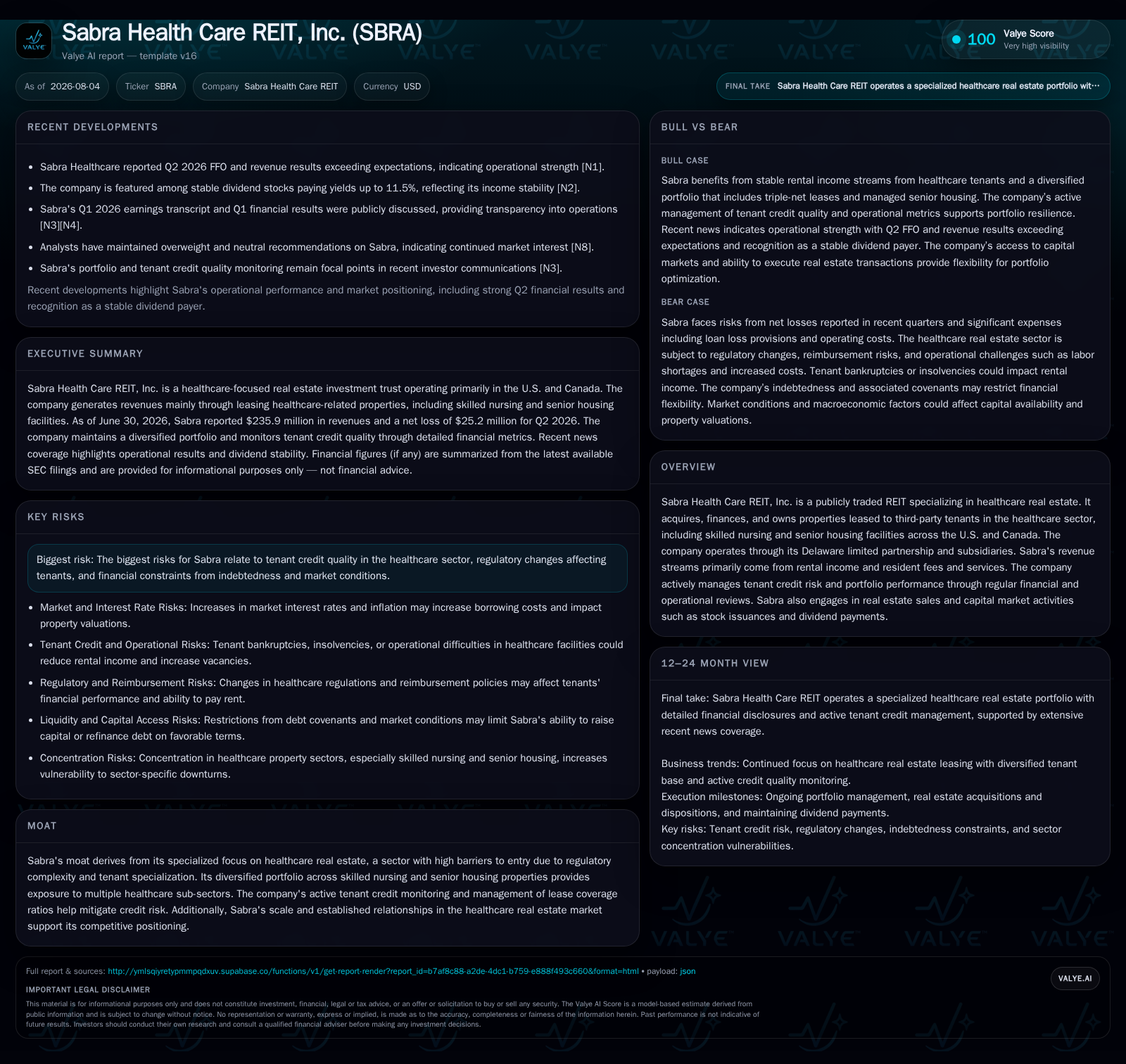
In its latest 10-Q filing for Q2 2026, Sabra Health Care REIT, Inc. reported a portfolio of approximately 270 healthcare properties leased under triple-net agreements with a weighted average lease term of seven years, reflecting the company's emphasis on lease duration as a driver of cash flow visibility. Sabra actively manages tenant credit risk across its specialized healthcare real estate portfolio, including skilled nursing and senior housing assets. The company maintains significant revolving credit availability and manageable leverage, enabling funding flexibility for acquisitions or asset repositioning. These strategic levers buttress Sabra’s operational stability and growth prospects despite ongoing regulatory and tenant financial pressures in the healthcare sector.
Q2 Portfolio Dynamics: Lease Terms, Tenant Credit Controls, and Operating Leases
Sabra Health Care REIT's latest quarterly filing on August 3, 2026 highlights a stable leasing framework underpinning its healthcare real estate portfolio. As of June 30, 2026, the company held approximately 270 properties subject to triple-net operating leases—an arrangement where third-party healthcare operators bear property-related expenses such as maintenance, taxes, and insurance [S2]. These leases have staggered maturities ranging from one to eighteen years with a weighted average remaining term (WALT) of seven years—a mature lease profile that lends predictability to rental income streams.
Long WALT is particularly critical in the complex healthcare real estate sector where finding replacement tenants involves specialized underwriting given regulatory hurdles and operator expertise requirements. This durability in leasing reduces re-leasing risk and supports consistent cash flows [S2]. Moreover, Sabra serves as the primary beneficiary of two important variable interest entities (VIEs), consisting of joint ventures owning three senior housing communities each. These interests diversify Sabra’s exposure beyond directly owned properties while integrating operational risk managed by third-party property managers under contractual agreements
Sabra’s stewardship over tenant credit risk remains central to portfolio health. Healthcare operators leasing skilled nursing facilities (SNFs) or senior housing face regulatory reimbursement variability affecting their financial viability; thus, maintaining robust lease coverage ratios—measuring tenant income against rent obligations—is essential for avoiding cash flow disruptions. The company conducts ongoing financial reviews informed by operational data from tenants to anticipate risk trends early.
Revenue Foundations: Rental Income Streams Driven by Triple-Net Leases
Sabra’s business model centers on generating revenue predominantly through triple-net leases with specialized healthcare operators who manage day-to-day facility operations while accepting full responsibility for property-related expenses [S1][S2]. This lease structure transfers many operational cost risks away from Sabra but concentrates exposure on tenant solvency. Stable rental income underpins recurring funds from operations (FFO), which fund dividend payouts characteristic of publicly traded REITs.
Supplementing base rent are resident fees and services commonly associated with senior housing portfolios—fees that provide some incremental revenue but also require nuanced management due to their linkage with occupancy levels and service delivery quality [S1]
The complexity of leasing highly regulated SNFs requires deep sector knowledge both in deal structuring and credit oversight. Losses or defaults have outsized impacts given fixed rental obligations coupled with limited ability to promptly replace defaulted tenants. Sabra's vigilant credit monitoring seeks to mitigate these challenges through proactive engagement.
Competitive Positioning: How Sabra Stacks Versus Other Healthcare REITs
Sabra’s portfolio exhibits meaningful diversification across skilled nursing facilities, senior housing, assisted living, and other specialized healthcare properties—a mix that compares favorably to peers such as Welltower or Healthpeak Properties known for varying emphases between medical office buildings or diversified seniors housing [S1]. Geographic dispersion across North America further buffers localized economic or regulatory shocks.
Operational KPIs including occupancy rates generally remain critical performance markers; while specific current figures are not disclosed here, maintaining solid occupancy drives net operating income (NOI) stability. Long weighted-average lease terms contribute an advantage over broader commercial landlords facing shorter renewals.
From a capital structure perspective, Sabra balances leverage prudently despite holding roughly $2.65 billion in total debt evidenced at June 30, 2026 [F1]. Credit facilities supplement term loans and senior notes issuance; liquidity access positions the company competitively for acquisitions or strategic repositioning without excessive refinancing pressure seen in peak rate environments. This contrasts with some peers potentially burdened by higher debt-to-equity ratios or more constrained revolver availability.
Growth Potential Underpinned by Demographic Demand and Healthcare Sector Trends
Demand dynamics within the healthcare real estate sector continue favoring skilled nursing and senior living properties amid an aging population driving structural need expansion. Regulatory frameworks sustaining infrastructure investment provide additional supportive tailwinds.
Innovations in care delivery—such as memory care specialization or transitional care enhancements—also expand real estate usage scopes that REITs like Sabra can target through acquisitions or development pipelines. The company’s available borrowing capacity—$682.5 million undrawn on its revolving credit facility at quarter-end—enables opportunistic portfolio growth aligned with these secular trends [S2]
Long-term leases lock in yields supporting dividend sustainability while allowing periodic asset repositioning driven by evolving operator needs or community demographics.
Risk Factors: Tenant Credit Quality, Regulation, and Capital Market Conditions
Tenant credit risk remains paramount given operating margins compressed by reimbursement uncertainty or labor market pressures prevalent in senior housing and SNF operations [S1][S2][S3]. Deterioration in operator financial health can jeopardize rent collections despite triple-net lease protections.
Additionally, evolving regulations affecting care standards or payment models inject uncertainty into tenants’ viability profiles requiring adaptive leasing strategies from Sabra.
Capital market fluctuations influence refinancing costs impacting overall cost of capital; rising interest rates could pressure future earnings if not well managed through hedging or debt maturity staggering.
Exposure via VIEs introduces complexity around consolidation accounting but diversifies direct asset risk concentration.
Monitoring Signals: Upcoming Milestones in Occupancy, Lease Renewals, and Capital Access
Key near-term indicators include trends in occupancy post the June quarter which influence revenue stability tied to resident fees beyond base rents [N1][S2]. Upcoming significant lease expirations or renewals will affect portfolio WALT measures; successful renewals maintain cash flow predictability while adverse events may signal heightened re-leasing costs or vacancy risks.
Liquidity evolution monitored via revolver utilization levels or new debt issuance signals capacity for acquisition pipeline execution.
Strong FFO performance beating estimates as reported recently provides positive feedback on cash flow visibility amid ongoing macroeconomic headwinds [N1]
Financial Profile Discussion: Recent Liquidity Metrics, Debt Positioning, and Cash Flow Stability
As of June 30, 2026, Sabra reported total debt approximating $2.65 billion offset by $231.6 million in cash equivalents yielding net debt near $2.41 billion [F1][S2]. Revolving credit utilization stands at $317.5 million from a $1 billion facility that includes two six-month extension options expiring January 4, 2027; undrawn capacity thus totals $682.5 million offering ample liquidity buffer for opportunistic investments or balance sheet management [S2].
Interest expense incorporates ratings-based margins plus prevailing short-term benchmark rates such as SOFR or CORRA adjusted based on currency denomination.
Net income variability is influenced by non-cash items including depreciation/amortization tied to real estate assets' useful lives—implying heavy capital stock—but funds from operations (FFO) remains a more operative earnings proxy supporting dividends typical for REIT investors [S6][N1]
Continued access to capital markets balanced against asset disposition proceeds inform flexibility for portfolio optimization alongside tenant credit risk management imperatives.
This analysis combines recent quarterly filings with sector-specific operational context to elucidate how Sabra Health Care REIT's emphasis on long-dated triple-net leases allied with vigilant tenant credit oversight form the backbone of stable revenues amid inherent sector risks. The company’s balanced capital structure paired with substantial undrawn credit capacity fortify its ability to pursue growth aligned with demographic trends underpinning healthcare real estate demand. Monitoring occupancy trends and lease renewal activity remain crucial indicators for assessing ongoing performance sustainability.
Disclosure: This report is for informational purposes only and does not constitute investment advice or research view.
Disclaimer: This is research-only, informational analysis and not investment advice. It may include AI-generated interpretation and general industry context. Always verify important details using primary sources.

Comments