
Backblaze Advances Cost-Efficient Cloud Storage Amid AI-Driven Demand Growth
Backblaze’s latest quarter highlights operational progress driven by AI workload expansion and strategic partner channels, balanced against persistent profitability challenges.
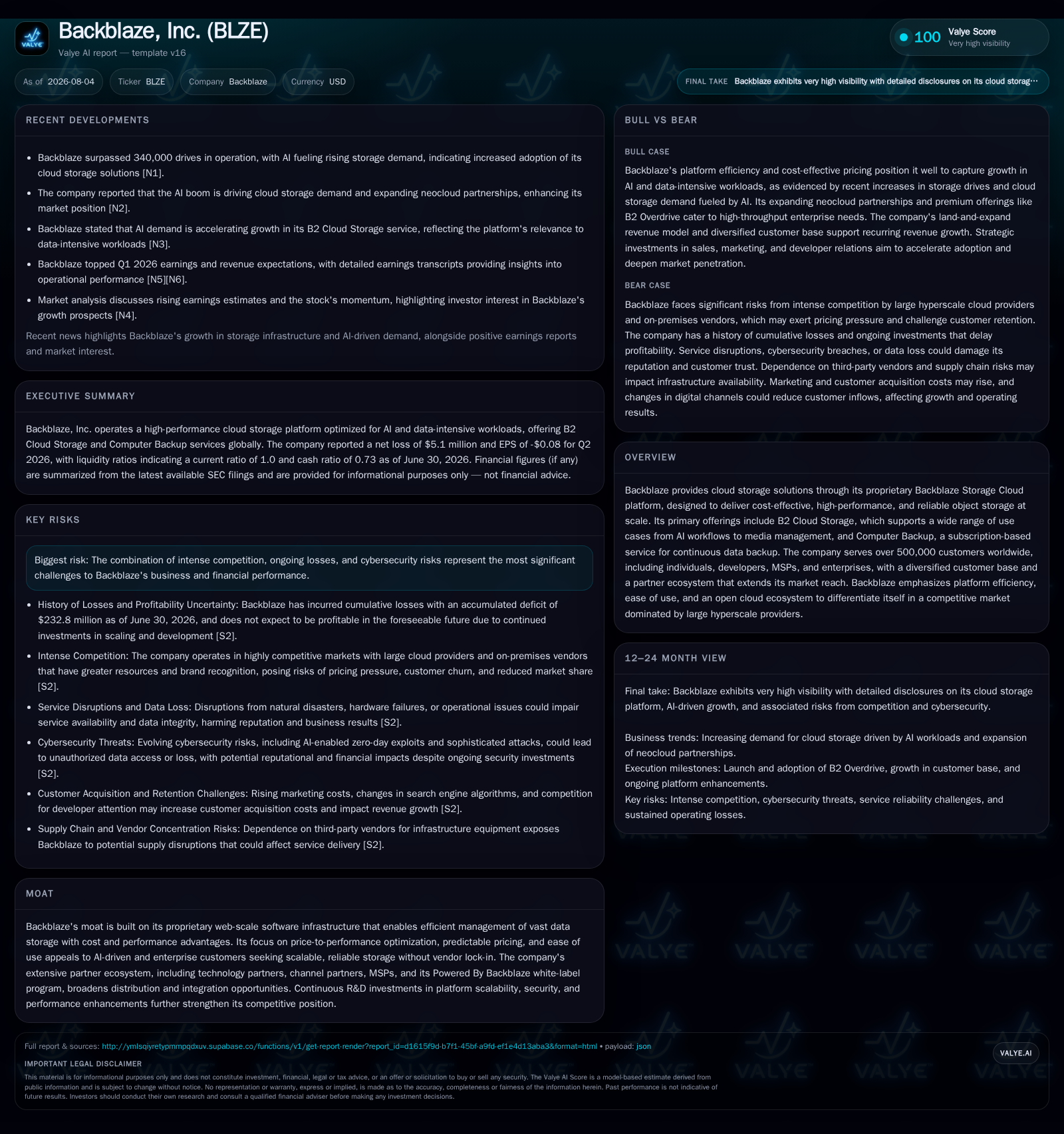
In Q2 2026, Backblaze reported operational momentum powered by rising storage demand from AI workloads and expanded use of its B2 Cloud Storage platform, alongside its subscription-based Computer Backup service. The company leverages a proprietary web-scale software infrastructure that delivers price-to-performance advantages, targeting developers, enterprises, and neocloud platforms through a diversified partner ecosystem. Despite growing revenue and platform scale, Backblaze continues to operate at a loss while navigating intense hyperscale competition and capital-intensive infrastructure needs. Key growth drivers include AI-enabled data growth, partner program expansions, and platform openness; watchpoints focus on achieving sustainable profitability and managing credit covenants.
Recent Operating Update
Backblaze's Q2 2026 filing revealed steady operational progress driven by broad demand acceleration in cloud storage linked significantly to burgeoning AI workloads. The company highlighted surpassing over 340,000 deployed hard drives supporting its storage infrastructure as AI fueling rising data generation pushed capacity utilization higher [N1], [S2]. Although total revenue figures are not detailed here, this increasing storage demand aligns with the firm’s mission to serve data-intensive applications through its cost-effective Backblaze Storage Cloud platform.
This quarter’s update also reaffirmed ongoing losses during investments in scaling sales efforts and R&D enhancements tailored towards platform scalability and integration of emerging tech like AI capabilities into its development pipeline [S2], [S25]. The company emphasized a balanced customer acquisition mix involving self-serve developers experimenting with AI-enabled applications alongside direct enterprise sales accelerated via its Powered By Backblaze partner program.
Business Model Analysis
Backblaze operates a dual-faceted revenue model centered around its proprietary Backblaze Storage Cloud software infrastructure delivering both Infrastructure-as-a-Service (IaaS) and Software-as-a-Service (SaaS) offerings. Its core products include:
- B2 Cloud Storage: An object storage service priced primarily on pay-as-you-go basis or committed contracts permitting scalable capacity usage suitable for developers and enterprises needing flexible cloud storage.
- B2 Overdrive: A high-performance variant built atop B2 Cloud Storage featuring up to 1Tbps throughput designed specifically for latency-sensitive AI and data-driven workflows requiring private networking.
- Powered By Backblaze: A white-label IaaS program enabling neocloud platforms and application providers to embed Backblaze’s storage within their offerings seamlessly backed by API integration.
- Computer Backup: A subscription-based SaaS product providing continuous backup of laptops and desktops with straightforward flat-rate pricing targeted at individual consumers and businesses.
Revenue streams are driven by customer consumption metrics such as total data stored (petabytes scale), data egress consumed during retrievals or transfers outside the network, subscription fees for Computer Backup users, as well as incremental value-added features accessed via APIs or premium tiers [S1]. The self-serve model enables scalable customer acquisition with low churn among developers experimenting with new workflows like AI training datasets. Meanwhile, enterprise acquisition focuses on higher average revenue per user (ARPU) via direct sales supported by an expanding partner channel offering bundled or embedded solutions
This business approach leverages Backblaze's vertical integration of web-scale software infrastructure optimized for price-to-performance on commodity hardware—a distinct contrast versus hyperscale players who often hide complex pricing layers. This simplification reduces friction in purchasing decisions for smaller tech firms and allows midmarket customers an alternative to the lock-in-hardened hyperscalers. The open-cloud philosophy integrates with partners’ ecosystems rather than attempting to replace entire IT stacks outright.
Industry Structure & Competitive Landscape
Cloud storage is a highly competitive segment dominated by hyperscale giants like Amazon Web Services (AWS), Microsoft Azure, and Google Cloud Platform which possess massive scale advantages in compute/storage capacity, geographic footprint, and integrated cloud services bundles. However, their pricing models tend to be complex, creating opportunities for specialized vendors offering transparent pricing optimized on specific workloads such as object storage or backup.
Peers like Wasabi Technologies focus on low-cost hot cloud storage specifically targeting media processing workloads; Carbonite caters more toward traditional SMB backup software niches. Backblaze carves out differentiation through its combined IaaS/SaaS hybrid portfolio addressing both developer-centric usage patterns (self-serve API access) plus enterprise partnerships enabling embedded cloud storage within broader software platforms via Powered By Backblaze.
Its competitive moats derive from:
- Proprietary web-scale software infrastructure reducing total cost of ownership,
- Predictable pricing models without hidden egress costs where applicable,
- High platform uptime reliability ensuring data durability,
- Active expansion of partner ecosystems including technology vendors and managed service providers,
- Openness fostering avoidance of vendor lock-in which appeals strongly to AI model builders accelerating cloud adoption.
Nonetheless, competing successfully requires ongoing investment in scaling security measures against evolving cybersecurity threats (notably sophisticated AI-powered attacks), continuous innovation in throughput performance for big data workloads, securing dependable hardware supply chains amidst global constraints, all while navigating aggressive pricing competition pressure compressing gross margins industry-wide.
Growth Drivers
Fundamental demand drivers for Backblaze include explosive data growth fueled by artificial intelligence workflows generating vast training datasets needing reliable object storage at large scale. This sector benefits from increasing organizations shifting away from legacy on-premises systems toward cloud-first architectures. Additionally:
- Expansion of the developer base innovating around AI/data science tools underpins growth in self-serve usage,
- Media companies require scalable offsite storage simplifying video editing pipelines,
- Cyber resilience imperatives boost demand for continuous backup subscriptions across SMBs,
- Partner ecosystem enlargement accelerates indirect sales velocity through white-label integrations,
- Hybrid/multi-cloud adoption trends drive customers seeking vendor diversity win favor toward open architectures,
- Technological improvements lowering infrastructure costs enhance potential margin expansion long-term.
Q2 filings cite ongoing R&D investment into platform scalability enhancements directly linked to improving customer experience on emerging workload types such as high-throughput analytics pipelines supported by B2 Overdrive tier. The concurrent restructuring actions initiated in late 2025 target streamlining go-to-market functions aimed at boosting sales efficiency without materially increasing operating expense base beyond CapEx-driven growth areas [S25], [S28].
Risks & Constraints
Backblaze's principal risks involve intense competition exposing it to margin pressure from powerful hyperscale incumbents with superior resource pools capable of aggressive discounting. The company has a history of cumulative operating losses reflecting the capital-intensive buildout needed for sizeable global data center presence coupled with ongoing R&D commitments targeting next-generation features essential for competitiveness.
Cybersecurity risk is explicitly material given the value held within its cloud environments combined with increasing sophistication of cyber-attacks leveraging artificial intelligence techniques against software vulnerabilities. Any significant disruption or breach could cause reputational damage affecting new customer acquisition and retention rates.
Supply chain risks related to sourcing adequate hard drives remain pertinent amidst global silicon chip shortages or geopolitical impacts disrupting datacenter hardware procurement cycles. Financially the revolving credit agreement imposes covenants constraining leverage levels (max total leverage ratio capped at 2.75x EBITDA) along with minimum liquidity requirements ($10 million cash threshold). This restricts flexibility to pursue opportunistic acquisitions or accelerate costly infrastructure expansions absent robust cash flow generation trends [S9], [S14].
Customer acquisition cost (CAC) must be carefully managed relative to ARPU given the subscription-and usage-based monetization models reliant on growing or retaining sizable active user bases alongside expansion of indirect partner revenue contributions. Execution risk exists in moving further up-market towards larger enterprises dependent on developing a sufficiently effective direct sales force paired with tailored contract terms suitable for complex procurement processes.
What To Watch Next
Important near-term milestones include:
- Quarterly customer count progression particularly shifts between self-service vs enterprise cohorts could indicate success pattern in up-market transition,
- Data storage under management growth rates measured in petabytes highlighting adoption strength among AI-focused clients,
- Changes in ARPU reflecting mix shifts towards higher value offerings such as B2 Overdrive performance tiers or Powered By Backblaze partners,
- Improvements in adjusted EBITDA margin signaling operational leverage realization amid revenue gains,
- Compliance reports relating to credit facility covenants maintaining access to $20 million revolving line ensuring liquidity buffers,
- Announcements regarding new partnerships or technology integrations expanding market reach or enhancing product functionality,
- Updates on cybersecurity protocol enhancements addressing emerging zero-day vulnerabilities potentiated by AI threat actors.
Collectively these indicators will elucidate whether Backblaze can sustain accelerated growth economically enough to eventually transition into profitability while fending off larger competitors entrenched within the broader cloud ecosystem.
Financial Profile Discussion
As of June 30, 2026, Backblaze held approximately $32.4 million in cash and equivalents against current liabilities about $68.8 million leading to a current ratio near one—indicative of tight working capital management but sufficient liquidity buffers align with lender requirements under their $20 million revolving credit facility expiring mid-2027 which includes standard affirmative/negative covenants governing leverage levels and minimum liquidity thresholds [F1], [S9], [S14].
In summary, Backblaze maintains adequate liquidity for near-term operations but faces capital allocation trade-offs balancing growth-focused capex versus pathway towards positive operating leverage amid competitive pressures forcing disciplined expense control.
Disclaimer: This analysis is for informational purposes only and does not constitute investment advice.
Disclaimer: This is research-only, informational analysis and not investment advice. It may include AI-generated interpretation and general industry context. Always verify important details using primary sources.

Comments