
CNH Industrial Navigates Cyclical Downturn with Discipline and Innovation in Q2 2026
Despite subdued agricultural equipment demand amid market headwinds, CNH Industrial leverages supply chain scale and precision technology investments to sustain operational efficiency.
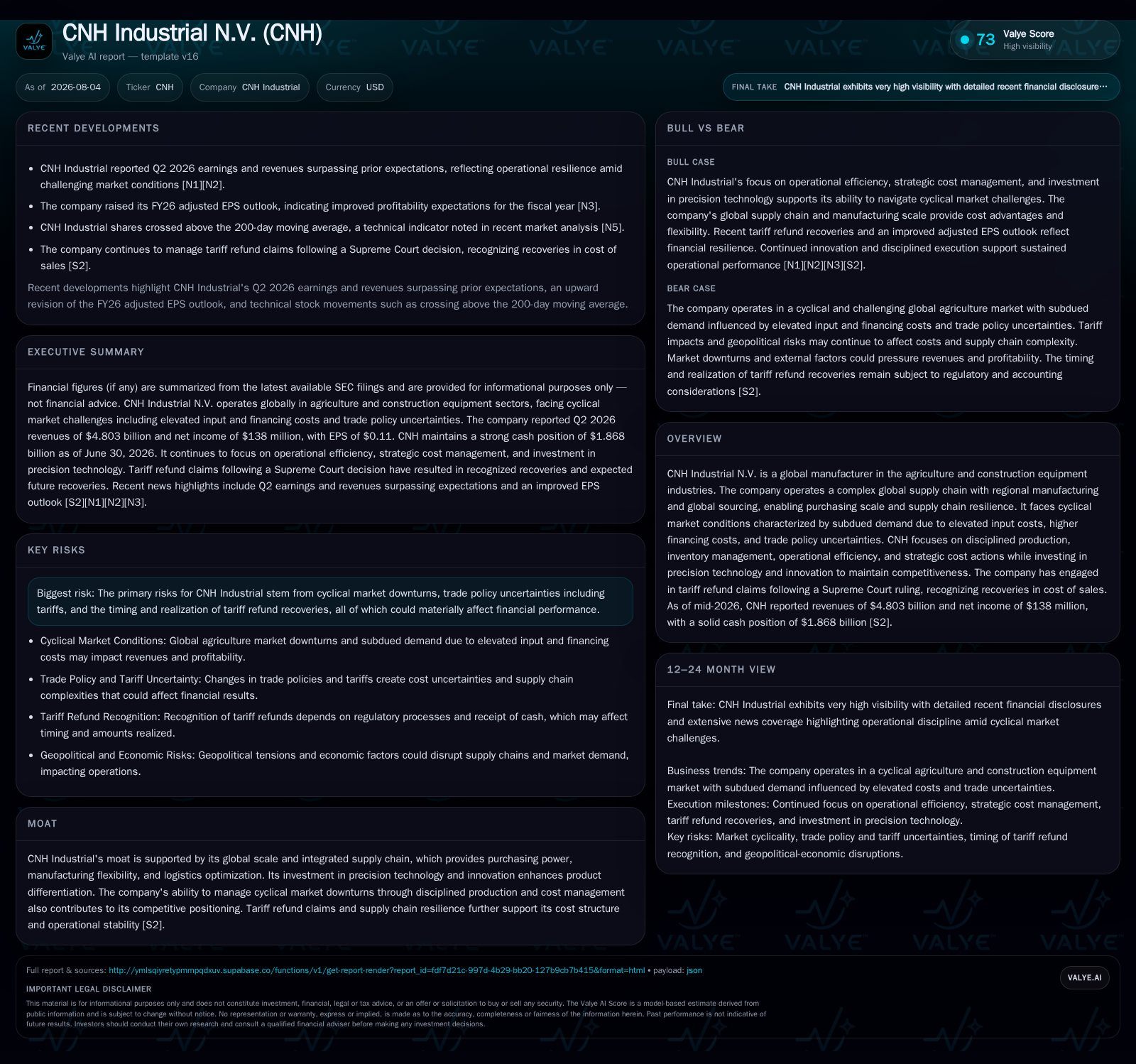
In its latest quarterly filing for Q2 2026, CNH Industrial reaffirmed that global agricultural equipment demand remains suppressed due to elevated input costs, tighter financing conditions, and policy uncertainty, marking a continuation of the cyclical downturn experienced since 2025. The company is executing a disciplined strategy centered on production and inventory management, cost control, and ongoing investment in precision agriculture technology, which underpins its competitive moat. Tariff impacts continue to create complexity yet also confer supply chain advantages via scale and flexibility. CNH reported mid-2026 revenues of $4.803 billion and net income of $138 million, supported by a strong cash position of $1.868 billion. Going forward, tariff refund claims related to a recent Supreme Court ruling provide potential financial upside but remain subject to timing and realization risks.
Recent Operating Update: Q2 2026 Highlights and Market Context
CNH Industrial's Q2 2026 results confirm the continuation of the agricultural equipment sector’s cyclical downturn amid macroeconomic headwinds. The company reported revenue totaling approximately $4.803 billion for the June quarter within a broader H1 context—although specific segment revenues were not detailed in the filing [S2]. Farmer sentiment remains cautious due to persistent elevated input costs such as fuel and raw materials, alongside increased financing costs that constrain capital expenditure decisions on heavy equipment. Nonetheless, management noted emerging strength in certain crop commodity prices which could bolster farmer incomes later in the year [S2].
The company reiterates its stance that current softness primarily reflects a temporary downturn rather than a structural shift in end-market demand patterns, consistent with commentary throughout 2025 [S1], [S2]. This framing underscores the importance CNH places on maintaining agility through disciplined production scheduling aligned with dealer inventory levels, thus avoiding overproduction risks that would pressure margins or result in obsolescence. Inventory management remains critical given consumption variability across North America, EMEA, South America, and Asia Pacific regions.
Business Model: Integrated Manufacturing with Precision Technology Focus
CNH Industrial operates as a diversified original equipment manufacturer (OEM) serving both agriculture and construction sectors globally. Its business model hinges on complex global supply chains that combine regional manufacturing hubs with global sourcing of components—enabling strong purchasing power benefits and logistical optimization [S2]. Finished equipment funnels through extensive dealer networks providing vital customer interfaces for new machinery sales as well as aftermarket parts and service revenue streams.
The Agricultural segment delivers tractors, combines, sprayers, and harvesters incorporating increasing degrees of precision agriculture technology—a critical differentiator enhancing operational efficiency for end-users through automation, GPS guidance systems, variable-rate application controls, and real-time data analytics [S1]. CNH’s sustained investment in R&D—including acquisitions such as Raven and Bennamann—reflects a strategic priority on embedding innovation into its core offerings to capture premium pricing and improve client retention
Meanwhile, the Construction segment focuses on earthmoving machinery like excavators and loaders where operational reliability and emissions compliance are key buyer considerations. Both segments face capital intensity pressures but benefit from predictable replacement cycles linked to infrastructure spending trends.
Complementing manufacturing activities is CNH’s Financial Services division which supports customer acquisitions through loans and leases structured to match agricultural production cash flow seasonality. However, this segment’s SG&A faced margin headwinds in 2025 related to higher credit risk provisions reflecting macroeconomic stress among borrowers [S1]. Tightening financing conditions across agriculture markets continue to dampen immediate purchasing power despite longer-term need for equipment upgrades.
Industry Structure and Competitive Position
Within the agricultural and construction equipment industry—characterized by intense capital requirements and cyclicality—CNH competes alongside peers such as Deere & Company (NYSE: DE) for agriculture OEM leadership and Caterpillar Inc. (NYSE: CAT) especially in construction machinery. While Deere has historically commanded large market share supported by brand loyalty and integrated precision agriculture platforms, CNH leverages scale advantages stemming from its diversified portfolio covering multiple geographies and industries.
Critical competitive factors include:
- Precision Technology Investment: CNH’s aggressive R&D spend anchors its differentiation strategy.
- Supply Chain Resilience: The ability to navigate tariffs via global sourcing flexibility mitigates cost shocks relative to more regionally concentrated peers.
- Dealer Network Breadth: Strong distribution footprint facilitates localized servicing essential for customer retention.
Tariff exposures remain a persistent challenge due to U.S.-initiated trade measures imposing duties on key components; however, CNH’s diversified sourcing partly cushions margin erosion. Importantly, the March 2026 U.S. Supreme Court ruling invalidating specific tariffs under IEEPA presents a financial recovery opportunity recognized conservatively only upon cash receipt [S2], [S8].
Growth Drivers Supporting Recovery Potential
Key growth catalysts for CNH lie within medium-to-long-term structural dynamics underpinning agri-equipment demand:
- Rising Global Food Demand: Population growth drives output needs necessitating farm mechanization upgrades worldwide.
- Precision Agriculture Adoption: Increasing yield optimization requirements foster demand for technologically advanced capital equipment.
- Replacement Cycle Normalization: An aging global fleet will spur natural replacement demand once financial conditions ease.
- Infrastructure Investment Growth: Construction activities support loader/excavator sales especially in emerging markets.
- Financing Availability Improvements: Tailored finance solutions can enhance buyer affordability amidst cost inflation.
CNH’s targeted investment in digital innovation aims not only at enhancing product quality but also creating ecosystem lock-in effects through software services—boosting aftermarket recurring revenue potential.
Risks and Watchpoints
CNH continues to be exposed to several substantial risks that could impact financial outcomes:
- Prolonged Cyclical Weakness: A longer-than-expected downturn in farm profitability may delay capital spending normalization.
- Input Cost Inflation: Raw material cost volatility could compress gross margins if not offset by pricing adjustments.
- Trade Policy Uncertainty: Future tariff actions or retaliation could disrupt supply chains or raise costs unpredictably.
- Timing Risk on Tariff Recoveries: Recognition hinges on future cash receipts; delays or shortfalls remain possible [S2].
- Inventory Obsolescence Risk: Overproduction during weak demand may require write-downs impacting earnings quality.
- Credit Risk Deterioration in Financing Segment: Macroeconomic stress could increase loan defaults beyond current provisions.
Management mitigation initiatives include proactive cost reduction programs emphasizing labor efficiencies within SG&A expense lines, production discipline tied tightly to confirmed order backlog signals, and continued focus on supply chain agility enabled by logistics optimization strategies [S1], [S2].
What to Watch Next
Market participants should monitor CNH’s execution against several key milestones:
- Quarterly updates on production volumes relative to dealer inventory levels which will indicate supply-demand balance improvements or deterioration.
- Progression in tariff refund claim realization impacting future gross margin resilience; headline recognition of additional recoveries beyond the initial $5 million logged would be a positive signal [S2].
- Commodity pricing trends influencing farmer income dynamics as leading indicators for capital spending recovery.
- Adoption rates of precision technology offerings affecting product mix premium capture.
- Credit quality metrics within Financial Services revealing exposure trajectory amid economic cycles.
- Management updates during upcoming earnings calls around inflation pass-through capabilities and potential inventory write-downs.
Financial Profile Discussion
As of June 30, 2026, CNH reported cash reserves of approximately $1.868 billion against relatively minimal total debt near $19 million—a net cash position affording leverage flexibility amidst uncertain market conditions [F1]. This liquidity buffer supports continued investments in R&D along with necessary working capital to navigate ongoing demand fluctuations. Operating income data from prior years indicates profitability capacity during normalized cycles; although recent quarters have reflected margin pressure from subdued volumes combined with tariff-related cost layering [S1], disciplined cost structure efforts are evident.
Overall liquidity strength underpins confidence in sustaining operations without immediate refinancing concerns despite external volatility [S29]. The company’s €3.25 billion credit facility maturity extended through April 2031 further enhances financial stability
This analysis synthesizes SEC filings up to August 3, 2026, complemented by industry knowledge relevant to the agricultural and construction equipment sector. It does not constitute investment advice but aims to elucidate CNH Industrial’s operational stance amidst prevailing market dynamics.
Disclaimer: This is research-only, informational analysis and not investment advice. It may include AI-generated interpretation and general industry context. Always verify important details using primary sources.

Comments