
Commercial Vehicle Group Confronts Cyclical Demand and Tariff Pressures with Strategic Leaseback and Debt Reduction
CVGI’s Q2 2026 results reflect ongoing industry cyclicality, moderated by long-term OEM contracts and proactive financial management.
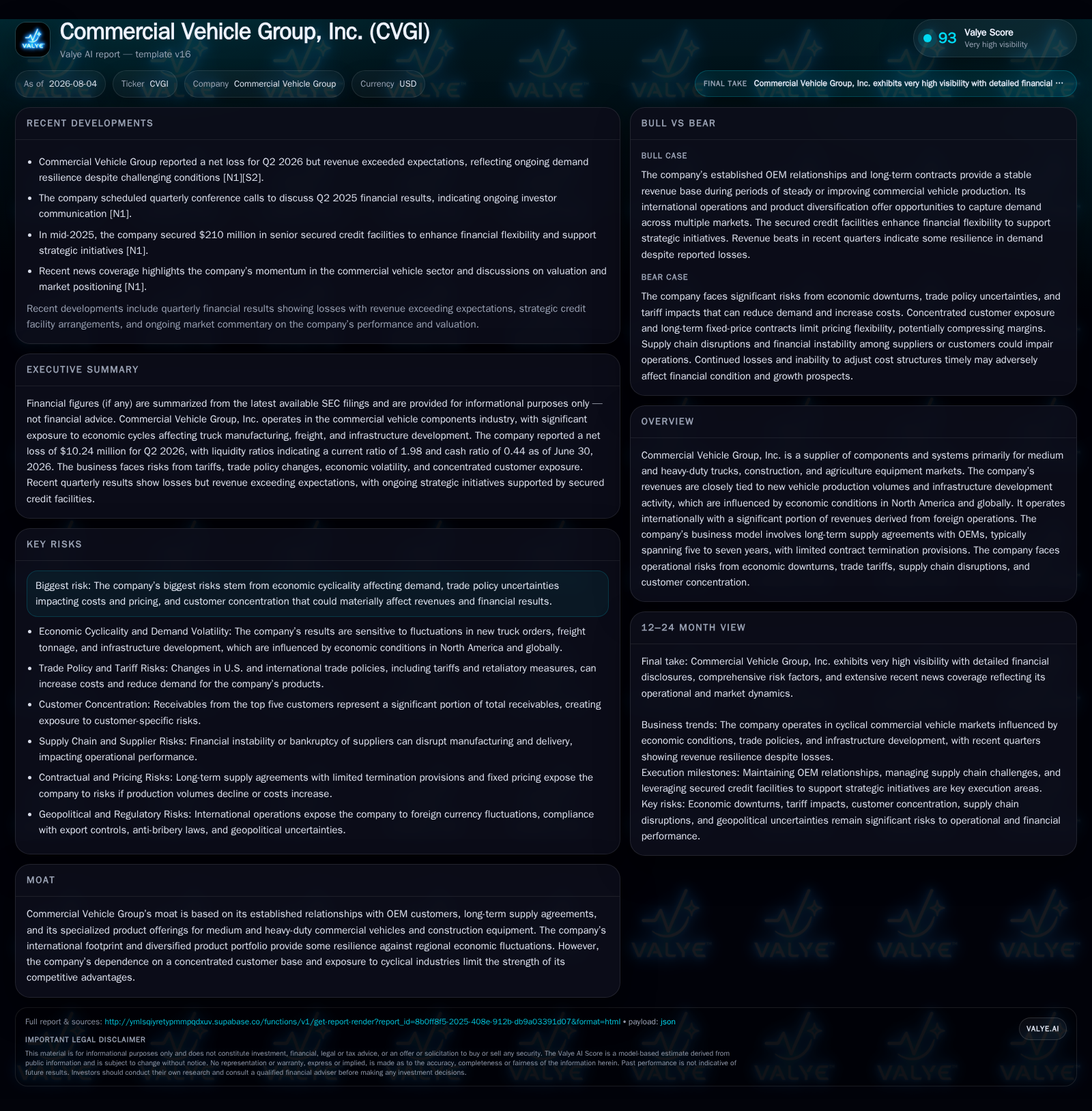
Commercial Vehicle Group, Inc. (CVGI), a supplier of specialized components for medium and heavy-duty trucks and construction equipment, reported Q2 2026 results showing resilience amid persistent cyclical challenges in new vehicle production and trade tariff uncertainty. The company leverages long-term supply agreements with OEMs to maintain order visibility despite volume fluctuations linked to economic conditions. Recent strategic moves, including a sale-leaseback transaction and share issuances under an ATM program, have been deployed to reduce debt and improve liquidity, positioning CVGI to manage cost pressures and supply chain risks amid volatile market dynamics.
Recent Operating Update
Commercial Vehicle Group's second quarter ended June 30, 2026 demonstrated modest top-line resilience despite persistent industry headwinds characteristic of the commercial vehicle components sector. Revenue exceeded consensus estimates due in part to stable execution of existing long-term OEM supply commitments amid challenging market conditions marked by new tariffs and supply chain disruptions [N1][S2]. However, the quarter also recorded a net loss consistent with operating pressure from inflationary material costs and constrained pricing power.
A significant liquidity-enhancing event earlier in the year was the strategic sale-leaseback of the Vonore property executed in March 2026 [S23]. The transaction yielded approximately $14.6 million net after taxes and fees, which was fully deployed to reduce outstanding term loan balances. This deleveraging move improved CVGI’s financial flexibility in a capital-intensive environment while retaining operational control through a twenty-year lease agreement with escalating annual rent
Moreover, the company established an At-the-Market (ATM) equity program in June 2026 for up to $25 million in shares issuance. Through this program, CVGI had raised $11.6 million net proceeds by late June, using these funds exclusively to pay down additional term loan indebtedness [S22]. This aligns with a prudent capital allocation approach aimed at lowering interest expense burden amid tightening credit markets.
Business Model Analysis
Commercial Vehicle Group operates as a Tier 1 supplier of specialized components and systems predominantly for medium-duty (MD) and heavy-duty (HD) commercial trucks as well as construction and agricultural equipment. The company’s core customers are original equipment manufacturers (OEMs) who integrate CVGI’s products directly into new vehicle platforms. The business model hinges on long-term supply agreements typically spanning five to seven years; these contracts provide demand visibility linked directly to OEM production forecasts but come with limited termination provisions allowing minimal renegotiation once signed [S1][S27]
Revenue is recognized based on product shipments aligned to OEM assembly schedules. Thus, operating performance is heavily tied to new vehicle production volumes—a cyclical variable influenced by broader economic conditions such as freight demand, infrastructure spending levels, and agricultural equipment replacement cycles. Margins depend on efficient manufacturing scale and the ability to pass raw material cost increases through pricing adjustments within contract parameters.
CVGI's multi-product portfolio spanning diverse vehicle types offers some insulation against localized market downturns but does not fully mitigate overall cyclicality given concentrated exposure to North American commercial vehicle production trends. Additional complexity arises from international operations contributing meaningful revenue but subjecting the company to foreign exchange volatility alongside trade policy uncertainty.
Industry Structure and Competitive Position
The commercial vehicle components industry comprises upstream suppliers providing critical parts—such as seating systems, trim components, elastomeric products—to OEMs like truck builders and heavy equipment manufacturers. CVGI competes alongside peers such as Modine Manufacturing and Cummins’ component divisions that emphasize innovation quality, cost competitiveness, reliability of supply chains, along with long-standing customer relationships.
CVGI’s relative competitive moat derives from established long-term contracts ensuring steady order backlogs and its technical know-how tailored for MD/HD truck platforms plus construction machinery. However, its client concentration is a double-edged sword; about half of its receivables are concentrated among five top OEM customers as per latest disclosures [S27], creating revenue vulnerability should one or more reduce orders abruptly.
Trade tariffs implemented since 2025 have imposed additional marginal cost burdens that have partially eroded pricing flexibility at contract renewal junctures or interim pricing discussions. This tariff environment remains volatile following recent U.S. Supreme Court rulings limiting certain presidential authorities but with ongoing legislative uncertainties potentially reintroducing tariff escalations [S1]. Such geopolitical factors further complicate global supply chain planning efforts.
Growth Drivers
Key growth avenues for CVGI center on global new vehicle production increases driven by economic expansion in target markets combined with continued large-scale infrastructure development projects fueling demand for construction equipment components. Electrification trends in commercial vehicles—such as battery electric trucks—may introduce incremental opportunities requiring redesign or specialized parts demand although current contributions remain nascent.
Geographic expansion into emerging markets represents another potential growth lever; however, execution risk remains given entrenched local suppliers and logistical challenges coupled with regulatory compliance hurdles (environmental standards notably).
Contract renewals governed by long-term OEM agreements provide revenue stability over multiple years but require continuous product innovation and cost management capabilities to sustain margins against competitive bidding pressures.
Risks and Watchpoints
The most salient risks identified include the inherent cyclicality tied closely to fleet operators' capital spend decisions that vary with freight tonnage hauled metrics and broader macroeconomic confidence affecting replacement cycles for commercial vehicles [S1]. Customer concentration risk amplifies exposure if any key OEM reduces platform output unexpectedly or decides on alternative sourcing strategies.
Trade policy shifts remain material risk factors; ongoing tariff impositions add direct cost inflation while potentially depressing demand via price sensitivity downstream through OEM pricing structures [S1]. Supply chain disruptions—whether due to geopolitical tensions or raw material scarcity—could exacerbate delivery timelines leading to lost sales or contract penalties.
Product liability claims represent standard caution points common across component manufacturers though management assesses no present material exposure beyond typical industry expectations [S15][S16].
What To Watch Next
Future monitoring should target quarterly OEM order backlog updates indicating new vehicle production outlook changes influencing near-term sales volumes at CVGI; these serve as early-cycle demand gauges relevant for inventory planning and capacity utilization assumptions. Trade policy developments during second-half 2026 may critically influence cost structure dynamics especially if tariff disputes escalate.
Key milestones include successful contract renewals without adverse price concessions which can signal sustainability of existing gross margin bands plus effective integration of any inorganic expansions if pursued.
Continued debt reduction progress supported by ATM equity program proceeds will be important signals of financial health improvement facilitating more nimble operational investments or weathering cyclical troughs with less liquidity stress.
Financial Profile Discussion
As of June 30, 2026, Commercial Vehicle Group reported total debt approximating $88.8 million offset by cash & equivalents estimated at $70.3 million yielding a modest net debt position around $18.6 million [F1]. The current ratio stood at approximately 1.98, indicating reasonable near-term liquidity coverage relative to current liabilities [F1].
This improved leverage profile primarily arises from targeted prepayments funded by the March sale-leaseback transaction generating net cash proceeds applied towards term loan reduction along with disciplined use of ATM equity raises initiated mid-year for further debt service purposes [S22][S23]. Maintaining compliance with restrictive covenants embedded in revolving credit arrangements remains pivotal given limited margin for additional borrowings absent refinancing or equity injections.
Profitability metrics have shown strain consistent with negative operating income reported at fiscal year-end December 31, 2025 reflecting ongoing margin pressure from higher input costs coupled with volume softness; sustaining positive operating earnings will depend on balancing pricing power versus cost containment effectiveness going forward [F1][N1]
In sum, CVGI's financial strategy emphasizes deleveraging through asset monetization paired with equity offerings while leveraging steady contractual revenue streams secured against cyclical headwinds inherent in commercial vehicle production markets.
This analysis synthesizes publicly available SEC filings up to August 3rd, 2026 alongside recent news reports without offering investment research views or price forecasts. It aims solely to provide an informed perspective on Commercial Vehicle Group's operational context within its commercial vehicle components industry sector based on verified data points.
Disclaimer: This is research-only, informational analysis and not investment advice. It may include AI-generated interpretation and general industry context. Always verify important details using primary sources.

Comments