
Inspire Medical Systems Targets Growth Through Streamlined Operations and Expanded Neurostimulation Adoption
Inspire Medical Systems advances its strategic growth plan while navigating reimbursement complexities and leveraging clinical evidence to sustain its leadership in implantable neurostimulation for obstructive sleep apnea.
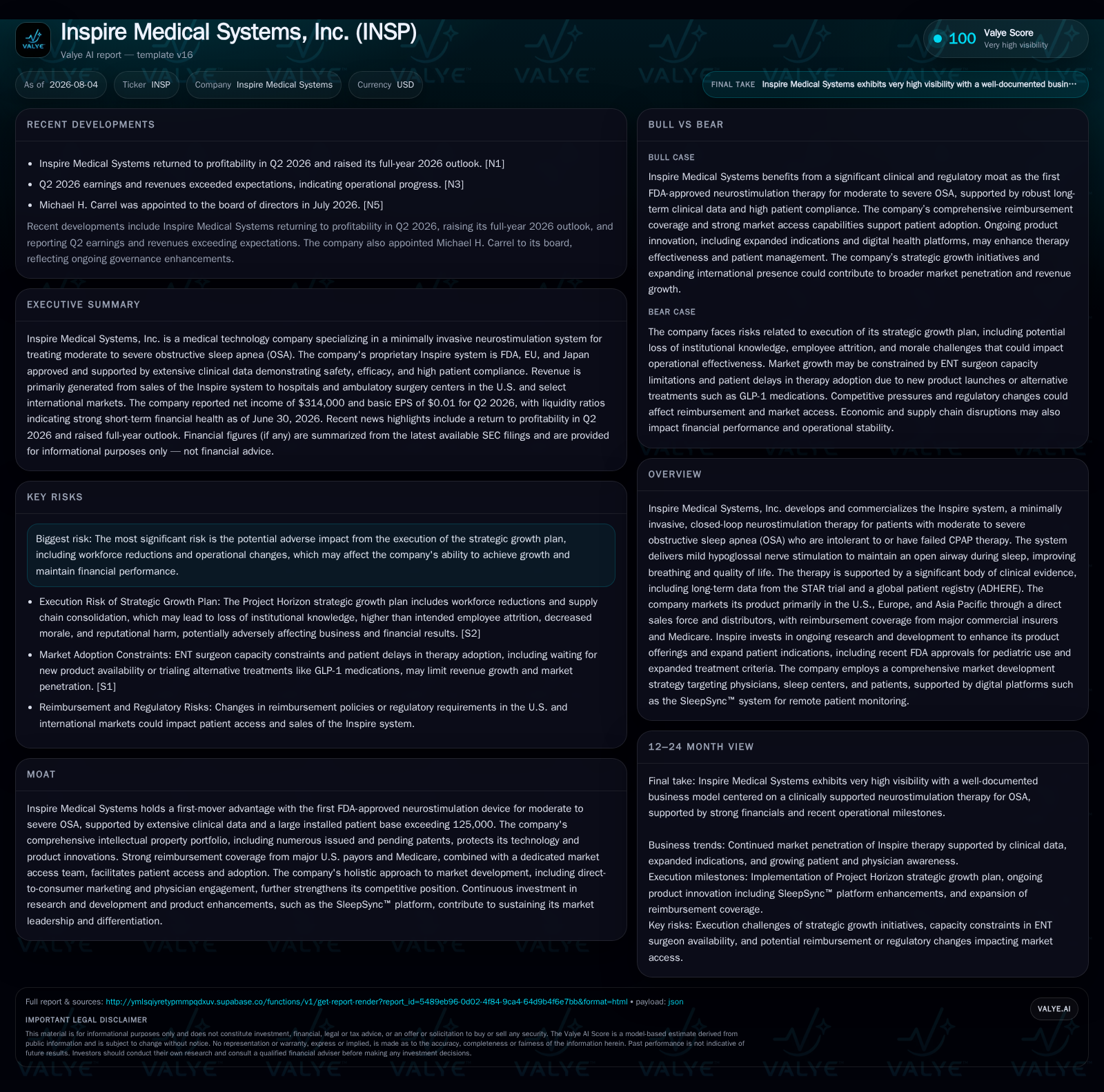
In its latest quarterly update, Inspire Medical Systems unveiled Project Horizon, a strategic initiative focused on operational streamlining, workforce reduction, and supply chain optimization to bolster revenue growth. The Company continues to capitalize on its FDA-approved hypoglossal nerve stimulation device for moderate to severe obstructive sleep apnea (OSA), supported by extensive clinical data and widespread reimbursement coverage. While revenue growth shows signs of deceleration against a backdrop of capacity constraints among ENT surgeons, Inspire's ongoing R&D investments and market access efforts position it well for geographic and indication expansion. Risk factors center on execution risks of the growth plan and regulatory or reimbursement uncertainties.
Recent Operating Update
In its second quarter ending June 30, 2026, Inspire Medical Systems detailed the initiation of Project Horizon, a comprehensive strategic growth plan designed to streamline operations through resource realignment toward revenue-generating initiatives. Notably, this program includes production consolidation aimed at enhancing manufacturing quality, capacity scale, and cost efficiency alongside a workforce reduction [S2], [S22]. This operational pivot reflects management’s response to slowing top-line growth momentum amid ongoing challenges such as ENT surgeon procedural capacity constraints—a critical bottleneck in patient access given that physicians specializing in ear, nose, and throat (ENT) are the primary adopters who perform device implantation procedures [S1].
The second quarter also featured earnings that beat consensus forecasts with the company returning to profitability after prior quarters of elevated investment outlays [N1], [N2]. Management raised full-year 2026 guidance based on improved execution trends yet acknowledged potential risks inherent in the transition within Project Horizon [S3]. No share repurchases occurred during Q2 despite an authorized $200 million open-market buyback program expiring in August 2027 [S5], indicating capital prioritization toward operational investments.
Business Model Overview
Inspire’s core product is an implantable neurostimulator approved by major regulatory agencies including the FDA (premarket approval granted in 2014), European Union under MDR since 2011, and Japan’s PMDA since 2018 [S1]. The system delivers mild hypoglossal nerve stimulation via a closed-loop mechanism during sleep to prevent airway collapse—a condition medically termed obstructive sleep apnea (OSA). This therapy targets moderate to severe OSA patients who cannot tolerate continuous positive airway pressure (CPAP), which remains the standard first-line treatment but suffers from low patient compliance due to discomfort and usability issues [S1].
Revenue is generated mainly through unit sales of the Inspire system consisting of an implantable pulse generator and leads sold predominantly to hospitals and ambulatory surgery centers (ASCs) where certified ENT surgeons perform implantations. The company employs a direct sales force across the U.S., Europe, and Japan complemented by distributor networks in Asia Pacific markets such as Singapore, Hong Kong, and Thailand [S1]. These sales are one-time per patient implant procedures but are supplemented by recurring revenues from ancillary devices or future enhancements as they move through the pipeline.
Critical monetization factors include surgeon adoption rates, procedural volume at hospital/ASC sites, reimbursement coding clarity for procedure billing under Current Procedural Terminology (CPT) codes—currently transitioning from code 64568 used for Inspire V implants toward code 64582 with modifier adjustments—and average selling price stability [S1]. The intricate medical reimbursement landscape demands continuous engagement with third-party payors; Inspire has succeeded in securing positive coverage policies from major commercial insurers covering over 300 million U.S. lives as well as Medicare Advantage programs administered through seven regional Medicare Administrative Contractors (MACs) [S1]. This breadth of payer coverage is essential given the high cost relative to alternative therapies.
Patient adoption is further propelled by direct-to-consumer marketing initiatives aimed at raising awareness among diagnosed OSA patients who have failed CPAP therapy—a growing demographic driven by increased disease recognition worldwide [S1]. Clinical adoption is supported by influential publications including a key New England Journal of Medicine article on the STAR trial demonstrating sustained therapy effectiveness up to five years post-implantation.
Industry Structure and Competitive Position
The medical implantable neurostimulation space focusing on OSA treatment remains niche yet rapidly evolving due to several unmet clinical needs. Unlike CPAP devices or invasive surgical interventions that modify airway structures with unpredictable outcomes, Inspire’s technology offers a reversible, minimally invasive alternative supported by extensive longitudinal data from more than 125,000 treated patients globally [S1].
Peer comparisons are informed primarily by companies developing alternative neuromodulation technologies or next-generation airway management devices targeting similar patient segments. Differentiation hinges on regulatory approvals across geographies; Inspire’s early FDA PMA approval coupled with EU MDR certification grants it entrenched access relative to competitors awaiting similar clearances.
Intellectual property protection constitutes a significant moat; Inspire holds rights to over 119 issued U.S. patents with numerous foreign patents pending or granted that cover both current systems and future product concepts such as the SleepSync™ technology platform integrating advanced sensor feedback mechanisms [S1]. This portfolio safeguards against encroachment from rivals patenting related hypoglossal nerve stimulation methods or device hardware configurations.
Strong insurer reimbursement relationships further elevate barriers for new entrants. Maintaining clarity around CPT coding has been challenging but recent clarifications regarding Aspire V procedures promote billing consistency critical for hospital procurement decisions. Nonetheless, ongoing surveillance is required as governmental payors periodically reassess coverage policies impacting procedural uptake.
Growth Drivers
Several structural trends underpin medium-term growth prospects:
- Increasing OSA diagnosis prevalence: Greater clinician awareness and screening foster expanding patient pools needing alternatives beyond CPAP.
- CPAP intolerance: The persistent compliance gap positions neurostimulation systems like Inspire’s as preferable options.
- Geographical expansion: Continued regulatory submissions aim at broadening European Union member states coverage beyond initial markets as well as deeper penetration into Asia Pacific territories via distribution partnership expansions.
- Clinical innovation: Investment in R&D targeting improved device functionality (e.g., battery longevity), enhanced patient experience via SleepSync™, and potential indication expansions beyond moderate/severe OSA will drive usage extension.
- Market access initiatives: Dedicated teams focus on education for referring physicians besides surgeons alongside proactive payer negotiations reinforcing coverage depth.
- Direct-to-consumer marketing ramp-up: Patient empowerment campaigns accelerate self-referral rates which historically lag behind physician referrals.
Together these factors align with operating KPIs like quarterly devices implanted, physician customer counts especially among ENT specialists performing implants, sustained reimbursement coverage breadth measured by payor live population counts, patient adherence rates exhibited in real-world registries like ADHERE, and ASP stability in core geographies.
Risks and Watchpoints
Execution risk linked to Project Horizon is paramount given announced workforce reductions which may inadvertently erode critical knowledge pools impacting training quality or slow market responsiveness [S2], [S22]. Morale issues among retained staff could exacerbate attrition above planned levels risking operational disruption particularly amid manufacturing consolidation efforts aimed at yield improvement.
Continued reimbursement uncertainties manifest in ongoing CPT code transitions could introduce billing delays leading hospitals or surgeons to defer purchases even temporarily.[S1] Regulatory dependency remains intrinsic; any delay or non-approval in emerging markets or extended indications could hamper planned expansion timelines.
Patient adoption depends heavily on ENT surgical capacity - delays here limit new implants regardless of demand signals. Additionally, emerging competitive neurostimulation modalities must be monitored although Inspire’s early mover advantage mitigates immediate threats.
Clinical trial outcomes remain critical; setbacks in safety or efficacy profiles could materially impact market confidence though recent long-term data support robust safety performance so far [S1]. Manufacturing scale-up under consolidation must maintain quality thresholds avoiding recalls or supply shortages that could damage reputation.[S2]
What To Watch Next
Key milestones include:
- Progress updates on Project Horizon implementation metrics particularly workforce stabilization timelines and production volume targets.
- Reimbursement policy announcements clarifying CPT code usage across all major regions influencing near-term billing dynamics.
- Regulatory filings status in additional countries outside current footprint including rest of Europe and Asia Pacific extensions.
- Launch progress of enhanced SleepSync™ platform products influencing both clinical efficacy perceptions and competitive positioning.
- Quarterly patient implantation volumes reported publicly serving as demand velocity indicators.
- Clinical registry expansions or published outcomes solidifying long-term safety/effectiveness narratives enhancing physician confidence levels.
Financial Profile Discussion
As of June 30, 2026, Inspire held $127.8 million in cash and equivalents against minimal reported debt levels last confirmed at $21.4 million two years earlier suggesting very low leverage risk [F1]. The current ratio stands robust at approximately 8.55 reflecting strong short-term liquidity supported by $608.7 million in current assets versus $71.2 million in current liabilities [F1].
Overall financial health provides runway supporting current strategic initiatives though future capital needs will hinge significantly on commercial traction outcomes tied directly to execution effectiveness under Project Horizon alongside evolving reimbursement landscapes.
This analysis synthesizes recent SEC disclosures combined with industry context pertinent to implantable neurostimulation devices addressing obstructive sleep apnea without providing investment advice or speculative forward-looking statements.
Disclaimer: This is research-only, informational analysis and not investment advice. It may include AI-generated interpretation and general industry context. Always verify important details using primary sources.

Comments