
Jazz Pharmaceuticals Balances Growth and Integration Amid Specialty Pharma Market Pressures
Latest quarterly results highlight Jazz Pharmaceuticals' steady core franchise performance alongside integration complexities from recent acquisitions within a challenging specialty pharmaceutical market.
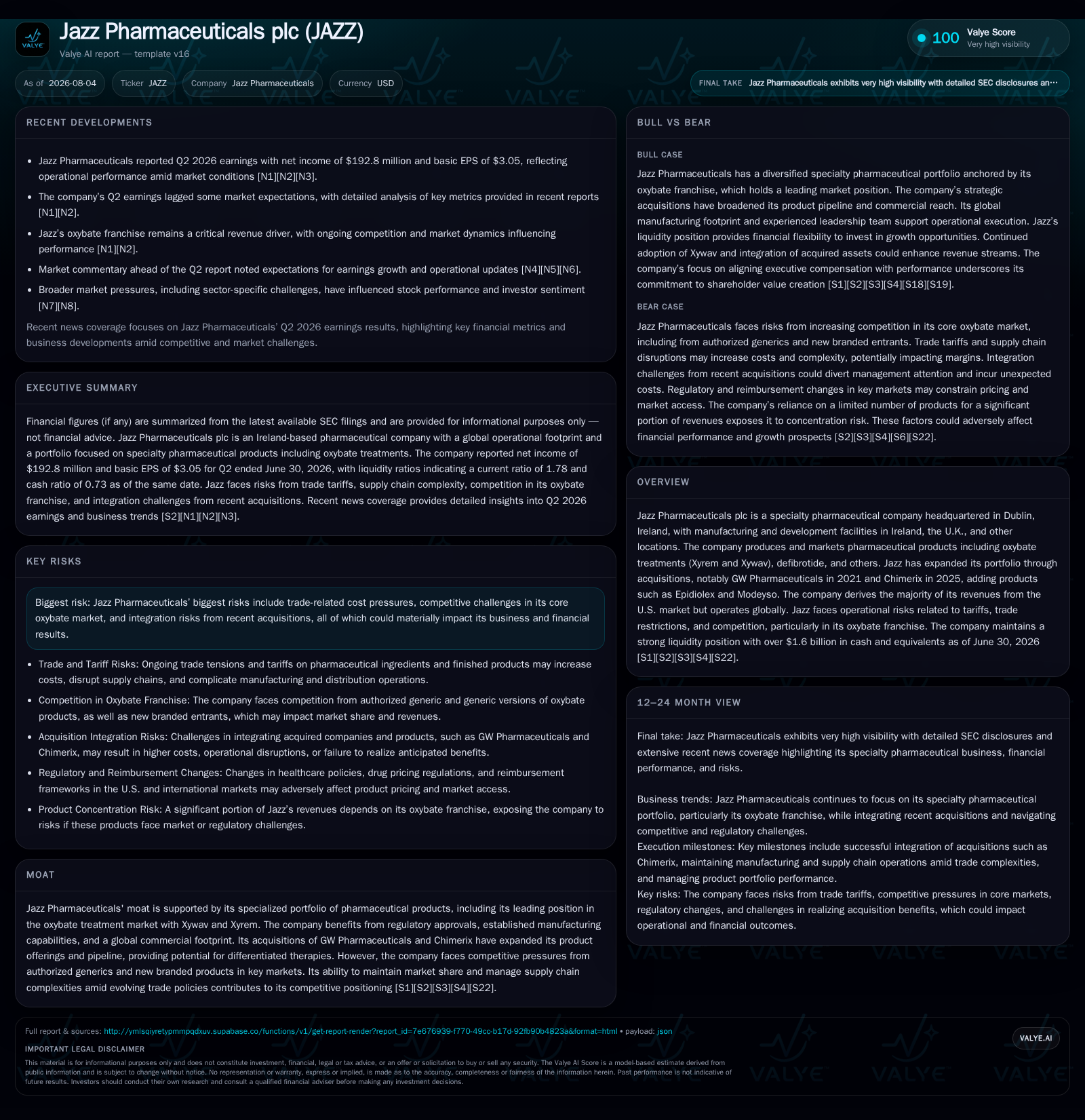
Jazz Pharmaceuticals’ Q2 2026 results reflect resilience in its oxybate franchise amid ongoing pricing pressures and payor scrutiny typical for orphan drug markets, while integration of recent acquisitions such as Chimerix adds operational complexity. The company’s business model, centered on proprietary specialty pharmaceuticals targeting rare diseases with orphan exclusivity benefits, faces regulatory and reimbursement headwinds. Jazz maintains strong liquidity but carries significant debt from acquisition financing. Near-term performance hinges on effective pipeline advancement, successful assimilation of acquired assets, and navigating evolving U.S. regulatory and pricing landscapes.
Recent Operating Update
Jazz Pharmaceuticals reported Q2 2026 results on August 3, 2026 [S2][S3]. The company maintained steady performance in its core oxybate franchise (Xyrem and Xywav), which remains a significant revenue source primarily in the U.S., where it commands a leading position in treating narcolepsy and related disorders. However, this segment continues to face pricing challenges from authorized generics and intensified payor scrutiny—a common dynamic within specialty pharmaceutical firms focusing on orphan indications [S1].
The quarter also reflected the ongoing operational impact of Jazz’s strategic acquisitions: GW Pharmaceuticals in 2021 expanded its cannabinoid-based product offerings (e.g., Epidiolex), while the more recent Chimerix acquisition in 2025 introduced Modeyso for rare brain tumors [S1][S19]. These additions diversify Jazz’s portfolio but add integration complexity that requires effective management to avoid disruption of core operations and to realize anticipated financial benefits.
Business Model Overview
Jazz's business model centers on developing and commercializing proprietary specialty pharmaceuticals targeting rare diseases with high unmet needs. Revenues are mainly derived from direct sales within the U.S., supplemented by licensing arrangements internationally [S1]. The company leverages orphan drug designations that provide periods of market exclusivity critical for protecting against generic erosion.
Pricing negotiations occur with private insurers as well as government programs such as Medicare and Medicaid, exposing Jazz to shifting reimbursement landscapes influenced by legislative initiatives aimed at reducing drug costs [S4][S9]. Sustained innovation via research and development is essential to replenish the product portfolio through new approvals or label expansions.
Manufacturing is conducted primarily in facilities located in Ireland and the U.K., supporting both commercial supply demands and clinical development activities [S1]. Global supply chain stability remains an operational priority given potential tariff impacts or logistic disruptions.
Industry Context and Competitive Positioning
Operating within biotechnology and specialty pharmaceuticals, Jazz faces sector-specific challenges including high fixed R&D costs, stringent regulatory processes, patent-driven exclusivity limits, and competitive pressures from generics post-patent expiry. Peers like Biogen, Vertex Pharmaceuticals, and Alexion share similar orphan-focused strategies but differ in pipeline depth or therapeutic areas.
Jazz's competitive strengths lie in its established oxybate franchise alongside an expanding portfolio enriched by acquisitions. Nonetheless, margin pressures arise from authorized generics competing within core franchises [S5][S9][S12][S24]. The evolving regulatory environment—with FDA workforce fluctuations impacting review timelines—and U.S. reimbursement reforms introducing inflation-linked penalties add further complexity
Growth Drivers
Jazz’s growth strategy depends on several factors:
- Pipeline Progression: Advancing late-stage clinical trials is crucial for launching new products or indications that diversify revenue streams.
- Acquisition Integration: Effective assimilation of GW Pharmaceuticals’ cannabinoid therapies and Chimerix’s oncology assets aims to broaden therapeutic reach beyond neurology.
- Geographic Expansion: While currently U.S.-centric, pursuing regulatory approvals internationally offers potential incremental growth.
- Lifecycle Management: Innovations in formulations or delivery methods can extend exclusivity periods for flagship products.
- Regulatory Incentives: Orphan drug status provides development cost savings and market protection advantages [S1]
Maintaining robust R&D investment supports these initiatives as evidenced by disclosures highlighting ongoing capital allocation toward innovation [S1].
Risks and Watchpoints
Key risks include:
- Pricing Pressures: Increased scrutiny over drug pricing transparency and reimbursement reforms pose margin risks [S9][S24].
- Integration Complexity: Cultural alignment issues and operational distractions during acquisition assimilation could delay synergy realization [S19].
- Patent Litigation: Ongoing disputes over patent validity threaten accelerated generic competition [S14].
- Supply Chain Risks: Tariff changes or logistical constraints may elevate manufacturing costs or disrupt supply continuity [S1].
- Regulatory Delays: FDA staffing shortages or policy shifts can prolong approval timelines affecting product launches [S12].
- Product Concentration: Heavy reliance on oxybate treatments exposes Jazz to revenue volatility if generic encroachment accelerates.
Monitoring developments around patent litigation outcomes, clinical trial data releases—especially Phase III studies—and legislative changes impacting Medicare drug pricing will be critical for assessing future performance.
What to Watch Next
Upcoming catalysts include:
- Quarterly earnings releases detailing oxybate franchise sales trends relative to generic competition.
- Clinical trial data announcements from pipeline candidates originating from recent acquisitions.
- Regulatory decisions facilitating international market expansion.
- Updates on operational integration progress post-acquisition.
- Legislative developments affecting Medicare drug price negotiation frameworks or rebate obligations.
Benchmarking Jazz’s progress against peers such as Horizon Therapeutics or BioMarin may provide insights into its competitive standing within the orphan drug sector.
Financial Profile Discussion
As of June 30, 2026, Jazz Pharmaceuticals reported cash and equivalents of approximately $1.62 billion against total debt of roughly $4.39 billion—largely reflecting financing related to recent acquisitions—resulting in a net debt position near $2.78 billion [F1]. Current assets stood at about $3.97 billion versus current liabilities of $2.23 billion, yielding a current ratio of approximately 1.78 which signals adequate short-term liquidity [F1].
Despite continued operating losses recorded at $430 million for fiscal year 2025 driven by elevated R&D spend and acquisition-related amortization charges, Jazz’s cash reserves provide a buffer supporting ongoing innovation investments without immediate refinancing pressure [F1]
The company’s capital structure illustrates the balance between leveraging M&A-fueled growth opportunities while maintaining sufficient liquidity for sustaining pipeline development—an inherent tradeoff within specialty pharmaceutical firms reliant on continuous product innovation to offset patent expirations.
This analysis synthesizes information from Jazz Pharmaceuticals’ latest SEC filings through Q2 2026 alongside broader industry characteristics typical of biotechnology companies focused on orphan drugs. Forward-looking statements are excluded unless directly supported by cited sources.
Disclaimer: This is research-only, informational analysis and not investment advice. It may include AI-generated interpretation and general industry context. Always verify important details using primary sources.

Comments