
Organon & Co. Faces Patent Pressures and Supply Chain Challenges Ahead of Sun Pharma Merger
Latest quarterly results reveal revenue headwinds from generic competition and ongoing operational costs amid a major supply chain separation.
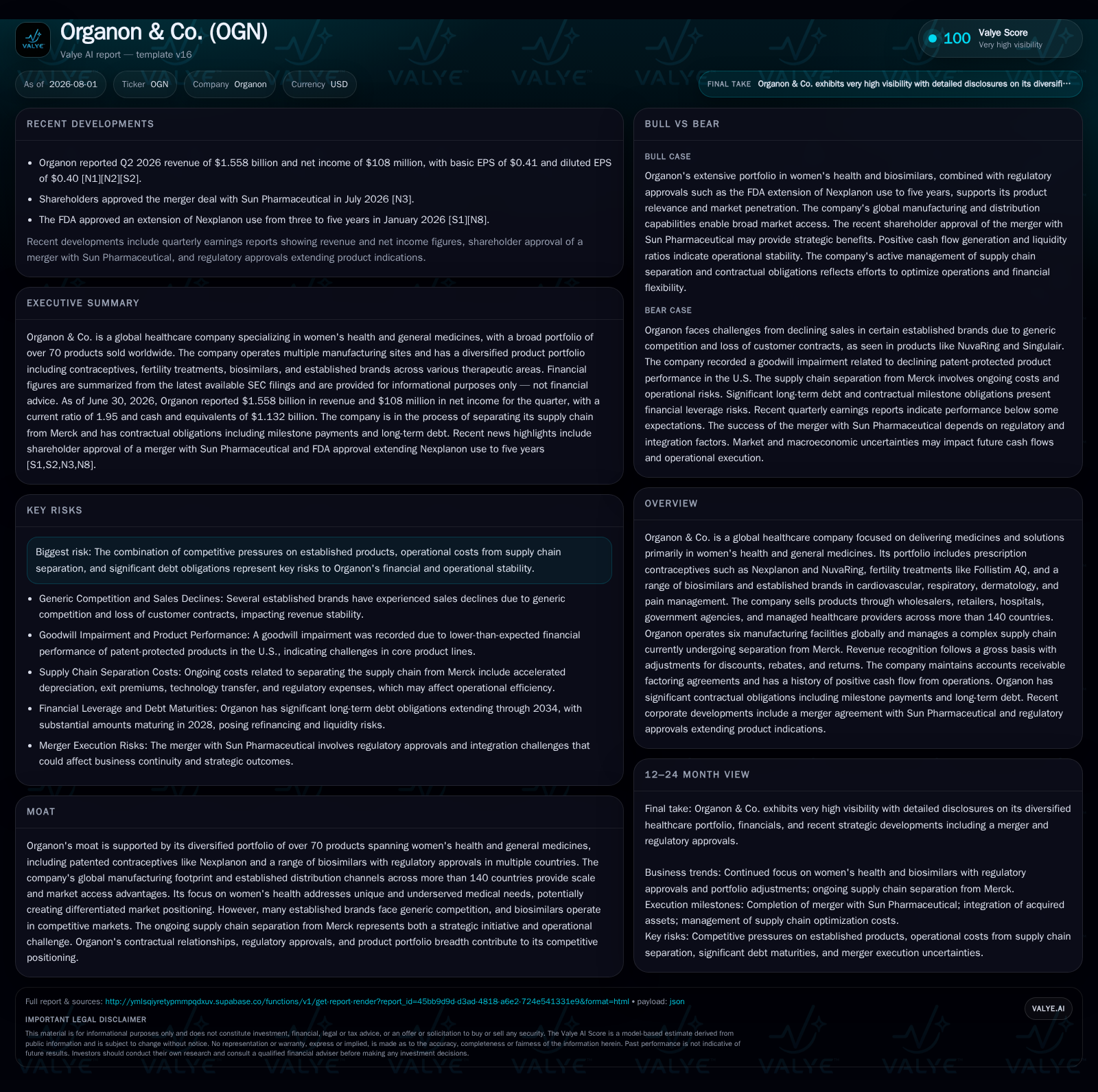
Organon & Co.’s Q2 2026 filing shows revenue pressures from patent expirations on key contraceptive products alongside incremental costs tied to its separation from Merck’s supply chain. The company’s strategic focus on women’s health and biosimilars provides a differentiated product portfolio across 140 countries, but many established brands face intensifying generic competition. The pending Sun Pharmaceutical merger represents a critical junction for integration and debt management, as Organon balances operational transition costs with the need to defend market share amid evolving regulatory and competitive dynamics.
Recent Operating Update
However, regulatory developments such as the FDA's supplemental approval extending Nexplanon's usage from three to five years offer some durability to this key product’s revenue stream through label life extension [S1]. Despite this positive regulatory milestone obtained in early 2026, patent litigation remains active regarding attempts to launch generic versions ahead of patent expiration dates in 2027 and 2030 [S6]. This litigation outcome will materially influence the exclusivity horizon for Nexplanon in the lucrative U.S. market.
Another notable operational feature involves the sustained complexity and expense associated with disentangling Organon's supply chain from Merck since the spinoff. The firm manages six production sites globally but faces increased logistical costs to establish independent sourcing, manufacturing efficiencies, and regulatory compliance distinct from its former parent company [S1]. Such transitional inefficiencies weigh on near-term profitability and cash conversion.
Business Model Specifics
Organon operates primarily as a specialty pharmaceutical company targeting two broad categories: women’s health products (contraceptives like Nexplanon and NuvaRing; fertility treatments including Follistim AQ; postpartum bleeding devices like Jada) and general medicines encompassing biosimilars for autoimmune diseases plus cardiology, respiratory, pain management, and dermatology therapies [S1]. Revenue derives from selling branded pharmaceuticals through multiple channels—wholesalers, retail pharmacies, managed healthcare providers, hospitals, government agencies—across over 140 countries.
Revenue recognition follows a gross-to-net model reflecting mandatory deductions for discounts, rebates (especially relevant in managed care markets), returns, and other contractual adjustments. Customer buying decisions hinge on product efficacy profiles balanced against pricing pressures pervasive in both branded contraceptives facing generic erosion and biosimilars competing on price relative to original biologics.
Margins are sensitive to supply chain efficiency given complex global manufacturing requirements and inventory management across diverse geographies. Biosimilar adoption trends affect volume growth potential but also entail steep commercialization expenses tied to clinical trial completion, regulatory approvals, physician education, and competitive positioning versus other branded or generic competitors.
Industry Structure and Competitive Position
In the pharmaceutical industry’s mid-to-late value chain where Organon is positioned—product development through marketing—the company confronts challenges typical for legacy spinoffs: balancing mature product decline with innovation-driven pipeline replenishment. Peer references include Pfizer for diversified branded pharmaceutical scale; Teva Pharmaceuticals on generics; Samsung Bioepis in biosimilars; former parent Merck as supply chain partner; plus forthcoming integration catalyst from Sun Pharma partnership.
Patent expirations critically threaten revenues for leading contraceptive products as competitors intensify efforts via abbreviated new drug applications (ANDAs) seeking FDA approval for generics prior to patent expiry. Organon's active patent litigations aim to extend exclusivity but pose legal cost burdens alongside inherent uncertainty.
Meanwhile, biosimilars represent a strategic growth avenue given their increasing uptake worldwide driven by healthcare payors’ desire for cost containment. Organon's varied biosimilar portfolio exhibits uneven performance reflecting market penetration challenges amid a crowded field of rival products and localized regulatory hurdles.
The women’s health focus provides a degree of differentiation by addressing specialty needs often underserved by larger pharma players concentrated on broader therapeutic classes. Yet product lifecycle management here is complicated by shifting reimbursement environments and evolving treatment paradigms.
Growth Drivers
Key growth levers include:
- Extended label indications such as Nexplanon's expanded usage window which can prolong commercial viability amid looming patent expiration.
- Biosimilars adoption trends, especially Hadlima's strong year-over-year growth signaling clinical acceptance in immunology segments.
- Pipeline progression with ongoing R&D driving novel women’s health solutions or lifecycle extensions that could yield additional contractual milestones and approvals.
- Geographic expansion into emerging markets where rising healthcare access creates demand for established brands at accessible price points.
- Merger synergies expected post close of Sun Pharma transaction anticipated to augment scale economies, expand portfolio diversity particularly in generics/biosimilars domain, enhance R&D pipeline breadth, and improve capital allocation flexibility { 026} [S2][S3].
Risks and Growth Constraints
Facing these drivers are substantial risks:
- Patent cliffs threaten rapid revenue erosions when exclusivities lapse without successful new product offsets.
- Intense generic competition especially if ANDA challengers gain accelerated regulatory approvals circumventing litigation barriers.
- Supply chain disruption costs linked to disentanglement from Merck elevate COGS temporarily reducing operational leverage.
- Regulatory investigations, currently focused on Nexplanon sales practices potentially leading to fines or legal settlements spotlight compliance vulnerabilities.
- Financial leverage, with total debt exceeding $8.5 billion against about $1.13 billion cash reserves at mid-2026 results in tight liquidity requiring careful refinancing strategies especially with sizeable notes maturing starting in 2028 [F1].
- Market pricing pressures globally emanating from reimbursement reforms put pressure on gross-to-net adjustments compressing effective realized pricing levels.
- R&D concentration risks, given relatively fewer late-stage candidates necessitate successful clinical outcomes or licensing deals for sustainable next-generation growth.
What to Watch Next
Upcoming milestones critical for monitoring Organon's trajectory include:
- Resolution timeline and outcome of patent infringement lawsuits concerning Nexplanon ANDAs which will clarify medium-term exclusivity status [S6][S11].
- Progress updates on Sun Pharmaceutical merger completion including announced synergy targets or integration impediments that may affect operational continuity [S3][N3].
- Sales trends into third quarter reflecting continued impact of inventory normalization at wholesalers post prior buy-in distortions [S1][N1][N2].
- Pipeline advancement reports or new regulatory filings for women’s health innovations or biosimilar assets that could signal fresh catalysts.
- Updates on supply chain separation milestones evidencing improved operational efficiency metrics such as capacity utilization rates or reduced logistics costs [S1].
- Disclosure regarding status or findings related to SEC inquiry into Nexplanon sales providing insights into potential compliance remediation or financial impacts [S5][S11].
Financial Profile Discussion
As of June 30, 2026, Organon held approximately $1.13 billion in cash and equivalents against total debt near $8.55 billion, resulting in net debt of roughly $7.42 billion [F1]. Current assets stood at about $5.11 billion versus current liabilities around $2.62 billion, producing a current ratio near 1.95 which implies acceptable short-term liquidity buffers [F1].
The company carries substantial goodwill reductions made via a $301 million impairment charge announced late 2025 resulting from revised discounted cash flow expectations primarily tied to upcoming patent expiries plus macroeconomic uncertainties affecting forecasts [S15]. This goodwill write-down signals investor caution regarding entrenched business lines losing steam faster than originally modeled.
Operating cash flows historically positive but weighed down recently by acquisition-related payments tied to product portfolios within women's health segment as well as separation-related investments highlight need for sustainable margin stabilization post structural reset [F1][S9][S10][S19]
In sum, while Organon's diversified yet specialized healthcare offerings provide some protective moat—supported by patented contraceptives' remaining exclusivities and rising biosimilar adoption—the company operates under significant pressure from expiring patents triggering generic incursions along with operational cost inflation fueled by ongoing organizational transitions ahead of its impending merger with Sun Pharmaceutical Industries Limited.
Disclaimer: This is research-only, informational analysis and not investment advice. It may include AI-generated interpretation and general industry context. Always verify important details using primary sources.

Comments