
California Water Service Group’s Regulatory Catch-Up and Infrastructure Strategy Drive Q2 Results
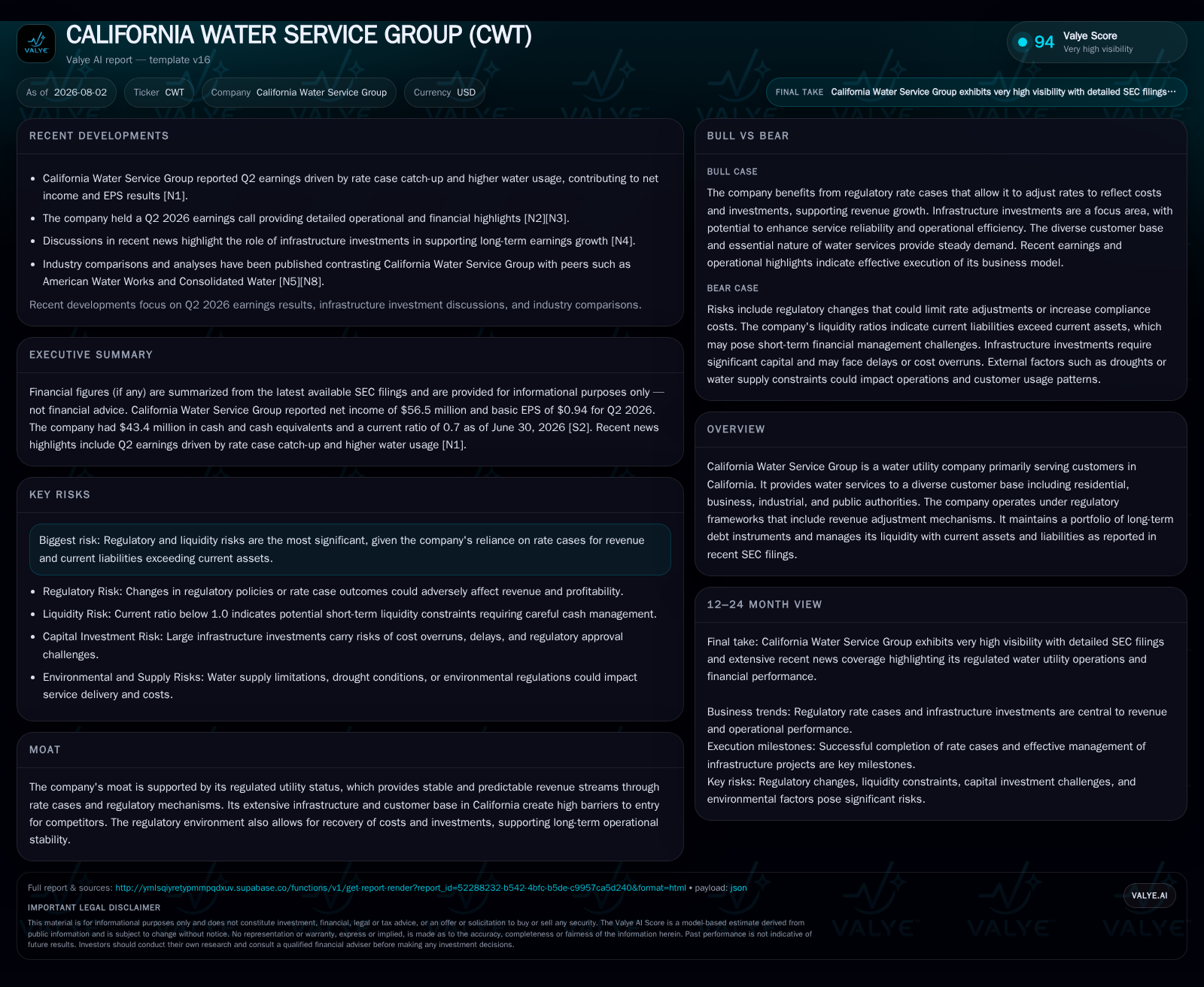
Q2 2026 results underscore revenue uplift from regulatory rate case catch-ups alongside ongoing capital investments amid liquidity pressures typical of regulated utilities.
California Water Service Group’s latest quarterly filing reveals a significant revenue increase fueled by recent regulatory rate case settlements, which improved earnings visibility for the near term. The company continues to invest heavily in infrastructure, supporting long-term service reliability and regulatory compliance, despite liquidity constraints highlighted by a below-unity current ratio. Operationally, steady demand from a diverse customer base underpins stable cash flows, but regulatory timing and aging system maintenance remain key risks. Comparisons with larger public peers emphasize the importance of managing capex efficiency and regulatory outcomes in sustaining growth.
Q2 Regulatory Rate Case Catch-Up Accelerates Revenue Momentum
California Water Service Group’s latest quarterly filing dated July 30, 2026, highlights a meaningful uptick in reported revenue attributable primarily to the recognition of catch-up adjustments from recent regulatory rate case approvals [S2], [S3]. These rate cases allow the company to recover costs expended since the last tariff update plus a regulated return on invested capital — a standard mechanism that creates strong linkage between capital spending and earnings visibility in regulated water utilities. The timing of these approvals critically influences quarterly financial results since the company can only implement new rates once public utility commissions grant authorization [N1]. This Q2 uplift signals progress in closing prior regulatory lags that temporarily deferred full cost recovery.
For CWT, whose operations span multiple states including California and neighboring western states through subsidiaries like Washington Water and New Mexico Water [S1], smoothly finalizing these proceedings is essential to stabilize cash flow streams. The recent earnings call emphasized that higher volumes due to weather patterns also bolstered revenue alongside rate increases [N2], indicating fundamental demand resilience in its diversified customer base.
Capital Expenditures: Investing in Infrastructure to Sustain Service Quality and Growth
The company maintains substantial capital expenditure (capex) commitments focused on modernizing its water distribution network and complying with evolving water quality standards mandated by state regulators [S1]. Regular infrastructure investments are vital to mitigate system leakage rates and reduce non-revenue water — critical operating KPIs affecting both operational efficiency and margin sustainability within regulated utilities. Capex intensity at CWT reflects both ongoing replacement of aging assets and capacity expansion tied to population growth within its service territories.
Industry reports underscore that disciplined capex programs underpin long-term regulated asset base (RAB) growth, which directly correlates with revenue escalation via rate cases [N4]. Compared with peer utilities such as American Water Works Company (AWK), which often serve larger national footprints with more standardized regulatory cycles, CWT's regional focus requires navigating varied commission timelines but still benefits from consistent investment-driven growth opportunities.
Regulated Business Model Anchored by Diverse Customer Base and Steady Demand Patterns
CWT’s revenue mechanics revolve primarily around delivering safe potable water services to approximately hundreds of thousands of customer connections spanning residential households, commercial entities, industrial users, and public authorities [S1]. Each customer segment contributes distinct demand volumes and pricing structures; residential accounts form the bulk but commercial and industrial consumers yield higher average revenues per connection due to increased usage intensity.
Approved tariff rates are designed to cover both operating expenses (opex) such as treatment costs and employee wages, along with capital-related expenditures amortized through depreciation plus an allowed regulated return on equity [S1]. Operator ability to meter consumption accurately helps reduce revenue leakage while providing data for better demand forecasting. Volume delivered fluctuates seasonally but has trended upward overall with population gains in California metropolitan areas served by CWT subsidiaries.
This structural diversification inherently reduces revenue volatility relative to utilities overly concentrated in one sector or municipality [S1]. Moreover, mechanisms like revenue adjustment clauses allow CWT to offset fluctuations in purchased water costs or power expenses by passing those costs largely through customers without margin erosion
Competitive Environment: Peer Context Highlights CWT’s Strategic Positioning under Varied Regulatory Regimes
Operating primarily in California—a state with stringent environmental standards—and along adjoining state lines exposes CWT to complex regulatory regimes differing from those affecting similar utilities such as American Water Works or Essential Utilities (WTRG). Regulatory timing variability can lengthen the interval between general rate cases (GRCs), temporarily constraining revenue adjustments despite rising cost bases [N6]
While some peers benefit from broader scale advantages easing capital procurement or accelerating project execution efficiencies, CWT compensates via focused regional expertise and active engagement with public utility commissions. The company’s ability to secure interim rate relief between GRCs or leverage revenue balancing accounts mitigates some regulatory risk inherent in multi-year filing cadences [S1]
Comparatively, benchmarking capex efficiency metrics—like ratio of capital expenses to incremental regulated asset base—against large peers provides insight into operational discipline necessary for sustaining competitive performance without eroding returns amid aging infrastructure corridors.
Growth Levers: Population Trends, Investment-Fueled Rate Approvals, and Technology Adoption
Growth drivers for CWT align closely with underlying demographic trends increasing customer connections across its regional footprint — especially within California’s growing suburbs where urban development fuels demand for reliable water supplies. Infrastructure investments aimed at system upgrades not only improve service reliability but create a foundation for requesting higher rates justified through enhanced asset value addition during GRCs [S1].
Furthermore, technological enhancements such as advanced customer metering systems contribute toward better detection of system leakage (non-revenue water), supporting margin expansion via lower operating inefficiencies. Industry-wide trends highlight how reducing non-revenue water can improve cash flow conversion even when volumetric sales falter due to conservation policies or drought conditions.
Continued investment in digital monitoring platforms exemplifies how modernized operations intersect with regulatory expectations around sustainability metrics — another potential catalyst for gaining favorable rate treatments that reflect increasing compliance complexity.
Watchpoints: Regulatory Timelines, Liquidity Strain, and Aging Infrastructure Risks
Despite the positive momentum reported this quarter, key risks persist notably relating to uncertain timing for forthcoming GRC outcomes across various subsidiaries [F1], [S2]. Delayed approval could postpone intended tariff escalations critical for offsetting inflationary pressures on operating expenses or debt servicing costs.
Liquidity considerations also command attention given CWT's current ratio stands at approximately 0.7 as of June 30, 2026 — indicating current liabilities exceed current assets — while total debt remains elevated near $1.47 billion net of cash balances [$43 million] [F1]. Such leverage ratios reflect capital-intensive industry norms but necessitate vigilant balance sheet management particularly when temporary mismatches occur due to phase lag between capital outlays and recovery through rates.
Lastly, aging distribution infrastructure imposes sustained maintenance requirements that could progressively increase operating costs unless timely replacement strategies succeed. The cumulative effect of deferred maintenance risks comes alongside tightening environmental regulations mandating system resiliency upgrades potentially inflating future capex beyond planned budgets.
Financial Profile Discussion: Liquidity Dynamics Under Pivoting Capital Requirements
From a financing perspective, California Water Service Group maintains a portfolio of long-term debt facilities structured around various maturities segmented by seniority levels typical for utilities seeking moderate refinancing flexibility [F1]. Its manageable cash holdings relative to substantial debt obligations underscore the necessity of continued orderly capital raising aligned with expected regulatory recoveries.
Compared with peers such as Essential Utilities who balance integrated utility models across water and gas segments, CWT's narrower pure-water utility structure focuses credit sensitivity more acutely on regulated returns’ stability tied to successful rate case negotiations [F1], [S2]. Credit ratings presumably factor these dynamics although precise levels remain undisclosed at this filing date.
Looking forward, prudent liquidity management will revolve around leveraging revenue adjustment mechanisms effectively while synchronizing capex schedules with anticipated cash inflows from approved tariffs — a fundamental challenge navigated adeptly by leading publicly traded water utilities amidst sector-specific cyclicality inherent in multi-year regulatory cycles.
This analysis synthesizes SEC filings and recent earnings releases highlighting California Water Service Group's ongoing efforts to harness regulatory frameworks for sustainable growth while addressing predictable financial pressures endemic to capital-heavy regulated water utilities. Readers should consider forward-looking statements cautiously given inherent uncertainties around regulatory decisions' timing as discussed above.
Disclaimer: This is research-only, informational analysis and not investment advice. It may include AI-generated interpretation and general industry context. Always verify important details using primary sources.

Comments