
Crinetics Pharmaceuticals’ Strategic Position Ahead of FDA and Commercial Milestones
Q2 results signal advancing commercialization, clinical pipeline momentum, and integration risks amid pending Vertex acquisition.
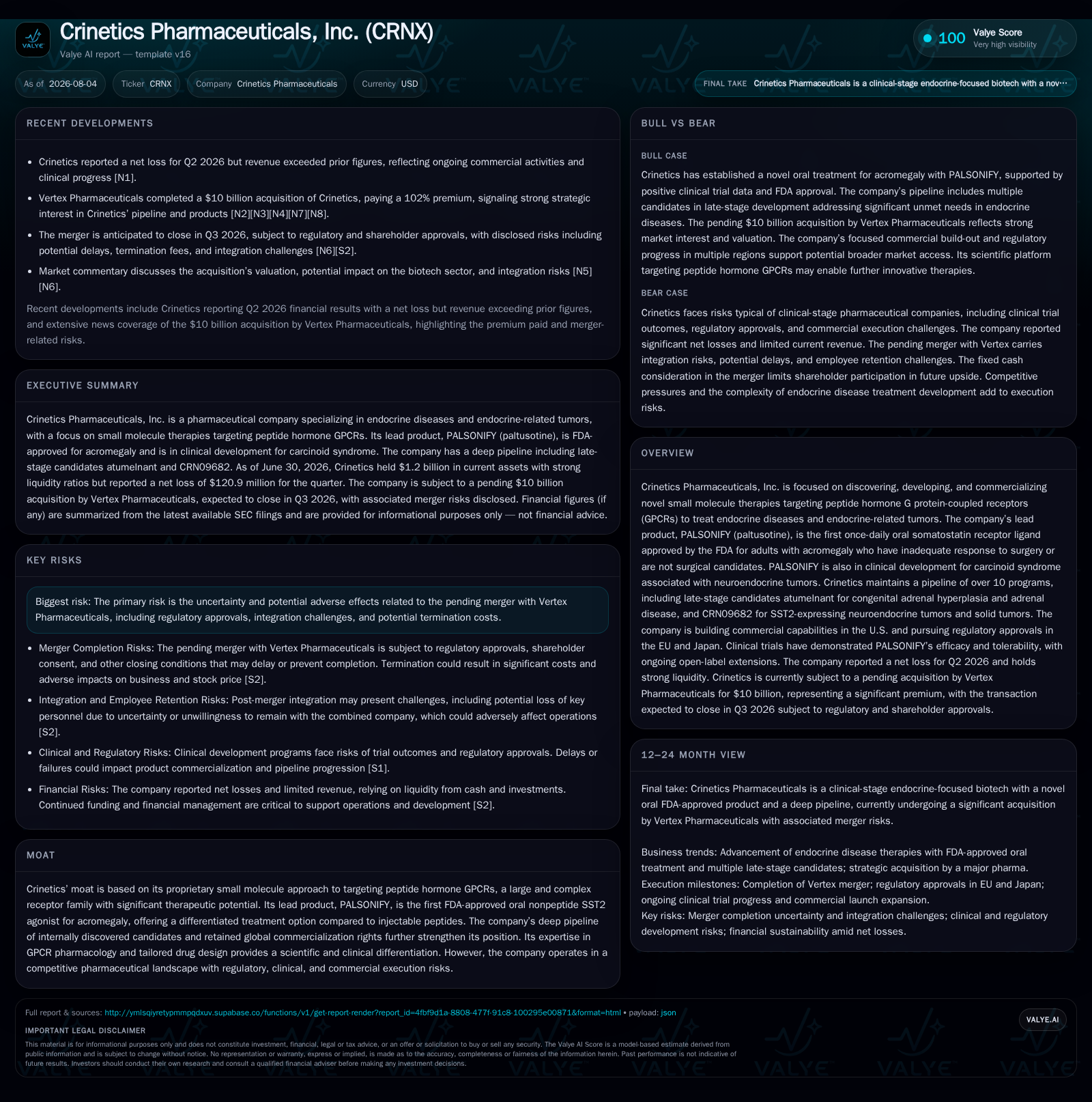
Crinetics Pharmaceuticals reported Q2 2026 results with initial revenue from PALSONIFY commercial sales and ongoing clinical progression of key pipeline candidates including paltusotine in carcinoid syndrome and atumelnant in congenital adrenal hyperplasia. The company awaits EMA marketing authorization following a positive CHMP opinion and is building U.S. commercial infrastructure. A pending merger with Vertex Pharmaceuticals introduces potential execution risks as the transaction nears completion conditional upon regulatory and shareholder approvals. Crinetics’ proprietary small molecule GPCR approach underpins a differentiated oral somatostatin receptor ligand offering amid a competitive endocrine-focused biotech landscape. The company’s cash position supports continued R&D investment and commercial scale-up through critical near-term milestones.
Q2 Operational Progress and Merger Milestones Set the Near-Term Outlook
In Q2 2026, Crinetics Pharmaceuticals began generating revenue from its lead product PALSONIFY (paltusotine), marking a pivotal transition from development-stage biotech to a commercial-stage enterprise [S2]. This milestone follows FDA approval in late 2025 and is accompanied by an active commercial launch effort in the U.S., reflecting early traction among physicians and payors treating acromegaly patients unsuitable for surgery or who show inadequate response post-surgery [S1]. Concurrently, the European Medicines Agency's Committee for Medicinal Products for Human Use (CHMP) issued a positive opinion recommending marketing authorization of PALSONIFY in Europe, setting an expected European Commission decision in H1 2027—an important international regulatory milestone that could extend market access [S1].
The company also initiated enrollment for a pivotal Phase 3 trial evaluating paltusotine in carcinoid syndrome (CS) patients with neuroendocrine tumors (NETs), expanding its label opportunity and potential patient population beyond acromegaly [S1]. These developments underscore growing pipeline momentum.
Simultaneously, Crinetics is navigating a pending $10 billion acquisition by Vertex Pharmaceuticals expected to close in Q3 2026, subject to several closing conditions including regulatory clearances (Hart-Scott-Rodino Act waiting periods), foreign approvals, and its own shareholder vote [S2], [S3]. This transaction poses both upside—access to Vertex’s larger commercialization infrastructure—and execution risk due to timing uncertainties and potential deal termination triggers carrying a $350 million termination fee exposure for Crinetics [S2].
Small Molecule GPCR Therapies Define Crinetics’ Differentiated Commercial Model
Crinetics operates within the pharmaceutical value chain focusing on internal discovery and development of small molecule therapies targeting G protein-coupled receptors (GPCRs) pertinent to endocrine disorders and related tumors [S1]. Its core asset, PALSONIFY, exemplifies this model as the first oral nonpeptide somatostatin receptor ligand approved by the FDA—offering significant differentiation compared to standard injectable peptide therapies historically used in acromegaly treatment. This oral administration potentially improves patient adherence and quality of life by simplifying dosing regimens, a critical driver of long-term therapy success in chronic endocrine diseases.
Beyond PALSONIFY’s commercial deployment, Crinetics’ pipeline features over ten programs including late-stage candidates such as atumelnant currently undergoing Phase 3 trials for congenital adrenal hyperplasia (CAH) and adrenal disease (ADCS). Another key candidate is CRN09682 targeting SST2-expressing NETs and solid tumors entering Phase 1/2 studies [S1]. The breadth across multiple orphan indications serves as a strategic moat anchored by proprietary chemistry expertise tailored to complex peptide hormone GPCR pharmacology.
Commercially, Crinetics is focused on building U.S.-based salesforce capabilities while simultaneously pursuing EU marketing authorization pathways leveraging orphan drug designations that catalyze regulatory expedience. This bifurcated approach seeks to maximize global market penetration yet requires substantial R&D expenditure alignment with evolving commercial investments [S1].
Tailored Competitive Landscape Framing in Endocrine Rare Disease Biotech
Within the biotechnology sector focusing on endocrine disorders and rare diseases, Crinetics occupies a specialized niche alongside firms advancing oral small molecule therapies targeting GPCRs—a class historically dominated by injectable biologics or peptides. Although direct peer comparisons are limited by lack of precise sales or share data, companies with FDA-approved oral somatostatin analogs stand out as reference points illustrating the competitive leverage inherent in oral dosing formats.
Patient switching costs favor oral agents due to convenience and reduced administration burden, potentially accelerating adoption curves if efficacy/safety profiles hold against injectables. However, these markets remain constrained by relatively small patient populations typical of orphan diseases, necessitating high pricing models supported by insurers aware of improved adherence outcomes.
Regulatory hurdles are formidable across all players given stringent endpoint requirements combined with long development cycles characteristic of rare disease indications. Thus, advancement to Phase 3 trials and receipt of positive regulatory opinions such as CHMP research views materially improve competitive positioning.
Clinical Pipeline Traction Fuels Potential Growth Avenues Beyond PALSONIFY
Crinetics’ pipeline progression underscores its growth trajectory beyond near-term commercialization of PALSONIFY. Atumelnant’s Phase 3 CALM-CAH study commenced enrollment late in 2025 with additional pediatric seamless Phase 2/3 trials underway (BALANCE-CAH), addressing unmet medical needs for CAH patients requiring glucocorticoid balancing therapies [S1]. Early positive Phase 2 outcomes validate the compound’s therapeutic promise.
Furthermore, plans are set to initiate Phase 2/3 studies for atumelnant in adrenal disease conditions (EQUILIBRIUM-ADCS) within 2026’s first half, reflecting disciplined operational pacing aligned with clinical milestones.
CRN09682 advances through dose escalation cohorts after IND clearance in April 2025; early patient dosing commenced late last year indicating steady pipeline de-risking efforts targeting SST2-expressing neuroendocrine tumors—a related but distinct indication from atumelnant's endocrine focus.
Number of active clinical programs thus remains robust at over ten candidates under investigation across different stages—an essential KPI signaling innovation depth supporting mid-to-long term revenue diversification.
Executing Merger Amid Regulatory Approvals Presents Key Risks & Opportunities
The impending merger with Vertex Pharmaceuticals introduces notable potential value creation opportunities paired with execution complexities typical in large-scale pharma M&A transactions [S2]. Completion hinges on standard conditions including shareholder approval (currently pending), absence of legal injunctions against deal consummation, expiration of HSR act waiting periods, plus foreign jurisdictional clearances where applicable.
Failure to meet these conditions or adverse legal rulings—such as lawsuits challenging the merger—may delay or terminate the transaction exposing Crinetics to material costs exceeding initial estimates due to ongoing legal fees plus possible payment of $350 million termination charges under predefined scenarios [S2], [S22].
Post-merger integration risk also merits scrutiny given Vertex will assimilate Crinetics’ sizeable R&D assets alongside nascent commercial operations built around PALSONIFY rollout—a process demanding careful resource allocation without disrupting ongoing clinical progress or market momentum.
What Investors Should Watch Next: Clinical Readouts & Regulatory Decisions
Key upcoming catalysts center on continued regulatory validation and clinical data that can materially affect valuation trajectories:
- EMA marketing authorization decision anticipated H1 2027 based on CHMP positive opinion already granted [S1]; approval here would unlock European commercialization potential.
- Completion timelines for Phase 3 paltusotine trial expansion into carcinoid syndrome could enable label extension impacting total addressable market scope.
- Further interim/pediatric trial results from atumelnant’s seamless Phase 2/3 CAH study provide pivotal efficacy/safety signals critical to confirm therapeutic leadership in this niche endocrine disease.
- Early metrics on U.S. PALSONIFY uptake rates including physician prescribing behavior, insurance reimbursement coverage breadth, patient adherence trends—all vital to confirm commercial viability beyond launch phase. These KPIs provide transparency into both clinical de-risking progression and market acceptance evolution fundamental for durable revenue growth confirmation.
Financial Profile Discussion: Cash Reserves Support Ongoing Growth Investments
As of Q2 end June 30, 2026, Crinetics held cash and equivalents totaling approximately $55.5 million alongside current assets substantially exceeding current liabilities resulting in an exceptionally strong current ratio near 15.6x—indicative of healthy short-term liquidity available to support both commercialization scaling efforts and continued R&D investments across multiple pipeline programs [F1], [S2].
The company continues reporting net losses consistent with investment-heavy biotech models transitioning toward commercial operations; operating loss drivers stem from sizable research expenditures alongside developing selling general & administrative costs related to market launch infrastructure development [F1]. Sustained cash burn requires monitoring especially given ongoing merger-related costs but presently liquidity appears sufficient to sustain planned activities through critical near-term milestones without immediate financing needs.
This analysis synthesizes SEC filings through August 3, 2026, recent market commentary, industry context frames around GPCR-oriented biopharma focusing on orphan endocrine diseases, and company-specific operational updates. It does not constitute investment advice but aims to clarify Crinetics Pharmaceuticals’ evolving strategic profile amid pivotal regulatory milestones and M&A dynamics shaping its near-to-midterm outlook. Readers should monitor upcoming approvals decisions, trial readouts timing, merger closing progress indicators, and initial commercial uptake data as primary barometers validating execution continuity against identified risks.
Disclaimer: This is research-only, informational analysis and not investment advice. It may include AI-generated interpretation and general industry context. Always verify important details using primary sources.

Comments