
Twist Bioscience's Silicon-Based DNA Synthesis Strengthens Throughput and Market Reach
The company's Q3 2026 results highlight scaling challenges amid solid revenue growth driven by its proprietary DNA synthesis platform.
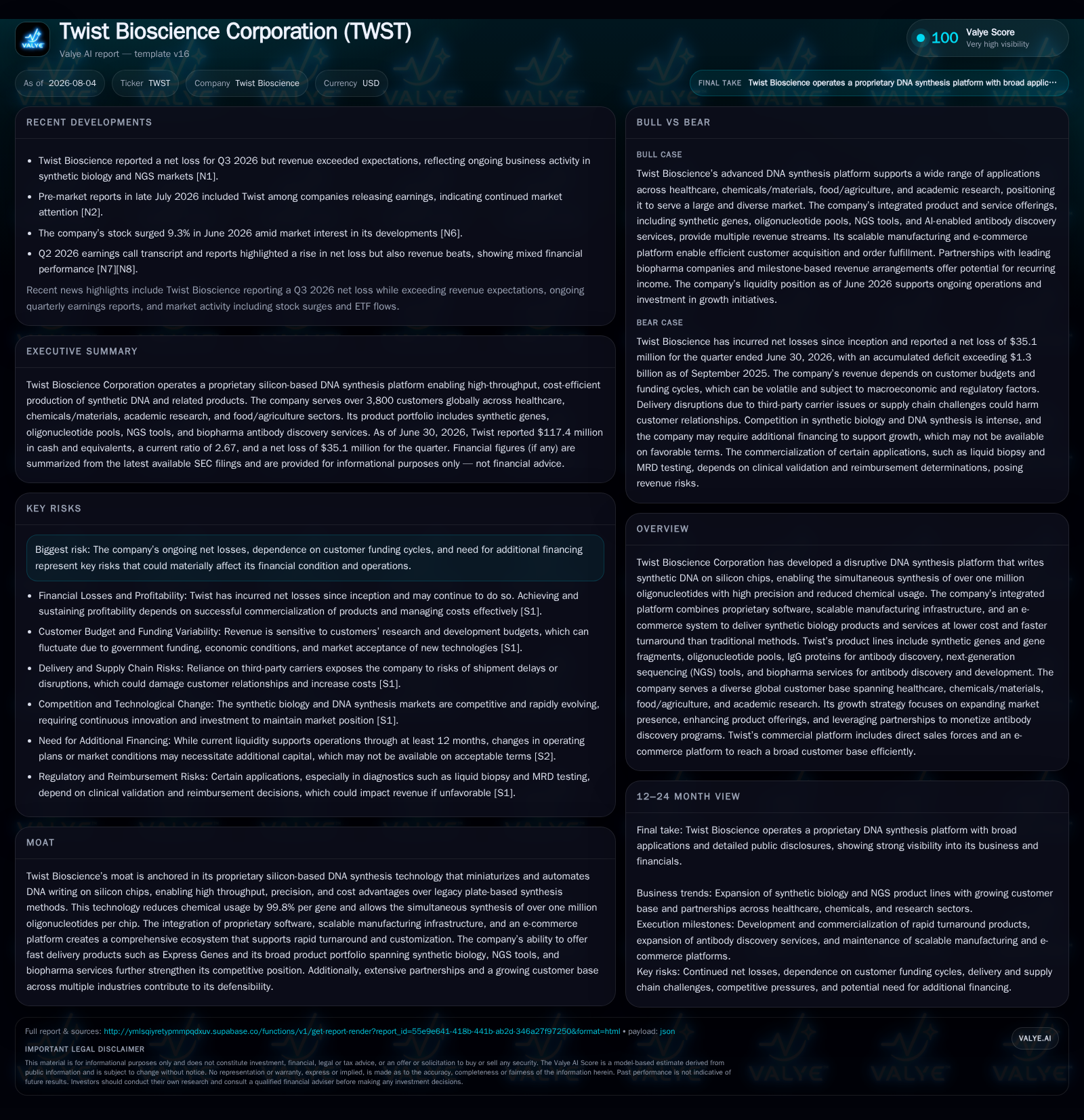
Twist Bioscience reported Q3 2026 revenue surpassing estimates driven by sustained demand across healthcare and industrial sectors, reflecting adoption of its high-throughput silicon chip DNA synthesis technology. Despite ongoing net losses and negative operating income, the company's integrated technology platform combining automation, proprietary software, and e-commerce enables cost advantages and rapid turnaround. Growth is supported by diversified applications spanning synthetic genes, biopharma discovery services, and NGS tools. Risks persist from dependence on single-source components, evolving customer funding cycles, and capital-intensive scale-up.
Recent Operating Update
No material changes in risk factors were reported in the recent filings beyond those described in the prior annual report, underscoring consistent operational challenges inherent to Twist’s capital-intensive growth trajectory and dependence on technology leadership to maintain competitive advantages [S8].
Business Model Overview
Twist Bioscience operates an integrated synthetic biology platform anchored by its proprietary silicon-based DNA synthesis technology that miniaturizes thousands of parallel chemical reactions on a silicon chip roughly the size of a large smartphone [S1][S16][S26]. This allows simultaneous synthesis of more than one million oligonucleotides per chip while reducing chemical usage by an estimated 99.8% compared to traditional plate-based synthesis methods. The company combines this core technological edge with proprietary software for design automation and a scalable manufacturing infrastructure linked to an e-commerce platform that facilitates rapid customer ordering and real-time project tracking.
Revenues principally arise from sales of custom synthetic DNA products including synthetic genes and gene fragments used for research in therapeutics development and industrial biotech applications. Complementing this offering are products serving next-generation sequencing workflows such as sample preparation kits targeting liquid biopsy tests and agricultural genomics applications [S1][S22][S26]. Beyond product sales, Twist provides biopharma services centered on antibody discovery through an integrated "discovery trifecta" combining in vivo, in vitro, and in silico platforms delivering rapid lead identification and engineering services to pharmaceutical partners [S24]. Monetization spans direct product orders via e-commerce as well as fee-for-service contracts accompanied by milestone payments and royalties linked to collaborative drug development programs [S20].
The sales strategy embraces a multi-channel approach deploying direct sales forces focused separately on synthetic biology customers, NGS markets, and biopharma services combined with digital self-service capabilities critical to addressing a broad customer base estimated over 100,000 users worldwide [S22]. This structure supports diversified end-market exposure spanning healthcare (dominant contributor), specialty chemicals/materials manufacturing, agricultural biotech innovation, academic research institutions, and emerging bioindustrial sectors seeking sustainable materials solutions.
Industry Structure & Competitive Position
Twist Bioscience occupies an upstream position within the synthetic biology value chain emphasizing advanced manufacturing of synthetic nucleic acids for diverse downstream users including pharma companies developing novel therapeutics, chemical manufacturers crafting specialty materials like spider silk or nylon alternatives, agricultural biotech firms optimizing crop genetics, along with academic researchers. The company stands out through its silicon chip-based synthesis platform—an approach that rivals traditional spot-welded plate methods prevalent among peers such as Integrated DNA Technologies or Agilent Technologies who operate largely with legacy chemistries.
By integrating silicon semiconductor fabrication techniques with biological chemistry, Twist achieves unprecedented throughput measured by the sheer number of oligonucleotides synthesized per run alongside significant reductions in reagent consumption—key cost drivers in synthetic biology production. This combination confers durable pricing leverage potential owing to lower unit costs coupled with accelerated turnaround times that help customers compress research cycles.
Further competitive differentiation arises from combining hardware advances with software-driven design automation alongside an efficient e-commerce ordering ecosystem facilitating customization at scale—advantages less accessible to competitors relying on fragmented workflows or manual order entry systems. Moreover, diversification into biopharma antibody discovery services establishes additional high-value recurring revenue streams aided by partnerships involving milestone payments reflecting therapeutic development progress.
Peers span multiple categories: traditional oligo/gene providers (e.g., IDT), NGS instrumentation/kit manufacturers such as Illumina focusing on sample prep tools but not synthetic gene manufacture at scale; contract research organizations offering biopharma discovery; plus broader synthetic biology companies targeting enzyme or material production but without Twist's direct DNA writing technology capability.
Growth Drivers
Structural expansion in demand for synthetic DNA underpins Twist’s growth prospects anchored on accelerating applications across healthcare drug discovery including antibody development pipelines; industrial biotech relying on genetically encoded pathways for specialty chemical production; agricultural genomics enhancing crop yields sustainably; plus expanding academic R&D budgets fueling basic science inquiries requiring reliable gene constructs.
Key enablers include continuous technical improvements driving automation enhancements increasing synthesis throughput further lowering manufacturing costs per base—critical for commercial competitiveness especially as scale expands. New product introductions such as mRNA-related synthesis capability or protein engineering assays extend market reach beyond nucleic acid fragments alone potentially tapping the lucrative biologics sector more directly [S16][S24].
Strategic partnerships featuring licensing deals often coupled with milestone-based payments deliver upfront capital inflows while aligning incentives for long-term collaborative success fostering recurring royalty streams that supplement fee-for-service sales contributing revenue resilience amid variable order flows from smaller customers [S20]. Increasing adoption of artificial intelligence approaches integrated into antibody discovery accelerates project timelines enabling customers to rapidly select candidates exhibiting desirable developability profiles—a compelling value proposition enhancing retention rates.
Cross-industry penetration across chemicals/materials (including sustainable biomaterials replacing petrochemical derivatives) alongside food/agriculture segments demonstrates breadth reducing reliance on any single vertical market improving stability against sector cyclicality or funding volatility common in biotech R&D landscape where capital markets influence spending patterns heavily.
Risks & Watchpoints
Despite promising innovation-led advantages underpinning competitive positioning, Twist remains exposed to multiple risks demanding close monitoring. Chiefly among these is ongoing net loss generation reflecting substantial investments required for manufacturing scale-up upgrading automation systems prerequisite for margin improvements essential for sustainable profitability over time [S18]
The company depends on proprietary manufacturing processes reliant on critical components sourced from sole suppliers posing supply chain fragility risks potentially disrupting production capacity ramp-ups adversely affecting delivery commitments impacting customer satisfaction levels negatively if unresolved swiftly [S1]
Customer orders exhibit variability tied partly to external factors such as funding availability within life sciences initiatives influenced heavily by macroeconomic conditions affecting venture capital financing cycles or institutional grant renewals resulting in periodic spending contractions or order postponements creating topline volatility complicating forecasting accuracy [S21].[N1]
Intellectual property protection challenges remain pertinent given rapid innovation pace within synthetic biology competing technologies advancing which could erode exclusivity or require costly litigation diverting resources.
Maintaining skilled scientific personnel necessary both for ongoing process innovation as well as biopharma service delivery amidst competitive talent markets presents execution risks that could impede progress if attrition rates rise unexpectedly or recruitment slows below planned levels.
Regulatory developments around nucleic acid synthesis screening frameworks add compliance overhead potentially delaying commercialization timelines albeit currently Twist has affirmed adherence meeting or exceeding US government standards mitigating short-term impact [S15].
What To Watch Next
Investors and industry watchers should closely track:
- Quarterly financial releases focusing on revenue growth rates segmented by end market validating sustained traction amid economic headwinds;
- Operating margin trends reflective of manufacturing efficiency gains proving scalability benefits;
- Progression within biopharma partnership pipeline including initiation or milestones triggering meaningful non-product revenues enhancing long-run cash flow profiles;
- Expansion of product offerings especially mRNA and protein synthesis lines indicating successful leveraging of platform versatility;
- Capacity utilization metrics confirming manufacturing floor ramp-up alongside automation enhancements translating into cost reductions;
- Order book dynamics especially concentration shifts among large customers revealing diversification progress;
- Updates concerning supply chain safeguards mitigating sole supplier dependencies;
- Staff hiring trends particularly R&D engineers signaling innovation momentum sustainability;
- Regulatory compliance affirmations maintaining access to US federally funded research market segment important for volume stability.
Financial Profile Discussion
As of June 30, 2026, Twist Bioscience held cash & equivalents totaling approximately $117.4 million with current assets of $321.3 million and current liabilities of $120.3 million, yielding a strong current ratio near 2.67 indicative of sufficient short-term liquidity provisions supporting operational needs without stress under normal business cycles [F1]. The company reported minimal total debt of approximately $0.8 million as of September 2021, suggesting a conservative leverage posture aligned with preserving flexibility amid capital-intensive operations [F1].
Capital expenditures primarily target capacity buildouts and automation tooling upgrades necessary to sustain throughput improvements central to competitive advantage realization commensurate with industry norms where upfront fixed costs predominate ahead of volume breakeven milestones—a standard pattern observed broadly among peers pursuing disruptive synthetic biology manufacturing platforms.
Overall financial health appears robust enough presently to support ongoing strategic initiatives though watchfulness warranted given historical operating losses necessitating continuous evaluation against cash burn rates amid evolving market conditions.
This analysis synthesizes publicly available SEC filings through August 2026 alongside industry context without providing investment advice. It highlights Twist Bioscience's technological differentiation via silicon-based DNA synthesis contributing notable cost efficiencies and throughput scale while navigating challenges typical within high-growth synthetic biology enterprises operating at the intersection of biotechnology manufacturing innovation and complex global end markets.
Disclaimer: This is research-only, informational analysis and not investment advice. It may include AI-generated interpretation and general industry context. Always verify important details using primary sources.

Comments