
Group 1 Automotive Expands Dealer Network Amid Supply Chain and Tariff Pressures
Group 1 Automotive’s latest quarter reveals growth pressures from supply challenges and tariffs balanced by a strategic acquisition and solid service revenue.
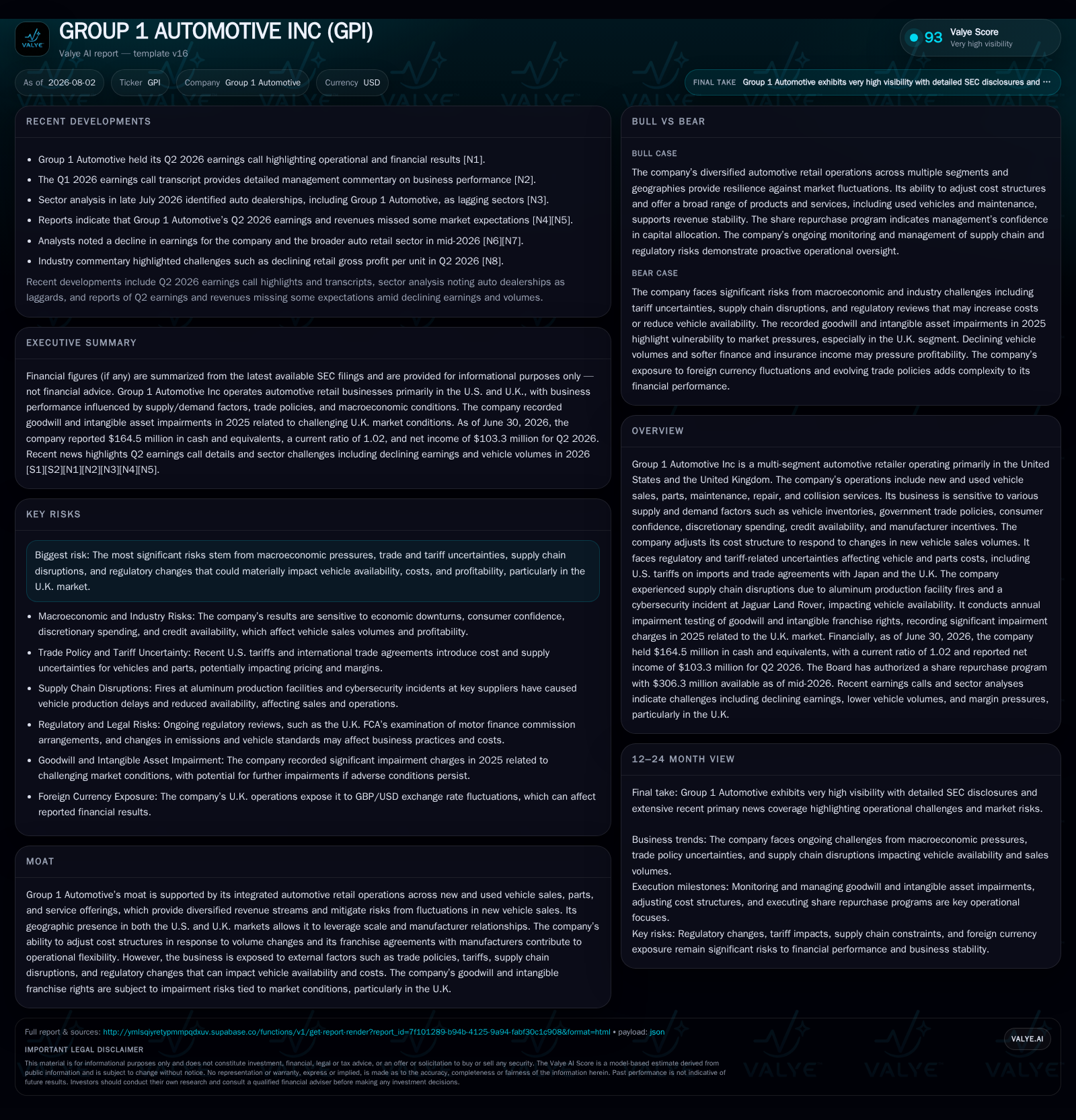
Group 1 Automotive reported Q2 2026 results highlighting ongoing impacts from supply chain disruptions and trade tariffs that have constrained new vehicle availability and cost structures. The company mitigated these headwinds with expanded operations through a major dealership acquisition, steady used vehicle sales, and resilient after-sales revenues in parts, maintenance, and collision services. Despite margin pressure influenced by regulatory uncertainties and inflationary costs, Group 1’s diversified business mix and cost structure flexibility continue to support operational stability. Upcoming milestones include integration of its recent large purchase agreement backed by bridge financing, while watchpoints remain on the evolving tariff environment, consumer credit conditions, and manufacturer incentives.
Recent Operating Update
Group 1 Automotive’s Q2 2026 filing presents a pivotal moment marked by a significant expansion through a newly announced purchase agreement involving multiple dealerships in Georgia with Hennessy Automobile Companies. This transaction, backed by a $1.25 billion senior unsecured bridge facility arranged concurrently, signals management's intent to bolster geographic presence and dealer scale during challenging industry conditions [S3][S10]. Such acquisitions serve as critical growth levers in automotive retail where scale can improve manufacturer access and operational efficiencies.
However, the quarter underscores persistent supply-side challenges adversely affecting new vehicle inventory availability. The company cites specific disruptions including fires at aluminum production facilities vital to the supply chain and a cybersecurity incident impacting Jaguar Land Rover’s vehicle availability [S1]. These constraints continue to weigh on new vehicle sales volumes — a traditional driver for revenue growth — contributing volatility to top-line results.
Further complications arise from evolving trade policies. Group 1 notes several U.S. tariff updates: Section 232's imposition of a 25% tariff on medium- and heavy-duty truck imports effective November 2025; U.S.-Japan trade alterations replacing higher previous duties with a uniform 15% duty on autos and parts; as well as the U.S.-U.K Economic Prosperity Deal setting quotas and tariffs for UK-made vehicles entering the U.S. market [S1]. These government interventions increase input costs for vehicles and parts sourced internationally, squeezing margins unless fully recoverable via pricing or offset by manufacturer incentives.
Business Model Insights
Group 1 operates integrated automotive retail businesses spanning new and used vehicle sales alongside parts, maintenance, repair, and collision services. This multi-segment model creates diversified revenue streams to cushion cyclical swings in new vehicle demand triggered by economic factors such as discretionary spending or consumer credit availability [S1]. Revenue primarily derives from franchised dealership operations under manufacturer agreements across the U.S. and U.K., with monetization driven by unit sales volume, gross profit per vehicle (factoring in manufacturer incentives), same-store sales improvement metrics, as well as stable after-sales components measured by service absorption rates.
New vehicle transactions face direct sensitivity to supply constraints impacting inventory turnover rates and average days to sell vehicles—a key operational KPI influencing financing costs tied to floorplan credit lines. Simultaneously, used car retailing benefits during slower new car cycles as consumers shift preferences or delay purchases but maintain their vehicles longer.
After-sales service segments mitigate overall revenue cyclicality since maintenance, collision repair, and parts sales generate recurring streams less dependent on vehicle sales cycles. Robust customer retention fosters repeat visits enhancing margins through higher service absorption rates relative to fixed overheads.
Management monitors cost structure agility closely; during periods of declining volumes or margin pressure, they implement timely SG&A expense adjustments incorporating workforce levels or facility utilization optimization [S1]. This operational flexibility is crucial given volatile macroeconomic inputs.
Industry Structure and Competitive Positioning
As part of the automotive retail sector—where distributors interface directly between manufacturers and end consumers—Group 1 competes with peers like AutoNation, Penske Automotive Group, Lithia Motors, Carvana (notably in e-commerce), and Sonic Automotive through franchise dealership networks diversified geographically.
Competitive strength derives from Group 1’s dual-market exposure (U.S. & U.K.), allowing scale leverage in franchise negotiations yet exposing it to forex and regulatory complexities unique to each geography [S1]. The company's ability to navigate manufacturer incentive structures while adjusting inventory financing strategies is essential amidst tight trade policy environments impacting OEM production decisions.
Margins tend to fluctuate with gross profit per unit sold but can be stabilized through higher share contributions from after-sales which typically enjoy more predictable pricing dynamics than new vehicle transactions influenced by promotional rebate programs or manufacturer discounting.
Peer benchmarking highlights that dealer groups adept at multi-brand diversification alongside digital retailing investments capture more resilient profitability amidst shifting consumer preferences toward online shopping models or electric/alternative fuel vehicles.
Growth Drivers
Key growth avenues include strategic acquisition-led geographic expansion evidenced by the recent material definitive agreement finalized July 2026 for acquiring multiple dealerships in the high-volume Atlanta metro area [S3][S10]. This enhances Group 1’s competitive footprint leveraging operational synergies across dealer networks.
Expansion of after-sales revenues through enhanced parts distribution centers or service capacity upgrades supports margin improvement irrespective of cyclical new car trends given the income stability afforded by maintenance demand. Rising adoption of electric vehicles (EVs) also creates novel service opportunities though simultaneously mandates adjustment in technician training and parts inventory specialization.
Increasing penetration of financing and leasing products align with industry-wide trends improving affordability for consumers while generating ancillary fee income for dealerships if executed efficiently.
Finally, evolving digital retail capabilities suit changing buyer behaviors favoring online research with eventual showroom visits or complete online transaction fulfillment—an area where traditional dealer groups compete against emerging pure-play platforms like Carvana but also find complementary growth through omnichannel integration.
Risks and Watchpoints
Significant risks are concentrated around macroeconomic headwinds: potential downturns reducing discretionary spending limiting new vehicle purchases; shifts in consumer credit availability tightening financing access; persistent tariff-driven cost inflation creating margin compression; regulatory mandates imposing compliance costs (especially UK BEV regulations); currency swings affecting international earnings translation; cybersecurity incidents disrupting operations; manufacturer incentive variability influencing consumer demand elasticity; and substantial goodwill impairment risks tied mainly to localized asset valuations especially in volatile regions like the U.K. market [S1][S5]
Supply chain resilience remains a critical metric reflecting upstream vulnerabilities directly impacting dealer inventory levels—a leading indicator affecting same-store sales growth potential.
Monitoring manufacturer relations is crucial since approvals for future acquisitions hinge on franchise agreements' covenant requirements underscoring strategic dealership portfolio reshaping capabilities.
What to Watch Next
Investors should track integration progress post-acquisition supported by bridge financing expected within fiscal terms outlined July 2026 – this will test Group 1’s operational scaling ability amidst elevated leverage conditions [S3][S10]
Quarterly updates on tariff developments or government policy adjustments will inform potential re-pricing strategies or sourcing shifts necessary for margin protection.
Changes in consumer credit trends or interest rate movements will materially impact financing volume growth – an important secondary revenue stream besides unit sales.
Service segment same-store sales growth rates coupled with gross profit per vehicle sold remain core KPIs signaling underlying business momentum beyond headline volume figures.
Management commentary on manufacturer incentive programs will clarify discount pass-through scenarios critically influencing net selling prices.
Financial Profile Discussion
As of June 30, 2026, Group 1 Automotive holds total debt approximating $3.05 billion offset marginally by $164.5 million cash reserves yielding net debt near $2.88 billion [F1]. Current assets modestly exceed liabilities resulting in a current ratio slightly above parity at about 1.02 — reflecting limited liquidity cushion typical for asset-heavy automotive retailers reliant on floorplan financing lines [F1][S2].
The company maintains a healthy balance regarding compliance with debt covenants under revolving credit facilities accented by recent bridge loan commitments structured for acquisition funding [S10]. Its share repurchase program remains active with $306.3 million authorized capacity available post-Q2 repurchases alongside an established dividend policy marked by recent increases signaling confidence in free cash flow generation [S9][S2][S14].
Overall financial posture reflects solid leverage discipline consistent with industry norms among franchised dealers balancing growth investments against refinancing risks amid evolving trade policy uncertainties.
This analysis synthesizes publicly filed SEC disclosures up through Q2 2026 quarterly reports combined with recent event filings describing material acquisitions that shape Group 1 Automotive’s near-term trajectory within the broader automotive retail sector context without offering investment advice.
Disclaimer: This is research-only, informational analysis and not investment advice. It may include AI-generated interpretation and general industry context. Always verify important details using primary sources.

Comments