
Marcus Corp’s Second Quarter Results Highlight Liquidity Constraints and Industry Pressures
Marcus Corp's Q2 2026 report reveals continuing liquidity challenges amid streaming-driven attendance pressures and evolving revenue mix dynamics.
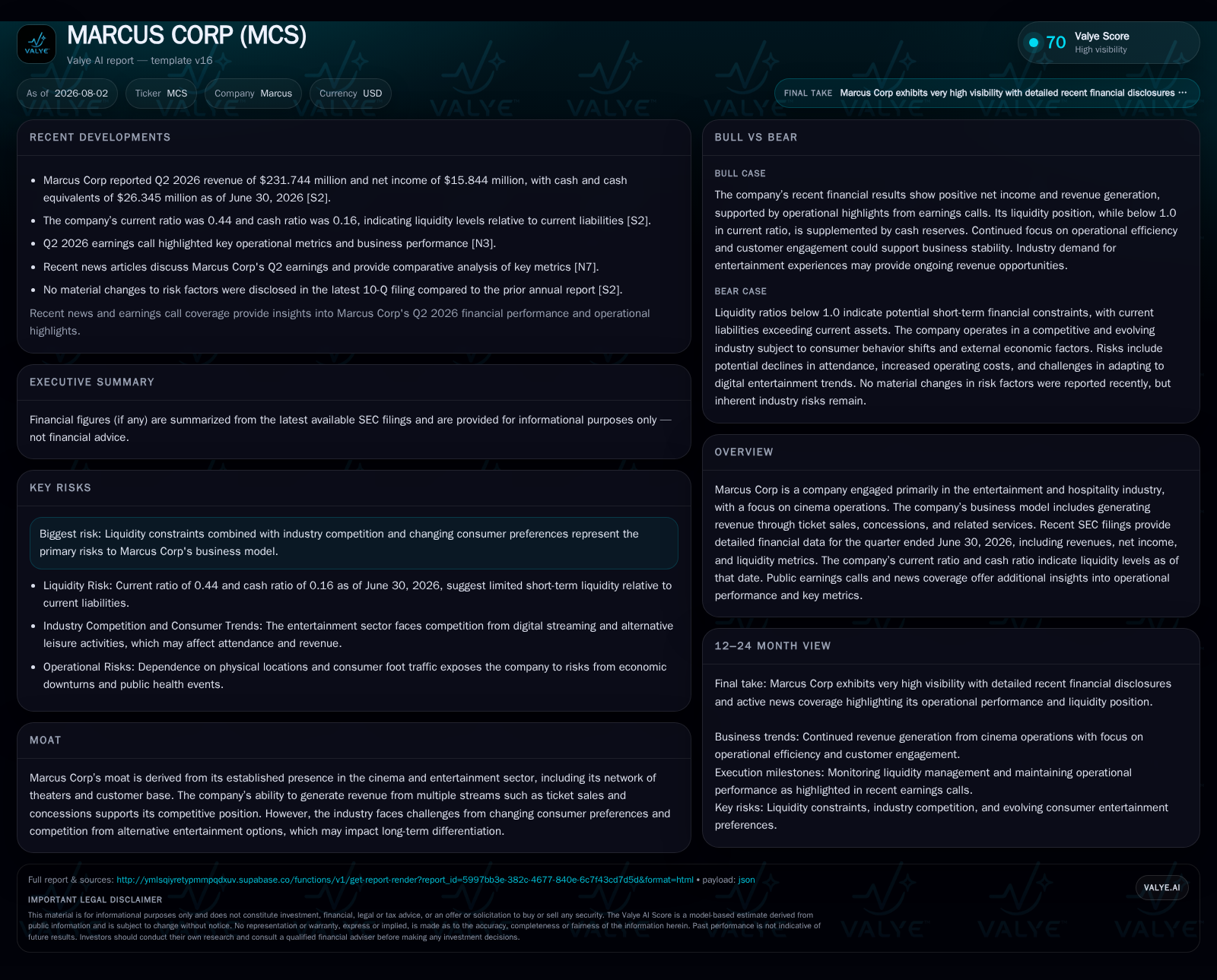
In its latest quarterly filing, Marcus Corporation reported ongoing headwinds from digital streaming competition that are constraining box office attendance growth. While average ticket prices and concession sales per patron showed modest resilience, liquidity metrics portray a tight financial position with a current ratio of 0.44 as of June 30, 2026. The company's traditional theatrical exhibition model continues to face structural risks from shifting consumer preferences and capital-intensive operations. Growth initiatives such as premium large format upgrades and event hosting are under development but have yet to fully offset macro pressures. Investors should monitor quarterly attendance, pricing power, and capital deployment execution to gauge recovery prospects.
Contextualizing Marcus Corp’s Q2 Operational Performance Despite Streaming Headwinds
Marcus Corporation's Q2 2026 filing [S2] highlighted a continuation of the industry's struggle with the encroachment of digital streaming platforms impacting traditional theatrical exhibition attendance. The company detailed its financial results for the quarter ended June 30, 2026, showing that while revenues remained steady, underlying attendance trends faced pressure consistent with wider industry dynamics influenced by changing consumer preferences [N3]. Marcus management noted stable average ticket prices (ATP), suggesting some retained pricing power despite attendance headwinds. Concession sales per patron remained a focal point for revenue enhancement efforts, reflecting the sector's reliance on ancillary services to bolster margins.
These operational updates underscore the persistent challenge posed by streaming alternatives, which have normalized convenience and at-home viewing for many consumers. This transition creates structural demand erosion risks for Marcus’ core box office revenue stream, which historically constitutes the primary inflow in the company’s multiplex-based business model operating across owned theaters [S1]. The reported operating margin compression reflects the difficulty in scaling fixed-cost-heavy multiplex operations against fluctuating consumer volumes.
Analyzing Exhibition Economics: Ticket Sales, Concessions, and Premium Offerings Drive Revenue Mix
Marcus Corp generates most of its revenues through direct consumer sales at its theater venues via ticket sales complemented by concessions such as food and beverages [S1]. The interplay between total attendance (volume) and average ticket price (price) drives box office revenue — the company's cornerstone monetization mechanic. The latest quarterly data confirm that while ATP has held relatively firm due to selective pricing adjustments, total attendance growth has stagnated in the face of competitive leisure alternatives including streaming platforms [S2].
Margin drivers in this model hinge heavily on concession sales per patron since these items carry higher gross margins compared to admissions [S1]. Marcus has continued initiatives to optimize concessions offerings through menu enhancements and promotional strategies designed to raise per-customer spending. Moreover, investments in premium large format (PLF) screens aim to provide differentiated theatrical experiences commanding price premiums over standard screenings — an important lever given the commoditization threat from free or low-cost digital content
Operating margins thus closely tie to effectively managing concession yield alongside controlling fixed costs inherent in running multiplex facilities — including staffing, utilities, and periodic renovation capital expenditures critical for maintaining customer experience standards.
Assessing Cinema Industry Structure: Competitive Dynamics Against Peers and Streaming Pressure
The broader cinema exhibition industry is characterized by significant capital intensity due to real estate leases or ownership obligations combined with technological refresh requirements such as PLF installations. Large peers like AMC Entertainment and Cinemark Holdings offer points of comparison on scale efficiency and screen utilization but face similar headwinds in terms of declining discretionary box office participation caused by streaming competition [S1]
Streaming platforms such as Netflix and Disney+ have evolved into direct substitutes for moviegoing convenience, eroding attendance frequency especially for mid-tier releases lacking exclusive event appeal. This forces exhibitors like Marcus into a cycle of increasing investment in experiential differentiation while grappling with unavoidable fixed-cost structures that limit marginal cost flexibility per admission.
Compared with hospitality operators such as Hyatt or Hilton who also depend on discretionary spending trends but benefit from lodging-related diversification, cinema chains rely heavily on cyclically driven movie release windows dictating traffic spikes — increasing volatility risk amid unpredictable studio content scheduling.
Growth Levers: Premium Formats, Event Hosting Expansion, and Digital Engagement Initiatives
Marcus continues to target revenue diversification within its venues beyond traditional film exhibition through event hosting options that include concerts and esports screenings — sectors growing in entertainment live consumption appeal [S1][N3]. These formats can attract broader demographics less sensitive to studio film cycles while potentially generating higher-margin bookings.
Technological enhancements such as mobile ticketing and loyalty programs form part of digital engagement strategies intended to strengthen customer retention alongside same-store sales growth—critical KPIs given that repeat visitation drives profitability in multiplex models where initial customer acquisition costs can be moderate but retention yields lifetime value.
Premium large format upgrades remain a cornerstone growth investment for Marcus, as these enhanced experiences allow charging premium admissions which can partially offset flat attendance volumes. Execution success will depend on realizing targeted incremental revenues per screen alongside customer willingness to pay higher ticket premiums without erosion from digital alternatives.
Key Risks: Liquidity Constraints, Consumer Behavior Shifts, and Content Window Vulnerabilities
Liquidity appears constrained at Marcus Corp entering second half 2026. According to companyfacts balance sheet data ([F1]) as of June 30, 2026, current assets totaled approximately $71.7 million versus current liabilities at $164.7 million yielding a current ratio near 0.44—a level suggestive of tight near-term working capital coverage that may restrict operational flexibility without external funding or asset optimization strategies.
Total debt levels stood near $150 million against cash reserves around $26 million indicating significant net leverage (approximate net debt of $124 million) relative to earnings capacity—posing potential refinancing or covenant risks under adverse economic conditions [F1]. Such leverage is typical for capital-heavy exhibitors but imposes heightened sensitivity to cyclical downturns or unanticipated capex burdens.
From an operational standpoint, shifting consumer preferences channelled by streaming competition threaten box office demand sustainability alongside concessions yield risks if volume drops accelerate faster than price increases can compensate [S1][S2]. Additionally, contract terms with film studios controlling release windows influence timing-sensitive attendance surges crucial for profitability.
Forward Monitoring: Attendance Trends, Pricing Power, and Capital Deployment Execution Markers
Key metrics warranting close tracking in upcoming quarters include total attendance variances compared year-over-year or sequentially to evaluate recovery trajectory post-pandemic normalization disrupted by streaming substitution effects [S2][N3]. Changes in average ticket prices coupled with concessions sales per patron will reveal pricing power durability amid inflationary cost environments.
Execution progress on premium large format rollouts offers tangible readouts on ability to monetize enhanced experience investments effectively — successful projects could signal moat expansion potential versus peers solely reliant on standard screens.
Liquidity improvements measured through working capital management or refinancing activity will also be vital indicators given current tight ratio constraints [F1]. Any strategic shifts toward event hosting scale-up could diversify revenues away from fluctuating movie attendance dependency.
Financial Profile Discussion: Liquidity Status, Leverage Metrics, and Capital Expenditure Needs
Drawing from the June 30, 2026 balance sheet snapshot ([F1]), Marcus Corp held $26.3 million in cash and equivalents against $150 million total debt resulting in a substantial net debt position (~$124 million). This leverage profile combined with operating margin pressure inherent in theater exhibition demands prudent capital allocation prioritizing maintenance capex for existing screen quality alongside selective expansions into premium formats or alternative event-hosting capabilities promised as growth engines [S1][S2]. Maintaining liquidity buffers will be crucial given the cyclical nature of discretionary entertainment spending which oscillates with economic conditions.
In sum, Marcus Corporation enters mid-2026 wrestling persistent liquidity constraints compounded by structural pressures undermining the traditional movie theater model due to shifting consumer habits favoring at-home digital options. While initiatives around experiential differentiation and event hosting offer paths forward for revenue diversification, success depends on execution effectiveness amid a challenging macro environment marked by highly fixed-cost operations and leveraged financial structure.
This analysis presents an evidence-grounded perspective on Marcus Corp’s recent operating results contextualized within broader industry dynamics confronting cinema exhibitors today. It intentionally avoids forward-looking statements unsupported by current filings or speculative valuation commentary in adherence with Valye News editorial standards.
Disclaimer: This is research-only, informational analysis and not investment advice. It may include AI-generated interpretation and general industry context. Always verify important details using primary sources.

Comments