
Holley Inc. Strengthens Brand Portfolio and Omni-Channel Presence Despite Supply and Economic Challenges
Holley’s Q2 results reflect solid demand across diversified performance segments, with innovation and distribution mix supporting growth amid global market uncertainties.
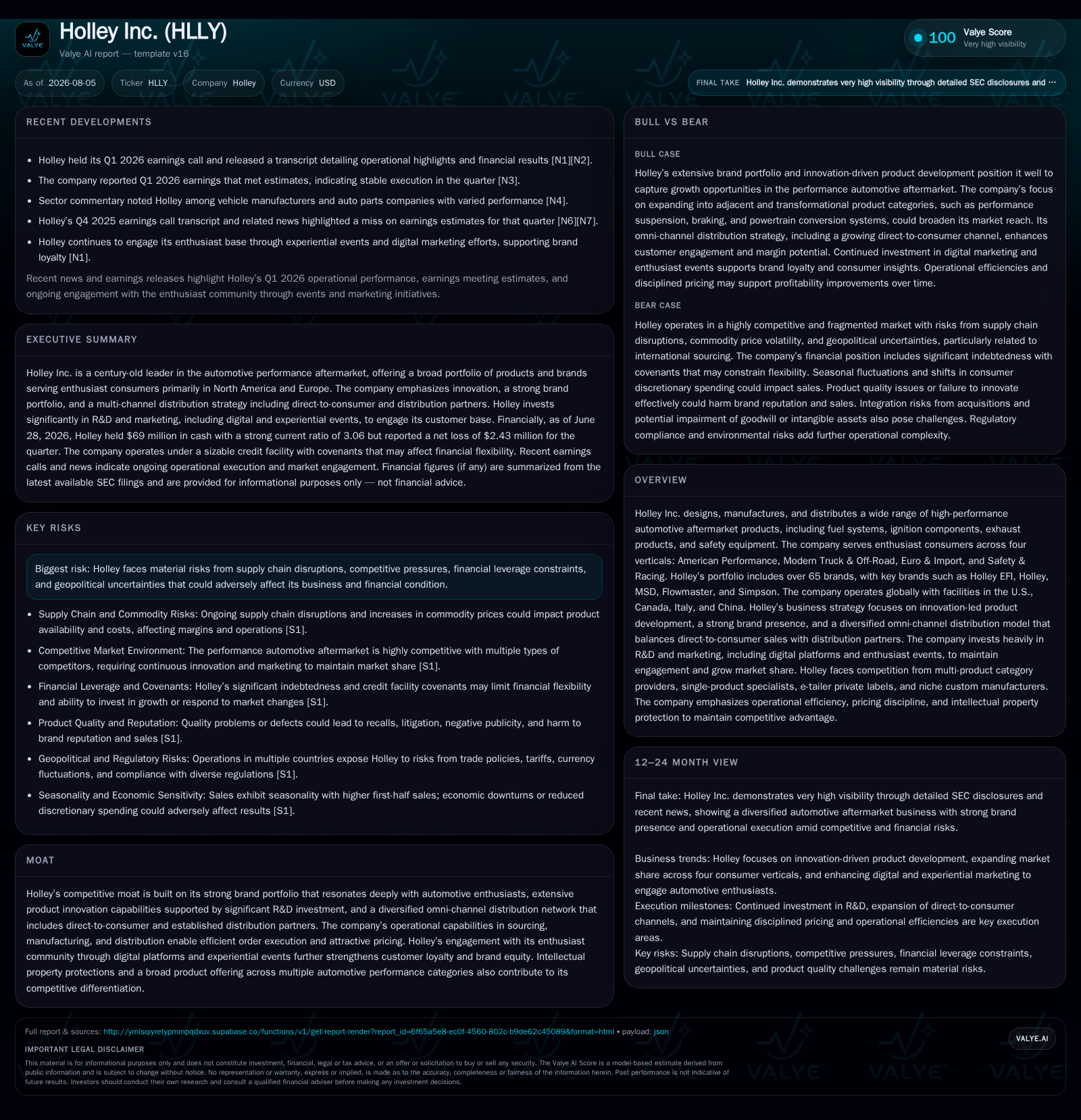
In its latest quarterly filing, Holley Inc. reported Q2 2026 revenues and earnings exceeding estimates, driven by robust consumer enthusiasm in key performance automotive verticals and a balanced omni-channel sales approach. The company’s broad brand portfolio, including legacy names like MSD and Flowmaster, underpins strong market positioning in the highly fragmented automotive aftermarket performance parts industry. While global economic headwinds and supply chain variables persist, Holley’s flexible sourcing model and emphasis on innovation sustain competitive differentiation. Upcoming milestones include product launches and channel expansion initiatives, with operating margin trends and inventory management as critical indicators of resilience.
Recent Operating Update
Holley Inc.'s results for Q2 ended June 28, 2026, announced alongside its latest 10-Q filing and an August 5 event update, illustrate continued momentum in its automotive performance aftermarket business. Revenues exceeded analyst expectations as the company benefited from sustained enthusiasm across its key verticals: American Performance, Modern Truck & Off-Road, Euro & Import, and Safety & Racing [S2], [N1]. This strength reflects not only broad-based demand but also Holley’s multi-brand portfolio leveraging iconic names such as Holley EFI, MSD ignition components, Flowmaster exhaust systems, and Simpson racing safety products [S1].
Operationally, Holley emphasized in MD&A commentary that investments in product development and marketing have bolstered engagement with enthusiast consumers globally. The company points to high new product introduction rates driven by innovation-led R&D as a foundation for future growth. Concurrently, it reiterates efforts to optimize its omni-channel distribution model—balancing direct-to-consumer (DTC) e-commerce with traditional channels like e-tailers and warehouse distributors—which accounted for over half of sales through partners in 2025 [S1]. These combined factors contributed to an improved top-line trajectory despite ongoing macroeconomic uncertainty.
Business Model
Holley's revenue generation hinges primarily on designing, manufacturing, and distributing specialized aftermarket automotive parts aimed at performance upgrades. Its products range widely—from fuel injection systems enhancing engine output to ignition components improving reliability—and extend to exhaust systems that boost both aesthetics and performance. The company services a passionate enthusiast market where brand heritage matters significantly. Holley's extensive brand portfolio of more than 65 names allows tailored access to diverse segments: vintage muscle cars (American Performance), modern trucks/off-road vehicles (Modern Truck & Off-Road), European imports (Euro & Import), plus safety equipment targeting recreational motorsports participants.
Revenue mechanics depend heavily on selling finished goods through distribution partners who then reach end consumers through various retail or installer channels. Approximately half of Holley's sales flow via such third parties—with e-tailers and warehouse distributors constituting a majority—while direct-to-consumer platforms provide higher-margin sales but require active consumer engagement programs including digital marketing and branded events [S1], [N1]. Price realization is influenced both by product innovation cycles introducing premium features or proprietary technologies protected under intellectual property rights as well as by competitive discounting pressures common in this fragmented industry.
Industry Structure and Competitive Position
The automotive aftermarket performance parts industry is inherently fragmented due to numerous niche players specializing in various part categories or vehicle platforms. Holley distinguishes itself through scale—the breadth of its brand portfolio—and operational capabilities that span global sourcing flexibility alongside some in-house manufacturing facilities located in the U.S., Canada, Italy, and China [S1].
Competitively, Holley compares favorably against peers such as MSD (as a heritage ignition brand), Flowmaster (competitive in exhaust systems), or specialty parts manufacturers targeting similar customer bases. Its moat derives from deeply embedded brand loyalty within enthusiast communities plus sustained R&D efforts fostering continuous product innovation. Moreover, Holley's combination of omni-channel reach—including direct online sales complemented by expanded relations with established distribution partners—helps diversify revenue sources amidst shifting consumer purchasing habits.
Supply chain management remains crucial; global disruptions or tariff fluctuations directly impact raw material costs for steel or electronic components essential for many aftermarket products. Holley's sourcing strategy mitigates some risk by dynamically balancing international suppliers against internal production capabilities while optimizing for total landed cost versus quality standards [S1]
Growth Drivers
Key growth catalysts for Holley include the ongoing secular trend toward vehicle personalization coupled with increasing participation in motorsports or off-road recreational activities globally. These facilitate demand for higher-performance fuel systems, ignition upgrades, exhaust enhancements, and specialized safety equipment—a category Holley is actively expanding into alongside mobile electronics accessories tied to vehicle connectivity.
Further momentum arises from e-commerce expansion facilitating direct-to-consumer outreach supported by sophisticated digital marketing tools creating deeper brand engagement. New product introduction cadence is vital here; faster development cycles enable Holley to capitalize on shifting customer preferences before competitors can react. Additionally, strategic acquisitions allow the extension into adjacent markets consistent with core competencies.
Geographic expansion beyond North America into European markets benefits from tailored product lines under the Euro & Import verticals aligned with localized vehicle trends. Growth also aligns with increasing automotive aftermarket penetration in emerging markets where aspirational spending on performance parts is rising.
Risks and Watchpoints
Holley's business remains vulnerable to several intertwined risks. Chief among them are supply chain disruptions potentially escalating input costs or causing inventory shortages impacting order fulfillment lead times [S1]. Geopolitical uncertainties—including tariffs related to U.S.-China trade tensions—add cost unpredictability influencing gross margins.
Consumer discretionary spending patterns are acutely relevant given the recreational nature of many aftermarket purchases; economic slowdowns could reduce demand or shift sales toward lower-margin products forcing price concessions. Competitive intensity from both branded premium offerings and generic aftermarket alternatives imposes pressure on pricing power.
Intellectual property protections are important yet challenged amid multiple smaller players offering functionally equivalent products potentially diluting brand equity if counterfeiting or patent disputes arise.
Operating KPIs warrant monitoring: shifts in distribution channel mix between DTC versus wholesale affect margins; inventory turnover rates indicate supply chain efficiency; new product launch velocity gauges innovation pipeline health; gross margin percentages reflect pricing effectiveness amid cost changes.
What to Watch Next
Key milestones include forthcoming new product introductions across catalyst markets like truck/off-road enhancements or mobile automotive electronics expansions as signaled in recent disclosures [S2], [N1]. Progression toward improved omni-channel balance will be tracked via quarterly channel mix disclosures that reveal consumer purchasing preference evolution.
Similarly, gross margin trends offer insight into pricing power sustainability given input cost dynamics.
Engagement metrics stemming from digital platform initiatives or enthusiast event attendance may foreshadow long-term customer loyalty gains vital for repeat revenue streams.
Financial Profile Discussion
At June 30, 2026 quarter-end, Holley held $69 million in cash and equivalents against current liabilities near $108 million yielding a robust current ratio above 3x that indicates solid short-term liquidity capacity [F1]
In summary, Holley's financial footing currently supports strategic investments while necessitating vigilant cost control amid macroeconomic uncertainties influencing aftermarket demand elasticity.
Disclaimer: This is research-only, informational analysis and not investment advice. It may include AI-generated interpretation and general industry context. Always verify important details using primary sources.

Comments