
Ponce Financial Group Confronts Rent Regulation Pressures and Capital Dynamics in Q2
Q2 results reveal operational stability but underline persistent challenges from New York rent control laws and capital adequacy constraints limiting growth.
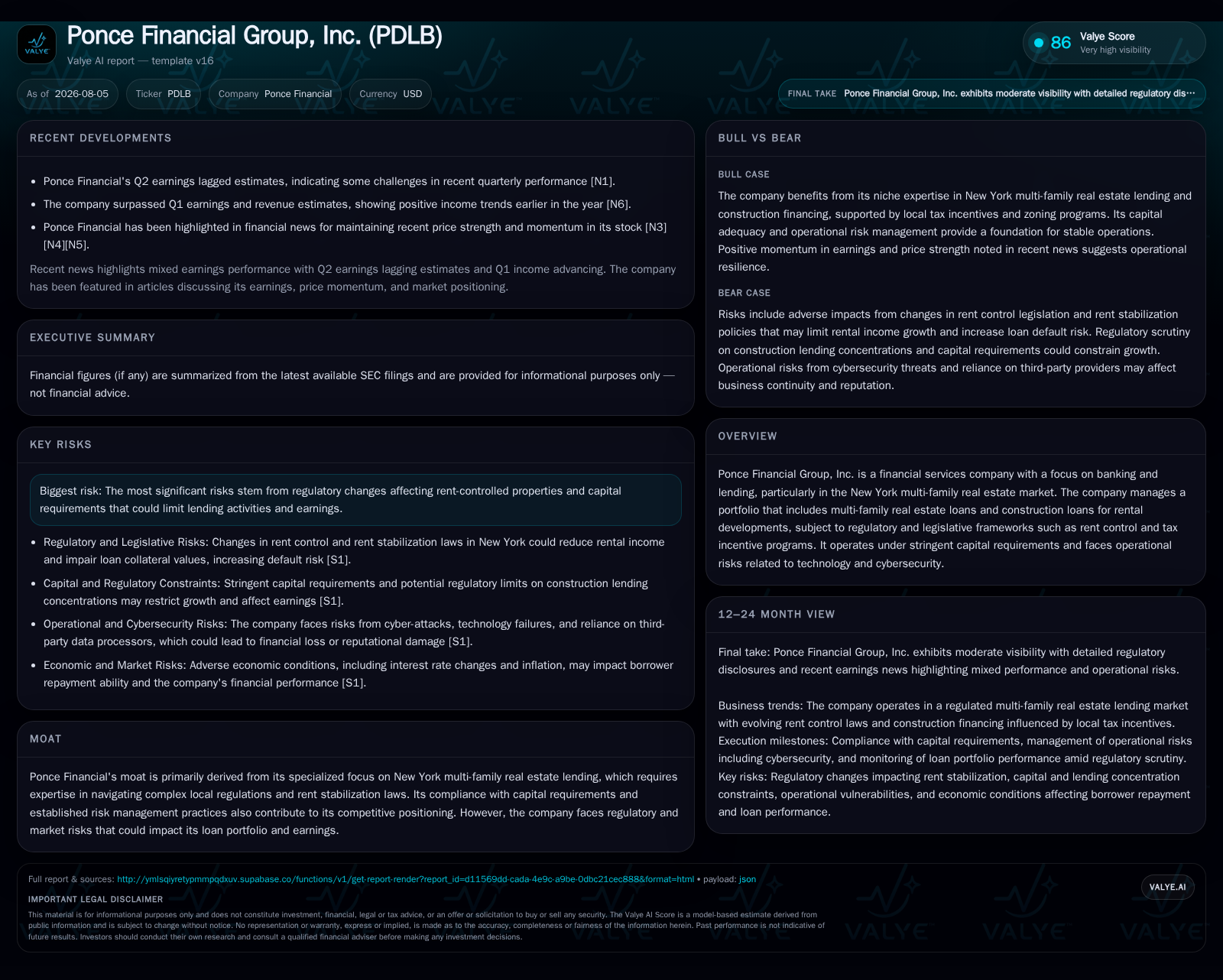
Ponce Financial Group's Q2 2026 filings confirm no material changes in risk factors, yet earnings lag market estimates amid ongoing headwinds from strict rent regulation and regulatory capital requirements. The company's specialized lending focus on New York multi-family real estate continues to expose it to credit risks driven by rent stabilization laws, which suppress rental income growth and increase default probability. Capital adequacy norms under Basel III further restrict lending expansion and dividend capacity, constraining near-term growth despite stable underlying loan portfolio quality. Monitoring capital buffers, loan performance, and deposit stability remains critical for assessing the firm's operational resilience.
Q2 Revenue and Risk Snapshot Confirming Persistent Regulatory Headwinds
Ponce Financial Group's most recent quarterly filing for Q2 ended June 30, 2026, reveals continued pressures weighing on financial performance even as risk disclosures remain stable. Specifically, the company confirmed there were no material changes in its risk factors compared to prior filings [S2], reinforcing an ongoing environment fraught with challenges rather than new episode-driven risks. Market reports highlight that Ponce’s Q2 earnings trailed analyst estimates despite steady operations, emphasizing the constraining impact of persistent regulatory headwinds in the New York multi-family real estate lending sector where it specializes [N1]. This combination of unchanged risk profile but earnings underperformance frames a business environment where external factors—chiefly regulatory and capital constraints—manifest in muted financial outcomes.
Specialized Multi-Family Lending Model Under Rent Control Constraints
Ponce Financial's core business revolves around generating interest income primarily through multi-family real estate loans concentrated in New York City. This specialization inherently involves navigating complex local housing regulations such as rent control and rent stabilization laws that directly affect borrower cash flow sustainability and collateral valuations [S1]. The company’s annual disclosures emphasize that legislative measures enacted since 2019 have severely curtailed permissible rent increases—for example, repealing vacancy bonuses and eliminating high-rent deregulation—thereby repressing potential rental income growth on many properties securing their loans. Additionally, NYC’s Rent Guidelines Board has set rent increase caps as low as 3% for leases commencing between October 2025–October 2026, with discussions underway about imposing a potential rent freeze thereafter [S1].
Industry Peer Perspectives: Regional Banks Navigating NYC Real Estate Markets
Within the broader industry context of regional banks specializing in urban multi-family real estate loans, Ponce shares characteristics with peers such as Signature Bank and New York Community Bancorp. These institutions contend with identical challenges stemming from localized rent regulations impacting credit risk assessments and loan underwriting practices. Additionally, Basel III capital rules uniformly govern this peer set’s lending capacity by mandating strict minimum Tier 1 capital ratios alongside conservatively calibrated buffers designed to absorb losses during stressed scenarios.
Industry participants invest heavily in portfolio diversification strategies while rigorously monitoring non-performing loans given the vulnerabilities introduced by rent-controlled collateral. Competition from larger banks and alternative lenders adds pressure on pricing power but also incentivizes niche specialization around regulatory expertise. Hence, Ponce’s competitive position is shaped by its operational focus within this informed local knowledge niche yet simultaneously constrained by macroprudential regulation regimes affecting all similarly placed banks.
Growth Drivers from Urban Housing Demand Offsetting Regulatory Pressure Points
Despite the significant challenges posed by regulation and capital rules, avenues for growth exist rooted primarily in demographic trends favoring increased urban multi-family housing demand. New York's dense population centers sustain ongoing need for rental accommodations which theoretically supports steady loan demand for property acquisitions or refinancing. Furthermore, ongoing favorable tax incentives or zoning amendments linked to initiatives like "Yes for Housing Opportunity" encourage affordable housing development that could gradually lift construction lending volumes subject to compliance with affordability standards [S1].
Interest rate environments also influence Ponce’s net interest margin (NIM), especially given adjustable-rate loan exposures typical in construction finance portfolios; upward rate moves theoretically improve yield spreads though borrower repayment capacity must be weighed carefully under regulatory stress tests.
However, these growth drivers are tempered by the limitations sales forced through regulatory compliance costs, capped rent increases slowing asset cash flows, and stringent capital consumption reducing deployable capital for new originations.
Risks Intensified by Legislation, Capital Limits, and Economic Cycles
Risks confronting Ponce Financial are layered: at the forefront are legislative efforts that amplify rent restrictions potentially reducing borrower revenues beyond currently modeled scenarios. Such tight regulation undermines collateral valuations thereby increasing non-performing loan incidence risk particularly if economic cycles worsen or inflationary pressures heighten operating expenses beyond tenant payment capacity.
On top of credit risks are imposed capital requirements under Basel III implemented via Federal Reserve oversight that demand minimum common equity Tier 1 ratios (at least 7% including conservation buffers) effectively limiting leverage used on new loans. Falling below these thresholds triggers restrictions on dividends or share repurchases diminishing shareholder returns while forcing cautious balance sheet management [S14], [S16].
Economic volatility compounds these risks; downturns reduce tenant pool affordability potentially increasing delinquencies while deposit outflows triggered by market jitters pressure liquidity needing expensive wholesale funding alternatives or asset sales at disadvantageous prices.
Key Milestones to Monitor: Capital Buffers, Loan Portfolio Quality, Deposit Stability
Investors should closely track upcoming disclosure milestones revealing whether Ponce maintains adequate capital conservation buffers enabling dividends or expansions without triggering regulatory sanctions. Equally critical are surveillance metrics on non-performing loan ratios reflecting stress absorption within the portfolio especially given its exposure to rent-regulated properties vulnerable under an adverse legislative shift.
Deposit base fluctuations warrant monitoring as well given prior banking sector events have shown propensity for rapid withdrawals sometimes forcing costly alternate funding measures dampening net interest margins. Observing cost of funds amidst competitive regional banking landscape also signals shifting profitability dynamics.
Collectively these parameters form practical markers confirming either operational resilience or emerging vulnerabilities within the firm’s specialized lending model.
Financial Profile Discussion: Liquidity, Leverage, and Capital Adequacy Status
Ponce Financial held roughly $140 million in cash and cash equivalents against approximately $621 million total debt as of June 30, 2026 per company facts data [F1]. This results in estimated net debt near $481 million indicating a leveraged balance sheet characteristic of a regional bank engaged heavily in commercial real estate lending requiring active liquidity management to meet customer withdrawal demands and loan commitments.
The firm reportedly complies with all minimum Tier 1 capital requirements including the mandated conservation buffer level under Basel III standards which is imperative for avoiding dividend limitations or compelled equity raises that could dilute existing shareholders or strain financing flexibility [S16]. Nonetheless, elevated leverage combined with sector-wide deposit volatility underscores a need for vigilant liquidity oversight.
Overall capitalization appears consistent with current regulatory expectations but leaves limited margin for error if economic conditions deteriorate markedly or regulatory demands intensify further.
This analysis synthesizes disclosures from Ponce Financial’s latest SEC filings with validated industry context reflecting local real estate market intricacies coupled with Basel III regulatory frameworks shaping bank operating models within NYC's multi-family housing finance segment. It emphasizes how persistent legislative constraints on rental income growth intersect with stringent capital requirements to define Ponce’s current operating environment while outlining essential KPIs necessary to monitor moving forward. All company-specific data is drawn directly from recent filings; no speculative forward-looking claims are made.
Disclaimer: This is research-only, informational analysis and not investment advice. It may include AI-generated interpretation and general industry context. Always verify important details using primary sources.

Comments