
Kaltura Expands AI-Driven Digital Experience Platform Amid Liquidity Challenges
Kaltura advances its unified video and rich media SaaS platform with agentic AI capabilities while navigating financial constraints and competitive pressures.
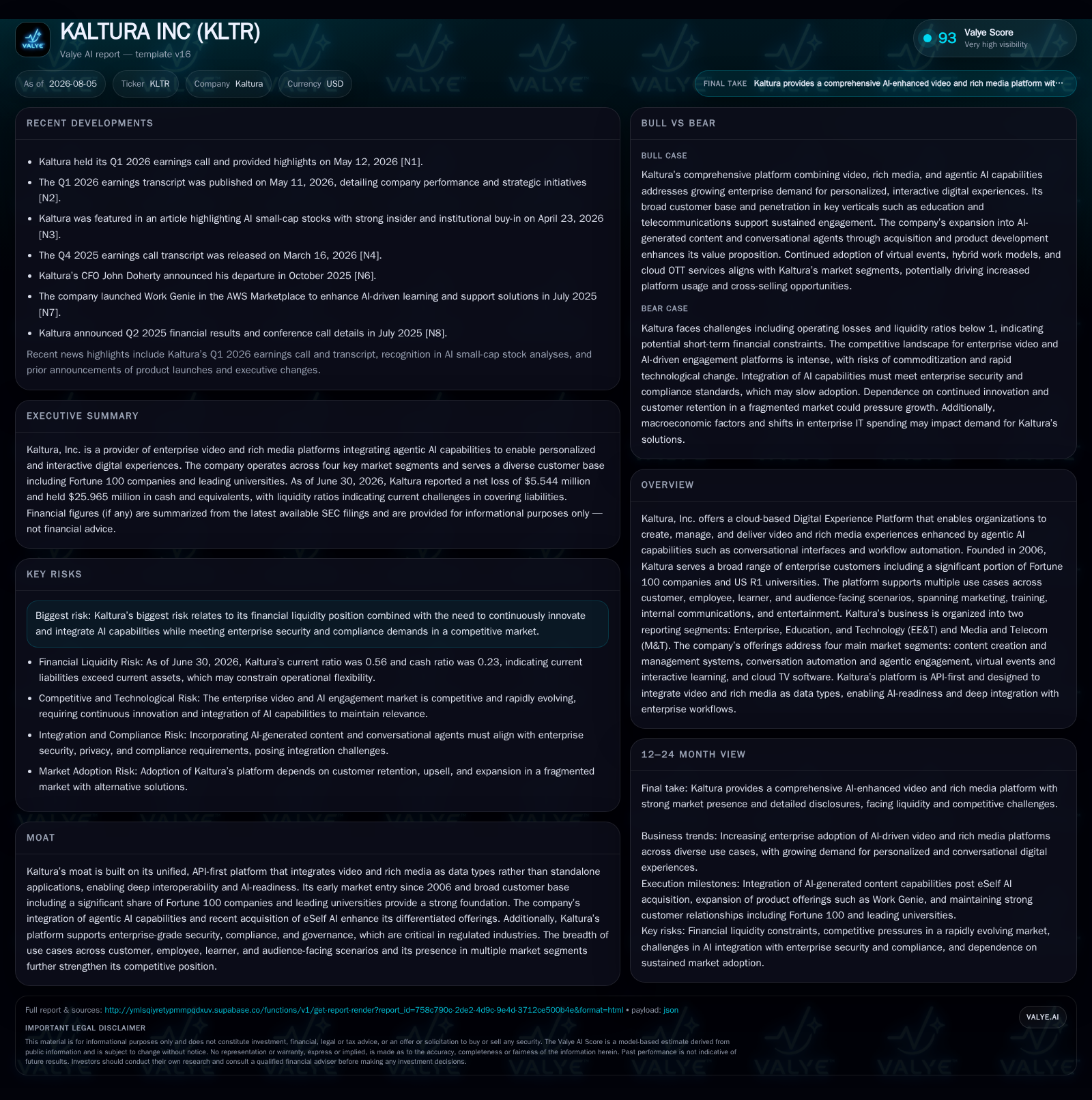
Kaltura Inc. continues to evolve its cloud-based Digital Experience Platform, integrating AI-powered conversational interfaces and workflow automation designed for enterprise video and rich media delivery. The company’s broad customer base, including Fortune 100 firms and major universities, supports diverse use cases across enterprise, education, media, and telecom markets. However, recent quarterly disclosures highlight ongoing challenges around liquidity, with a current ratio of 0.56 and net debt close to zero, underscoring the need to balance innovation investments against financial discipline. Growth drivers include expanding AI features and virtual event offerings, but risks remain from macroeconomic volatility, competitive pricing pressure, and evolving AI regulatory frameworks.
Recent Operating Update
In its Q2 2026 filing dated August 5, Kaltura reaffirmed its strategic push towards embedding agentic artificial intelligence into its Digital Experience Platform. The recent acquisition of eSelf AI bolsters Kaltura's capabilities in AI-generated video content and avatar-based interactions that facilitate real-time conversational experiences across multiple digital channels [S1][S3][S26]. This move marks a key inflection point where traditional video SaaS platforms are transforming into interactive digital experience ecosystems.
However, from a financial standpoint, the company faces liquidity constraints. As of June 30, 2026, Kaltura held $25.97 million in cash against $26.69 million in total debt with current assets at $75.35 million significantly lagging current liabilities totaling $134.49 million—resulting in a current ratio of roughly 0.56 [F1]. Such a tight short-term liquidity profile suggests that working capital management will be critical to sustaining operational agility during ongoing R&D investments.
Business Model Analysis
Kaltura operates as a subscription-based SaaS provider delivering integrated video and rich-media content solutions through a cloud-hosted platform structured around three layers: content creation, content management, and experience delivery [S1]. The platform supports multi-modal media types—video streaming intertwined with interactive data-driven elements—and now incorporates agentic AI features such as workflow automation and conversational agents.
The company's monetization primarily hinges on recurring subscription revenue derived from long-term enterprise contracts that serve customers spanning Fortune 100 corporations to leading US research universities [S9]. Enterprise contracts often involve complex deployments addressing multiple organizational functions like marketing campaigns, employee training programs, internal communications, and virtual events management
Revenue is reported via two segments: Enterprise, Education & Technology (EE&T), which contributed approximately 74% of total revenue for the year ended December 31, 2025; and Media & Telecom (M&T), comprising the remainder with products like cloud-based TV services [S16]. The EE&T segment illustrates diversification across institutional verticals beyond the core enterprise offering.
Sales cycles tend to be protracted due to technical integration complexity—especially regarding security compliance—that is vital for regulated industries where governance is paramount [S1][S9]. Kaltura supplements direct enterprise sales with emerging product-led growth (PLG) and developer-led growth (DLG) motions targeting departmental or smaller-scale deployments through self-service tools augmented by APIs and SDKs aimed at embedding its capabilities within third-party applications over time [S15].
Industry Structure and Competitive Position
Within the enterprise video and rich media SaaS landscape—populated by peers like Brightcove, Vimeo, Zoom Video Communications—the shift towards unified platforms merging video streaming with agentic AI tools distinguishes Kaltura’s strategic positioning. Its early market entry in 2006 establishes first-mover advantages such as deep interoperability driven by an API-first architecture enabling seamless integration across enterprise ecosystems.
Kaltura's moat resides in this architectural approach combined with its comprehensive security certifications satisfying stringent regulatory mandates—a non-trivial friction point given demand from healthcare, finance, education sectors where data compliance is critical [S1][S20]. The recently acquired eSelf AI technology expands Kaltura’s addressable use cases into conversational avatars that supply contextual information dynamically during user interactions—an innovation area less penetrated by generalist competitors.
Nonetheless, competitive pressures persist especially as rivals aggressively pursue feature parity in virtual events and rich media engagement tools amid intense pricing negotiations triggered by buyer caution in uncertain economic conditions [S1]. Demonstrating durable net revenue retention rates or growing average contract values amid lengthening sales cycles will be key indicators validating competitive differentiation going forward.
Growth Drivers
Artificial intelligence integration represents the principal catalyst driving demand expansion for Kaltura's offerings. Deploying agentic conversation automation leverages generative AI advances to deliver personalized media experiences at scale—rising prominently within customer engagement programs as well as internal communications [S1][S26].
The pandemic-induced surge in virtual events has normalized hybrid interaction formats that Kaltura targets via its virtual event modules enabling interactive webinars enriched by real-time analytics. Continued hybrid workplace adoption among enterprises fuels volume growth for these units.
Another growth lever derives from cross-selling within existing large accounts—from initial narrow use cases like learning management systems branching into broader marketing or employee engagement solutions—facilitated by their unified platform capable of supporting multiple workflows simultaneously [S15].
Product-led strategies enabling smaller teams or SMBs to adopt modular components without full-scale integrations present incremental runway opportunities expanding the customer base while shortening acquisition cycles compared to complex enterprise deals.
Risks and Constraints
The foremost risk centers on liquidity dynamics highlighted in Q2 disclosures. With a current ratio under one (0.56) coupled with high current liabilities outpacing assets substantially [F1], Kaltura must carefully balance innovation spending with operational cash flow generation to avoid covenant breaches under its secured credit facilities [S4][S6][S19].
Externally, macroeconomic volatility—including inflationary pressures and geopolitical uncertainties—can lengthen sales cycles as IT budgets contract or reprioritize spending away from discretionary projects such as new SaaS subscriptions [S1]. Compounding this are escalating compliance requirements around the deployment of AI technologies exemplified by EU AI Act regulations introducing transparency and liability obligations that may increase compliance overheads materially or restrict feature rollouts pending certification regimes [S20].
Competition remains acute with incumbent video providers expanding into AI functionalities rapidly; failure to continue innovating could impair client retention in global markets increasingly demanding next-generation interactive media experiences.
Lastly, integration risks from acquisitions like eSelf AI exist given cultural alignment needs and potential delays realizing synergy benefits which could temporarily affect profitability metrics.
What To Watch Next
Key upcoming milestones include monitoring quarterly ARR growth figures alongside net revenue retention rates to assess whether cross-sell efforts within broad client portfolios are effective post-2025 reorganization initiatives [S16][S24]. Observing product adoption rates for newly introduced AI-powered conversational agents will signal market receptivity to agentic digital experiences.
From a financial perspective, focus areas should include updates on liquidity management strategies addressing low working capital ratios observed mid-2026 plus any amendments related to debt covenants or refinancing activities required as the term loan amortizes nearing end-2026 maturity dates [F1][S7]
Evolving regulatory guidance around AI deployment may also dictate changes to product roadmaps; tracking industry-wide compliance benchmarks will provide insight into operational risks.
Financial Profile Discussion
As of June 30, 2026, Kaltura's balance sheet reflects $25.97 million in cash and equivalents offset against $26.69 million in total debt resulting in near-neutral net debt positioning but accompanied by notably imbalanced short-term assets ($75.35 million) versus liabilities ($134.49 million), yielding a challenging current ratio of approximately 0.56 [F1]. This suggests working capital deficits requiring financing through operating cash flows or access to revolving credit facilities capped at $25 million available borrowing capacity per earlier amendments [S5][S12].
Operating losses compressed significantly in fiscal year 2025 compared to prior years—net loss reduced from $31.3 million in 2024 to $12.07 million in 2025—reflecting cost discipline including lower R&D expenses following peak investments associated with stock compensation expenses being fully expensed prior periods while incurring modest restructuring costs around workforce optimization plans implemented late 2025 [F1][S16][S24]
Given ongoing investment demands in AI enhancements alongside competitive pressures mandating robust platform development pipelines, maintaining adequate liquidity buffers while improving operational efficiencies will remain imperative for sustainable growth execution.
This analysis reflects information available as of August 5, 2026 based on public filings without extrapolation beyond verified data points provided directly by Kaltura Inc.'s SEC reports.
Disclaimer: This is research-only, informational analysis and not investment advice. It may include AI-generated interpretation and general industry context. Always verify important details using primary sources.

Comments