
Plumas Bancorp Upscale: Acquisition Growth and Lending Dynamics Reshape Local Banking
Recent quarterly disclosures reveal key loan composition shifts and credit loss methodology refinements underpinning Plumas Bancorp's regional expansion and earnings stability.
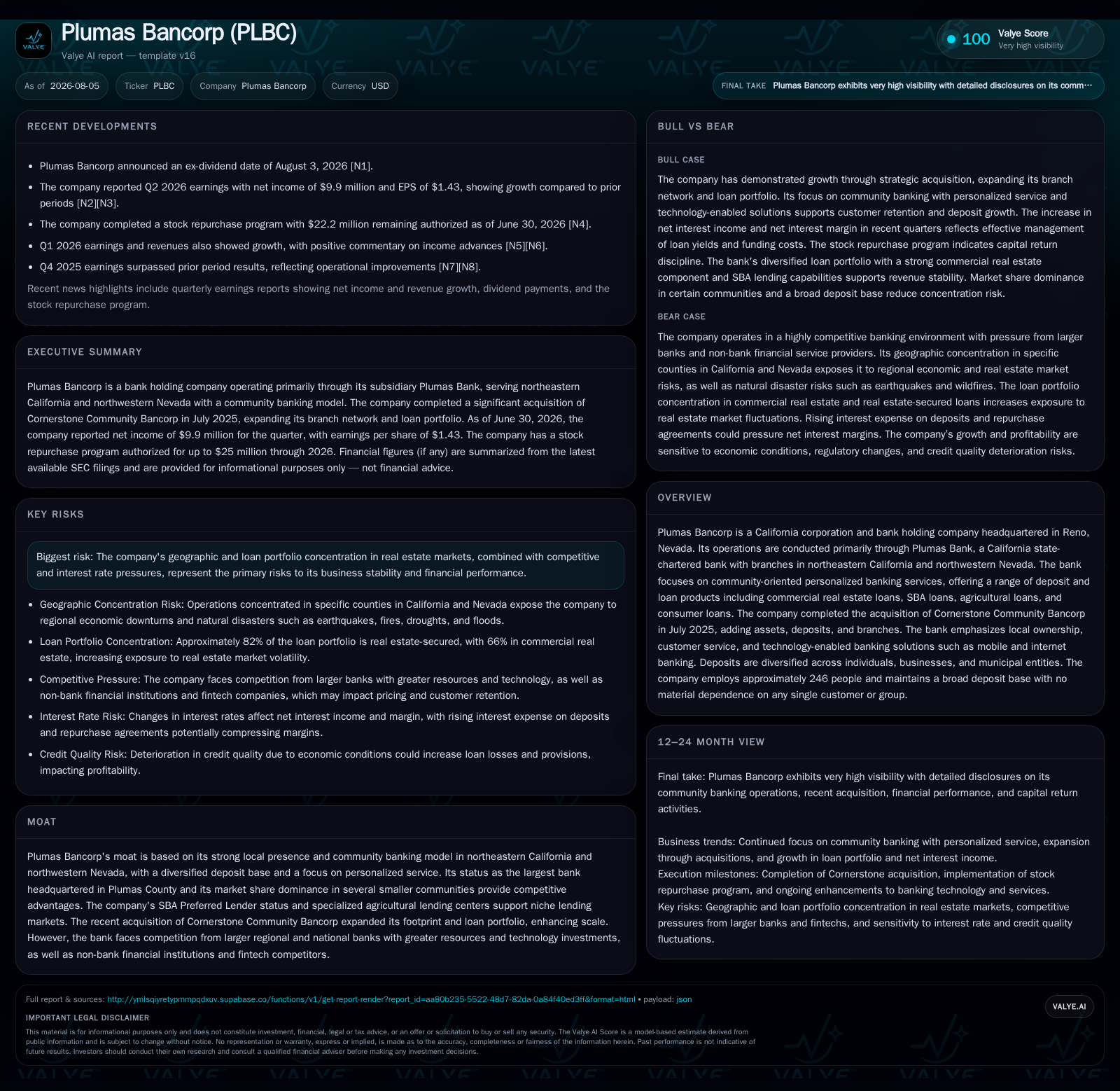
Plumas Bancorp’s Q2 2026 results highlight a strategic recalibration of its loan portfolio following the 2025 Cornerstone Community Bancorp acquisition, with growth in commercial real estate and construction loans offsetting declines in agricultural and automobile loans. Concurrently, management’s extension of the reasonable forecast period within its allowance for credit losses model from four to eight quarters signals a more forward-looking risk assessment. Supported by a diversified deposit base and prudent liquidity management, the bank continues emphasizing personalized community banking while cautiously navigating geographic concentration risks in northeastern California and northwestern Nevada. Dividend increases and active share repurchases reflect confidence in earnings durability amid competitive pressures from larger regional peers and fintech entrants.
Evolving Loan Mix Fuels Adjusted Earnings Stream Post-Acquisition
Such shifts align with broader community bank strategies focused on intensifying relationships with local businesses leveraging SBA loan programs as part of a diverse lending mix. Plumas Bancorp’s emphasis on locally rooted commercial clients underscores the bank's efforts to deepen footholds in its northeastern California and northwestern Nevada territories post-Cornerstone acquisition [S1]. Structurally, these portfolio dynamics may enhance risk-adjusted returns over time but necessitate vigilant monitoring given CRE sector sensitivities during economic slowdowns.
Refined Credit Loss Modeling: A Forward-Looking Provision Framework
During Q2 2026, the company refined its CECL methodology for estimating allowance for credit losses by extending the reasonable and supportable forecast period from four to eight quarters. This change incorporates a longer horizon of economic inputs into expected loss calculations, underscoring management's cautious stance amid evolving macroeconomic uncertainty [S2]. The adjustment suggests an intent to capture potential delayed credit deterioration ahead of contemporaneous financial reporting rounds rather than relying solely on near-term indicators.
From an analytical standpoint, this proactive allowance modeling could lead to smoother provision expense recognition patterns over multiple future quarters if economic forecasts remain stable or improve. However, it also exposes the company to higher volatility should projections worsen.
Deposit Strategy Supports Sustainable Funding Amid Competitive Pressures
The company holds solid cash reserves ($135.5 million at June 30, 2026) alongside unpledged U.S Government-sponsored agency securities classified as available-for-sale that provide liquid buffers especially during fluctuations in loan demand [F1][S2]. Borrowing facilities including Federal Home Loan Bank advances further complement liquidity sources.
Competitive pricing is utilized strategically on deposit products to attract diverse customers spanning individuals, businesses, and municipal entities—a diversification essential for mitigating deposit beta risk especially under rising interest rate environments where flight towards higher yielding instruments or institutions is common [S1][S2]. Maintaining this balance is critical because deposit attrition can generate costly funding gaps or force reliance on higher-cost money market funding. The firm’s ability to manage effective deposit costs within peer norms will be vital to sustaining NIM.
Expansion Through Acquisition: Cornerstone’s Role in Scale and Market Reach
The July 2025 acquisition of Cornerstone Community Bancorp significantly enhanced Plumas Bancorp's asset base by approximately $658 million with $478 million attributable to gross loans along with new branches added to their network [S1]. This acquisition not only increased scale but also broadened market presence across select communities reinforcing Plumas' standing as the largest bank headquartered in Plumas County.
While mergers often create opportunities for operational efficiencies through overlapping cost rationalization or shared technology platforms—thus improving efficiency ratios—the incremental integration complexity can temporarily weigh on metrics relating to expense control or asset quality vigilance. As such, the full realization of synergy potentials will depend on effective consolidation execution combined with maintaining organic growth momentum via core community banking strengths.
Navigating Competition: Community Banking Model Amid Larger Peer Benchmarks
Plumas Bancorp operates amid formidable competition from larger regional banks like Western Alliance Bancorporation or Banner Corporation as well as national institutions that benefit from deeper technology investments enabling advanced digital engagement capabilities. Compared with these peers bearing larger economies of scale, Plumas prioritizes localized service differentiation through relationship banking which supports customer loyalty but may entail higher relative operating costs per dollar of revenue generated.
Capital cushions appear adequate under recently modified regulatory guidance permitting community banks under $10 billion assets to use an adjusted leverage ratio framework lowering minimum Tier 1 capital requirements from 9% to 8%, affording some capital relief conducive for measured growth initiatives [S2]. Sustained efficiency gains are likely contingent upon further technology adoption without compromising personalized service—a delicate balance many community banks face.
Growth Engines: SBA Lending, Agricultural Focus & Digital Adoption Trends
A notable competitive advantage for Plumas arises from its SBA Preferred Lender status which facilitates expedited processing for small business government-backed loans—a niche segment often underserved by larger banks due to scale mismatches or risk appetite constraints [S1]. Coupled with dedicated agricultural lending centers focusing on rural economies within their geographic footprint, these specialized product lines underpin sustained loan demand insulated partly from general commercial market cycles.
The company’s deployment of mobile and internet banking platforms enhances customer convenience thereby reinforcing deposit stickiness—a critical factor when competing against fintech entrants offering alternative digital-first experiences [S1]. While exact platform capabilities remain undisclosed, managing seamless omnichannel access aligns with modern community bank standards necessary for retention across demographic cohorts.
Risks & Constraints: Geographic Concentration and Real Estate Exposure Vigilance
Despite operational strengths, geographic concentration remains an inherent vulnerability given a primary footprint focused on northeastern California and northwestern Nevada counties [S1]. Economic fluctuations localized within these areas could disproportionately affect loan performance especially within commercial real estate sectors where elevated balances heighten sensitivity during downturns.
Credit concentration risks spotlight the need for rigorous underwriting standards alongside dynamic portfolio stress-testing mechanisms particularly considering exposure shifts toward CRE in recent quarters [S2]. Regulatory compliance stress tests coupled with internal allowances must adapt promptly if emerging trends indicate weakening repayment capacity or collateral valuation deterioration affecting non-performing asset ratios.
"Shareholder Returns" Reinforced: Dividend Policy and Share Repurchase Updates
Reflecting confidence derived from steady earnings progression post-acquisition integration, Plumas Bancorp’s Board declared an increased quarterly dividend of $0.33 per share payable August 17, 2026—an uptick from previous levels indicative of underlying cash flow strength supportive of shareholder returns [S3]. Dividends remain subject to regulatory restrictions mandating sufficient retained earnings alongside capital adequacy assessments.
Complementing dividend payouts is an active share repurchase program authorized at up to $25 million through end-2026—with approximately $22.2 million remaining capacity after purchasing 15 thousand shares totaling around $756 thousand during Q2 funded exclusively via cash on hand—demonstrating balanced capital allocation aimed at enhancing per-share metrics without jeopardizing excess capital buffers [S2]
Near-Term Indicators to Monitor For Earnings Sustainability
Key performance indicators warrant monitoring include:
- Net Interest Margin (NIM): Stability amid shifting portfolio mix toward higher-yielding CRE/construction loans versus lower-yield agricultural segments will critically influence core profitability margins.
- Allowance for Credit Losses: Future provisions post CECL model refinements will validate whether extended forecast horizons adequately capture evolving credit risk or precipitate periodic volatility.
- Deposit Composition & Growth: Success retaining deposits amid competitive rate environments affects funding cost trajectories directly impacting net interest income.
- Integration Efficiency: Operating expense trends following Cornerstone's absorption will reveal scale benefit realization pacing relative to prior targets.
- Non-Performing Asset Ratios: Monitoring for upticks in delinquencies especially related to CRE concentrations provides insight into emerging credit quality risks.
Together these markers form a composite view of earnings durability as Plumas Bancorp consolidates scale advantages while preserving high-service-level community anchoring within challenging macro-financial contexts.
Financial Profile Discussion
As of June 30, 2026, Plumas Bancorp held cash and equivalents totaling approximately $135.5 million providing comfortable liquidity buffers amidst moderate loan book fluctuations consistent with prior periods [F1][S2]. Capital ratios meet regulatory thresholds adjusted recently downward for qualifying community institutions allowing some flexibility while maintaining safety margins above minimums mandated under Basel III frameworks [S2].
Net income reported at year-end 2025 was approximately $29.6 million illustrating profitability levels robust enough to support increasing dividends without excessive constraint on retained earnings or capital accretion needs [F1][S3]. The ongoing share repurchase program funded through excess cash underscores strategic capital discipline balancing shareholder yield enhancement against preservation of regulatory capital compliance parameters.
While efficiency ratios are not explicitly disclosed here due to report limitations, industry norms suggest continued emphasis on cost control post-acquisition combined with technology-enabled channel expansion will be necessary levers sustaining margins within competitive peer cohorts focused similarly on SBA niche lending and regional market footprints.
This analysis synthesizes publicly filed disclosures through August 2026 alongside sector knowledge pertinent to regional community banking dynamics without projecting forward-looking financial outcomes or investment advice.
Disclaimer: This is research-only, informational analysis and not investment advice. It may include AI-generated interpretation and general industry context. Always verify important details using primary sources.

Comments