
Elanco’s Strategic Balance of Portfolio Diversification and Regulatory Headwinds in Q2 2026
Elanco’s latest quarterly results confirm robust operational cash flow amid evolving antibiotic regulations and growing generic competition.
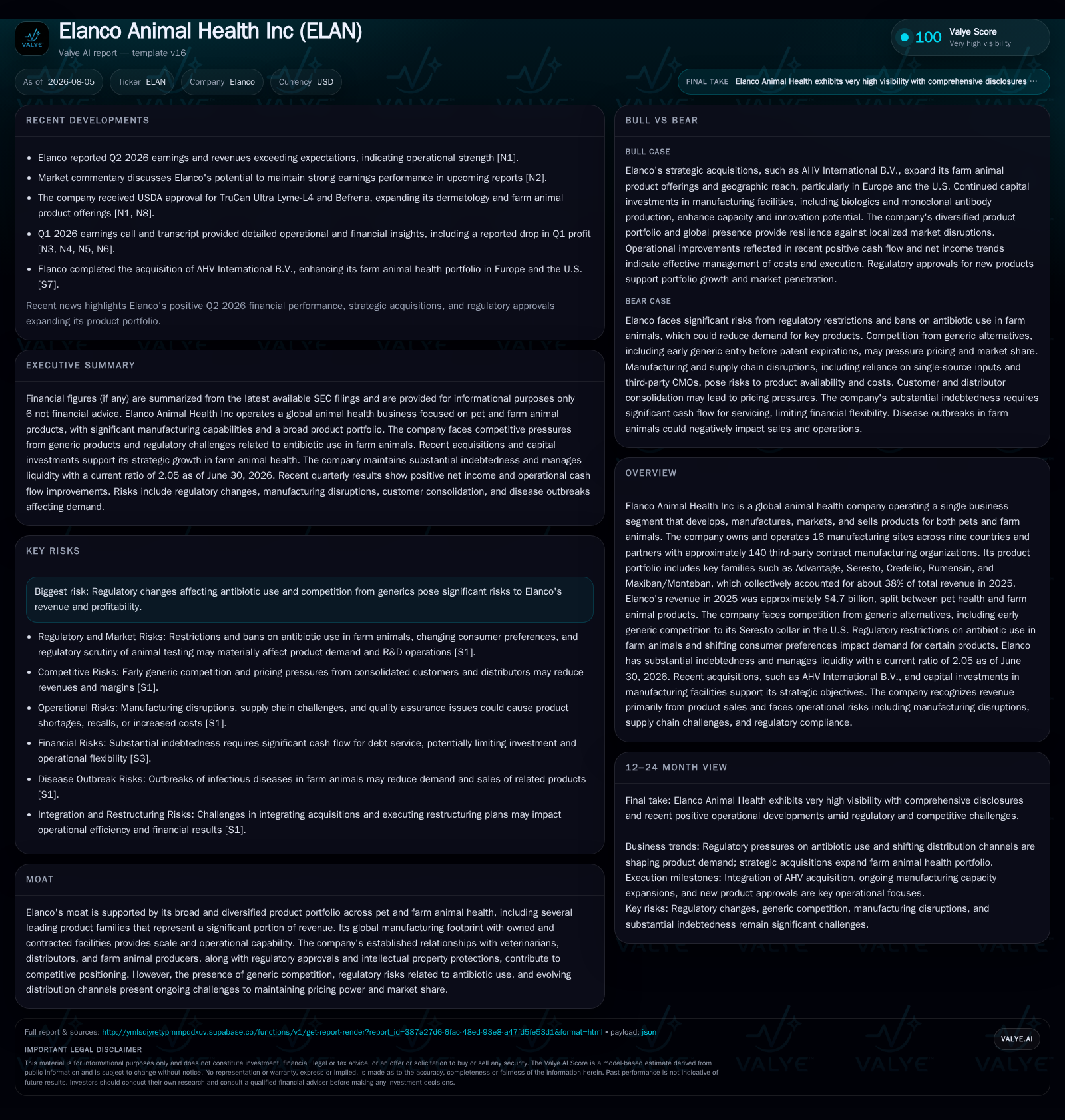
In Q2 2026, Elanco Animal Health demonstrated solid operating cash flow improvement and strategic investment in biologic manufacturing capacity. While facing intensified generic competition notably on branded products like Seresto, and regulatory challenges restricting antibiotic use in farm animals, Elanco’s diverse pet and farm animal product portfolio provides resilience. The company’s ongoing acquisition of AHV strengthens its foothold in antibiotic alternatives for livestock, though its substantial debt load and restructuring remain key financial watch points.
Recent Operating Update: Q2 2026 Highlights
Elanco Animal Health's second-quarter results highlighted a solid improvement in operating cash flow, which increased by $57 million to $290 million compared to the same period last year [S2][S21]. This growth was supported primarily by higher cash earnings even as changes in working capital partially offset gains. Investing activities reflected increased capital allocated toward manufacturing expansions, notably at their monoclonal antibody facility in Elwood, Kansas. This mirrors a strategic pivot toward innovative biologic therapies for animals alongside traditional pharmaceuticals [S1][S2]. Furthermore, the April 2026 acquisition of AHV International B.V., a Netherlands-based firm specializing in antibiotic-reducing solutions for farm animals, added $76 million to investing outflows, emphasizing Elanco's commitment to respond proactively to regulatory trends curtailing antibiotic use [S2][S26]. Financing activities included $89 million allocated toward early and scheduled repurchases of long-term debt, indicating active capital structure management amid high leverage levels [S2][S21].
The company reaffirmed guidance for continued margin improvement driven by restructuring plans initiated in late 2025, which involve workforce reductions totaling approximately 600 global roles, including closures of specific implant production sites such as Kansas City and partial exit from Monheim, Germany facilities [S11][S1]. These moves are expected to reduce fixed costs while enabling more focused investments in growth areas like biologics and companion animal products
Business Model Overview
Elanco operates as an integrated global animal health company focused on developing, manufacturing, marketing, and selling products for both companion animals (pets) and farm animals (livestock). Revenues derive from direct sales to veterinarians, distributors, farm producers, and retail outlets globally [S1][F1]. Its product portfolio is broadly diversified across parasiticides like Advantage and Seresto collars for pets, pharmaceutical antibiotics including ionophores used exclusively in animals (accounting for a significant portion of farm animal segment revenue), vaccines, nutritional supplements, and increasingly biologics such as monoclonal antibodies
The pet segment predominantly sells parasiticides (flea/tick prevention), pharmaceuticals for chronic conditions (like Credelio), and wellness products through veterinarians and retail chains. Revenue depends on volume growth via companion animal ownership trends, price realization against generics or alternative therapies, and veterinarian endorsement.
The farm animal segment faces more complex dynamics due to regulatory restrictions on medically important antibiotics—those shared between humans and animals—and market shifts toward antibiotic-free protein production. Elanco's revenues here hinge on ionophore sales (non-medically important antimicrobials not currently restricted in many markets), productivity enhancers like Rumensin/Maxiban feed additives, vaccination programs to reduce disease incidence without antibiotics, and emerging non-antibiotic alternatives addressing welfare concerns. Regulatory approvals and product pipeline developments are pivotal revenue drivers.
Manufacturing is mixed-model: owned sites provide scale control; third-party contract manufacturers (about 140 partners globally) supplement capacity but add complexity. The company invests heavily in proprietary manufacturing technologies to enhance efficiency while preparing capacity expansion for next-generation biologics—a trend that demands costly specialized facilities but promises higher margins owing to patent protections and reduced commoditization risk.
Elanco monetizes through upfront sales typically invoiced on delivered goods basis with some contractual arrangements granting rebates or volume discounts based on market share or channel penetration. Maintenance of strong veterinarian relationships remains critical given their gatekeeper role influencing adoption especially for prescription-only products.
Industry Structure and Competitive Position
The global animal health industry is characterized by a few large integrated players combined with numerous generic manufacturers specializing primarily in off-patent pharmaceuticals. Elanco competes alongside Zoetis—considered the industry leader—Boehringer Ingelheim Animal Health, Bayer Animal Health’s legacy assets absorbed into Elanco itself post-acquisition, Merial (under Boehringer Ingelheim), and specialist firms such as Virbac focusing mainly on companion animals.
Key competitive pressures derive from:
- Patent expirations resulting in rapid generic penetrations that force price erosion (e.g., Seresto collar facing early U.S. generic entrants).
- Increasing regulatory scrutiny limiting antibiotic-based productivity enhancers particularly in major markets like the EU following bans on preventive antibiotic feed additives implemented since 2022.
- Changing consumer preferences favoring organic or antibiotic-free meat production increasing demand for alternative farm animal health solutions.
- Necessity of continuous R&D investment to innovate new parasiticides or vaccines with novel mechanisms or superior safety profiles to maintain differentiation.
Elanco benefits from its diversified portfolio balance between companion animal products less sensitive to regulation-driven demand swings versus more fluctuating farm product lines constrained by political/regulatory delays. Its expansive global footprint enables access across emerging markets where rising veterinary infrastructure supports growth prospects beyond saturated developed countries.
Growth Drivers
Growth potential is anchored chiefly on:
- Rising global pet ownership trends fueling increased spending on prophylactic care (flea/tick control), chronic disease management medicines, boosted further by premiumization themes.
- Expansion into emerging markets where veterinary care coverage continues improving embedding newer product introductions.
- Innovation pipeline focusing on advanced biologics including monoclonal antibodies offering potentially better efficacy/safety profiles garnering premium pricing opportunities.
- Acquisition-led portfolio expansion exemplified by the AHV deal targeting cattle health with products decreasing reliance on antibiotics aligning directly with evolving regulatory expectations.
- Development of next-generation parasiticides or vaccines responding dynamically to resistance patterns or novel pathogens affecting both pets and farm animals.
- Capitalizing on increased awareness around animal welfare promoting preventive healthcare consumption rather than reactive treatment increasing lifetime customer engagement through veterinary channel loyalty programs.
Risks and Constraints
However, multiple risks could temper growth:
- Accelerated erosion from generics impacting established high-revenue franchises like Seresto requiring flexible pricing strategies that may compress margins.
- Regulatory shifts banning or restricting key antibiotic classes used for growth promotion or disease prevention diminish core revenue pools especially for farm animals.
- Integration challenges related to recent acquisitions while scaling innovation initiatives could divert management attention or inflate operating expenses beyond initial forecasts.
- Manufacturing supply chain disruptions caused by reliance on third-party CMOs increase vulnerability given limited substitutability plus stringent compliance regulations governing veterinary pharmaceutical production quality.
- Substantial indebtedness near $3.8 billion total debt minus $530 million cash equals roughly $3.26 billion net debt introduces liquidity constraints limiting available capital deployment options notwithstanding compliance with covenants under existing credit facilities expiring mostly between 2028–2032 [F1][S4][S5][S15].
- Pending litigation tied to product liability claims around Zenrelia safety continue representing an unsettled legal risk affecting reputational standing albeit currently without material reserve requirements [S7][S19][S23].
What to Watch Next
Key monitoring points include:
- Milestones related to the AHV acquisition integration progress and performance-based contingent payments tied to future growth targets.
- Quarterly updates on market share trends for flagship pet products confronting generics—indicators include average selling price trends versus volume lift/deceleration.
- Regulatory developments notably extension of antibiotic bans into new geographies impacting shared-class antibiotics demand profile.
- New product launches—especially innovative biologics—and their acceptance within veterinary communities evidenced via early sales ramp metrics or inclusion within established distribution channels.
- Manufacturing capacity utilization rates at owned sites plus stability or expansion of CMO partnerships signaling supply chain resilience versus bottleneck risks.
- Debts levels relative to adjusted EBITDA progression confirming ability to sustain scheduled repayments without disruptive divestitures or equity issuances.
Financial Profile Discussion
As of June 30, 2026, Elanco reported cash and equivalents of approximately $530 million against total debt near $3.79 billion as of December 31, 2025 translating into net debt roughly $3.26 billion [F1]. The company maintains a healthy current ratio above 2.0 suggesting sufficient short-term liquidity from current assets covering liabilities comfortably [F1]. Ongoing scheduled amortization payments partly funded through strong operating cash flows ($290 million over six months ended June 30) reflect diligent capital stewardship amidst sizable leverage.
Capital expenditures remain elevated but are focused predominantly on expanding proprietary monoclonal antibody manufacturing capacity alongside other global facility upgrades—signaling commitment toward innovation-driven margin enhancement.
Operating expenses incorporate restructuring charges following announced headcount rationalizations aimed at improving profitability structurally.
In summary, Elanco exhibits operational momentum underpinned by a diversified asset base adapting swiftly through strategic acquisitions and capacity investments despite headwinds from competitive generics pressure and tightening regulatory regimes governing antibiotic use especially within farm animal healthcare.
Disclaimer: This is research-only, informational analysis and not investment advice. It may include AI-generated interpretation and general industry context. Always verify important details using primary sources.

Comments