
Eagle Bancorp Montana Steadies its Loan Portfolio Amid Local Market Challenges
The latest quarter from Eagle Bancorp Montana illustrates a conservative credit stance and cautious loan growth amid dependence on Montana's localized economy.
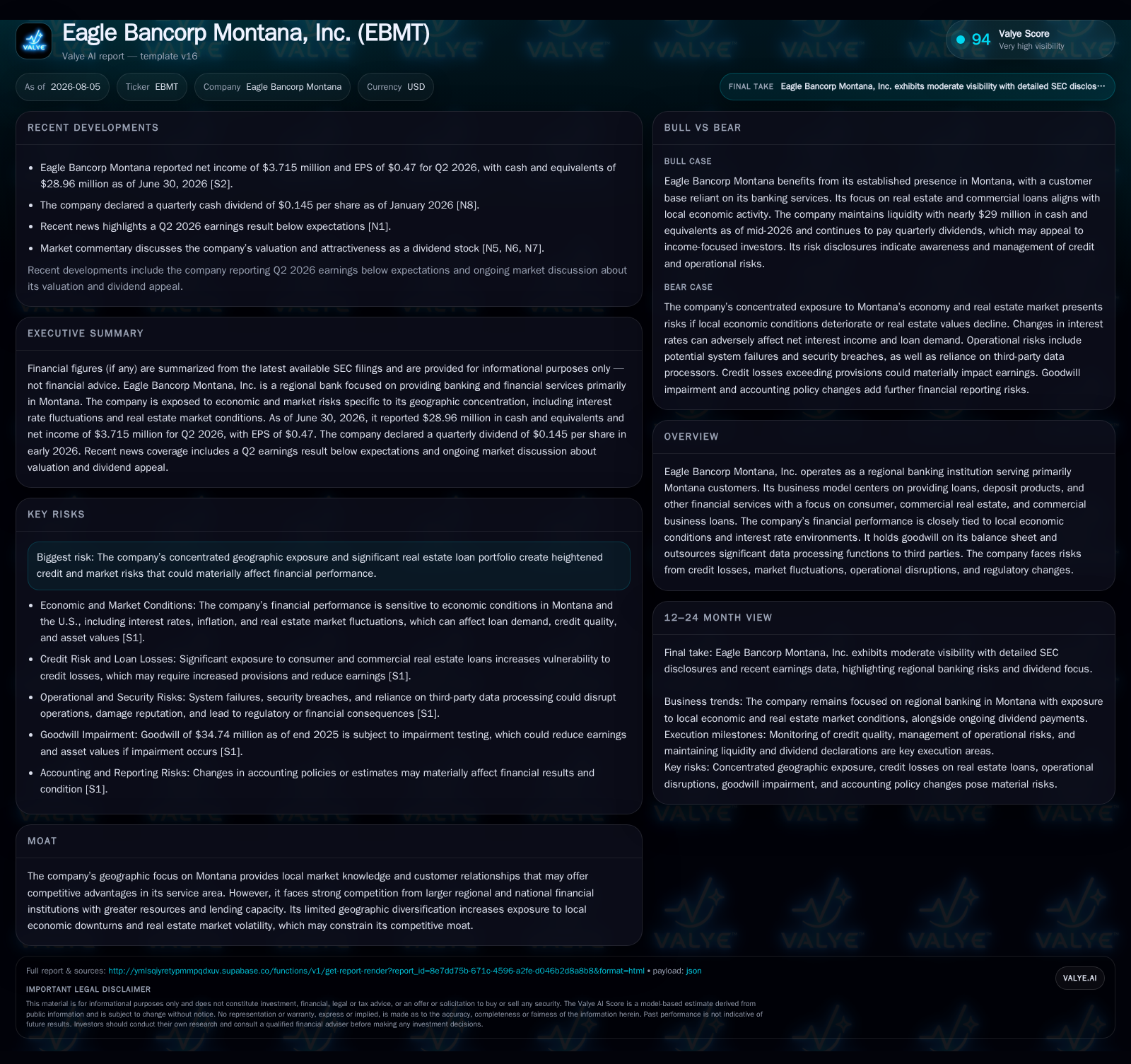
Eagle Bancorp Montana’s Q2 2026 results reflect stable asset quality despite softer earnings driven by net interest margin pressure and deliberate credit loss provisioning. The bank’s business model is heavily shaped by its Montana geographic focus and commercial real estate lending, posing concentration and credit risks balanced by strong local market knowledge. Competitive pressures from larger regional and national institutions constrain scale advantages, while growth hinges on navigating local economic conditions and deposit base expansion. Upcoming milestones include monitoring loan performance metrics and deposit trends against interest rate shifts.
Q2 Operating Review: Loan Quality Holds Firm during Profitability Pressures
Eagle Bancorp Montana’s Q2 2026 report reveals stable asset quality despite headwinds to earnings. The company maintained a steady non-performing loans (NPL) ratio with no significant increase in problem assets, reflecting disciplined credit underwriting in a region prone to localized economic volatility [S2]. This resilience supports the durability of the loan portfolio and mitigates immediate credit risk concerns.
Profitability faced pressure primarily from net interest margin (NIM) compression. Changes in short-term interest rates during Federal Reserve policy adjustments narrowed the spread between interest earned on loans and funding costs. This margin squeeze constrained earnings growth even as loan volumes showed signs of measured expansion [S2][N1]. Effective management of funding costs and deposit pricing will be key to restoring margin stability.
Local Economic Conditions Drive Business Dynamics
Eagle Bancorp’s concentrated presence in Montana ties its financial performance closely to local economic conditions such as employment trends, business activity levels, and real estate market health [S1]. Unlike more geographically diversified regional banks, this focus amplifies exposure to regional downturns or sector-specific shocks. Consequently, fluctuations in local commercial real estate markets directly affect credit risk profiles and loan demand.
Deposit base stability is similarly influenced by consumer confidence within these markets, reinforcing cyclicality in revenue streams [S1][S2]. This reliance underscores the importance of strong local relationships but also highlights inherent concentration risks absent broader geographic diversification
Loan Portfolio Composition: Concentration in Commercial Real Estate
The bank’s lending portfolio is weighted significantly toward commercial real estate (CRE) loans alongside consumer and commercial business loans concentrated within Montana [S1][S2]. CRE exposure heightens sensitivity to property value cycles and rental demand shifts that can impact asset quality. Prudent provisioning practices have helped maintain adequate buffers against potential credit losses without signaling systemic portfolio deterioration [S2].
This conservative approach supports ongoing asset quality but may limit near-term profitability as provisions temper earnings.
Competitive Landscape: Local Focus Versus Scale Advantages
Eagle Bancorp benefits from deep community ties and localized market knowledge that foster client retention through personalized service offerings not easily replicated by larger competitors [S1]. However, competition from national and larger regional banks such as Wells Fargo or Zions Bancorporation imposes challenges due to their scale-related advantages including lower-cost funding access and broader product suites.
The bank’s limited geographic footprint constrains economies of scale critical for competing effectively in an increasingly consolidated banking environment. Balancing these dynamics requires strategic investments in technology and partnerships such as third-party data processing services that help control operating expenses but introduce operational risk considerations [S1].
Growth Outlook Within Regulatory and Market Constraints
Future growth depends on favorable developments in Montana’s economy alongside disciplined capital management. While cross-selling fee-based services offers incremental revenue diversification, it does not materially offset margin pressures or concentration risks embedded in core lending segments [S1][S2]
Maintaining deposit growth sufficient to support loan originations is essential for preserving optimal loan-to-deposit ratios—a key driver of net interest margin sustainability.
Potential acquisitions could provide scale benefits but carry integration risks typical of community banks pursuing expansion cautiously [S1].
Key Risks: Credit Loss Volatility, Interest Rate Sensitivity, Operational Dependencies
Concentration in Montana combined with CRE lending elevates vulnerability to regional economic downturns or sector-specific disruptions that could increase credit losses beyond current provisions [S1]. Interest rate volatility further complicates earnings predictability via impacts on net interest margins.
Regulatory developments affecting capital requirements or deposit insurance premiums may raise operating costs or limit dividend flexibility.
Outsourcing critical functions like data processing helps manage costs but increases vendor-related operational risk requiring robust oversight mechanisms—an important consideration given competitive pressures from better-resourced peers investing heavily in technology infrastructure [S1].
Upcoming Milestones: Monitoring Asset Quality and Funding Metrics
Investors should watch quarterly trends in NPL ratios alongside changes in loan loss provisions for signals about evolving credit risk management effectiveness. Deposit growth relative to loan advances will indicate liquidity balance sustainability.
Management commentary on regional economic outlooks will provide insight into future demand conditions. Interest rate policy developments remain pivotal for projecting net interest margin trajectories.
Regulatory updates impacting capital adequacy or compliance costs could necessitate strategic adjustments.
Financial Profile Discussion: Capital Structure and Liquidity Highlights
As of June 30, 2026, Eagle Bancorp Montana held approximately $28.96 million in cash and equivalents against total debt of about $44.5 million, resulting in a moderate net debt position near $15.5 million [F1]. This balance sheet positioning suggests sufficient liquidity to support operations without excessive leverage.
Goodwill recorded reflects past acquisitions that have solidified the bank’s presence in Montana; however, this intangible asset requires monitoring for impairment given the company’s geographic concentration.
While capital adequacy appears balanced for its size, it remains constrained relative to larger regional competitors benefiting from broader diversification and deeper capital pools. Ongoing attention to regulatory compliance concerning capital levels is essential amid evolving banking oversight standards [S1][F1].
This analysis integrates Eagle Bancorp Montana's recent quarterly update with broader regional banking dynamics emphasizing localized economic dependencies. The company demonstrates stable asset quality amid challenging margin pressures but faces inherent risks linked to geographic concentration and competitive scale disadvantages. Future performance will depend on prudent credit risk management coupled with maintaining deposit base growth within its focused market—a critical path for sustaining net interest margins and overall earnings resilience.
Disclaimer: This document is for informational purposes only and does not constitute investment advice or research views concerning any securities discussed herein.
Disclaimer: This is research-only, informational analysis and not investment advice. It may include AI-generated interpretation and general industry context. Always verify important details using primary sources.

Comments