
Stifel Financial Expands Capital Market Access Amid Stable Wealth Management Performance
The Q2 2026 results underscore Stifel Financial’s balanced revenue mix and solid liquidity with new senior note issuance enhancing capital flexibility.
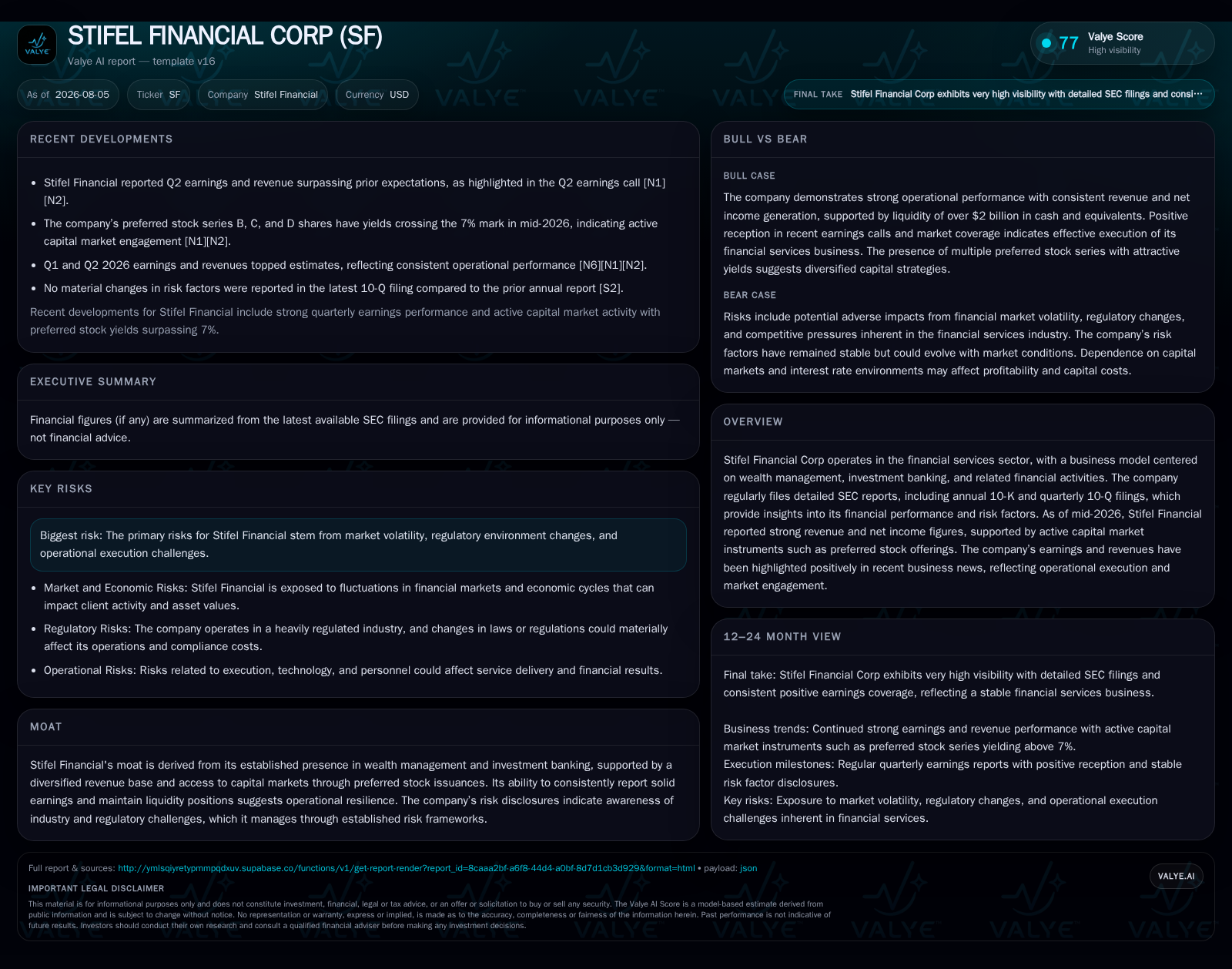
Stifel Financial Corp reported a steady operating environment in its Q2 2026 filing, maintaining diversified revenue streams from wealth management and investment banking. The company leveraged capital markets by issuing 5.20% senior notes due 2047, bolstering its financial flexibility while holding net cash on the balance sheet. Market volatility and regulatory challenges remain risks, but Stifel’s solid earnings execution and liquidity position reflect operational resilience typical of its peer group.
Recent Operating Update
Stifel Financial Corp’s latest quarter ended June 30, 2026, as disclosed in its August 5, 10-Q filing, portrays a company sustaining a broadly stable operating environment while strategically expanding capital market tools [S2]. The firm reported no material changes to previously disclosed risk factors, underscoring consistency in its business risks from market volatility and regulatory challenges [S2]. The quarter evidenced solid earnings performance supported by core wealth management fee income alongside transactional investment banking activity. Supplementing liquidity, the July 22, 8-K filing confirms a new issuance of $625 million in senior notes bearing a coupon of 5.20%, maturing in 2047, which enhances Stifel's long-term financing flexibility and capital adequacy [S3].
This issuance reflects an active capital markets engagement strategy allowing Stifel to leverage favorable funding conditions without disrupting existing liquidity buffers. Indeed, the balance sheet at quarter-end shows about $2.19 billion in cash and equivalents against total debt approximating $625 million, translating into a net cash position which affords operational resilience amidst economic uncertainty [F1]. Such a conservative leverage stance is noteworthy given the sector’s exposure to interest-rate fluctuations impacting net interest margin.
Business Model Analysis
Stifel operates primarily within financial services sectors including wealth management, investment banking, and brokerage services. Revenue is driven through multiple channels: advisory fees from wealth management accounts aggregated across individual and institutional clients; commissions from brokerage activities; underwriting revenues tied to capital markets transactions; and interest income from lending activities within its financing portfolio [S1]. Its diversified model reduces reliance on cyclical underwriting spikes or trading volume surges common among full-service banks but expects continued growth tied to assets under management (AUM) increases and sustained client trading activity.
The firm’s ability to monetize advisory relationships through fee-based wealth management stabilizes revenue flow during periods of market turbulence when transactional volumes can vary substantially. Brokerage commissions complement this stream but are inherently more volatile reflecting client trading cadence. Investment banking activities contribute through underwriting fees capturing capital raising demand and mergers & acquisitions advisory — though this segment tends to fluctuate with broader economic cycles [S1]. The recent senior notes issuance highlights strategic capital access aimed at supporting growth investments or potential acquisitions without materially increasing short-term leverage risk.
Customer retention likely benefits from integrated platforms offering combined brokerage and advisory capabilities facilitating cross-selling opportunities [N1]. However, competitive pressure from larger peers such as Morgan Stanley or Goldman Sachs, who command scale advantages especially in global capital markets, remains a challenge. Yet Stifel’s niche regional focus and comprehensive financial solutions provide competitive moats in select market segments
Industry Structure and Competitive Position
Investment banking and wealth management sectors revolve around intermediary roles connecting issuers of securities with investors while delivering personalized portfolio solutions to clients ranging from individuals to large institutions. The value chain includes product origination (advisory), distribution (brokerage), asset servicing (management), and risk assessment (compliance frameworks).
Peers like Charles Schwab Corporation operate at a larger scale emphasizing technology-driven brokerage services with an expansive retail base; meanwhile full-service firms such as Morgan Stanley balance global investment banking with asset management dominance. Stifel positions itself entrepot-wise as a diversified regional broker-dealer combining wealth management scale with tailored investment banking offerings analogous to Raymond James Financial.
Operating metrics relevant include AUM growth rates reflecting client acquisition/retention success; fee-based revenue stability indicating diversification beyond trading commissions; net interest margin signaling balance sheet deployment efficacy; trading volumes impacting commission income; efficiency ratios gauging cost control against revenue growth; and liquidity ratios ensuring capacity for client financing demands or market disruptions.
Regulatory compliance costs remain significant industry-wide given heightened scrutiny post-financial crisis periods plus emerging cybersecurity mandates creating operational complexity for mid-sized custodians such as Stifel.
Growth Drivers
Structural drivers underpinning Stifel's growth encompass rising wealth accumulation across demographics demanding sophisticated advisory services for retirement planning and inheritance transfers. Increased demand for capital raising services catalyzes underwriting pipelines with corporate clients seeking equity or debt issuance aligned with expansion strategies.
Technological innovation enabling digital platforms for wealth management offers channels to broaden reach cost-effectively while enhancing client service experience—a key differentiator still developing among regional players. Market volume recoveries after recent volatility also catalyze brokerage commissions providing transactional revenue upside.
Regulatory reforms introducing transparency requirements or fiduciary standards can indirectly expand advice-driven revenue pools as clients seek compliance-aligned counsel.
Internationalization trends—though limited given Stifel's current US-centric operations—could offer longer-term entry points into emerging affluent segments or cross-border deal flow facilitation.
Risks and Constraints
Market volatility presents persistent headwinds by suppressing trading activity thereby reducing commissions and underwriting appetite creating revenue unpredictability – this cyclicality requires robust cost control mechanisms to maintain margins during downturns [S1]. Interest rate fluctuations have dual impacts: raising funding costs potentially compressing net interest margins on loans while increasing yields on invested cash positions requiring adept asset liability management.
Regulatory burdens elevate compliance expenditure raising fixed operating costs especially for mid-tier brokers expanding nationally where localized regulations differ. Cybersecurity threats pose operational risks impacting both data integrity and customer trust.
Competition intensifies from fintech platforms eroding traditional brokerage fee bases via lower-cost models or robo-advisory alternatives compelling innovation investments that increase near-term expenses.
Client concentration or dependence on key advisors may introduce retention risk if personnel departures occur, potentially disrupting relationships central to recurring fee streams.
Capital allocation must balance shareholder returns with reinvestment in technology infrastructure and possible M&A initiatives supporting scale expansion without overleveraging the balance sheet.
What to Watch Next
Key upcoming milestones include quarterly earnings releases quantifying AUM trends validating ongoing client loyalty amid shifting market conditions. Monitoring net interest margin movements relative to Federal Reserve policy will gauge financing profitability stability.
Capital markets activity levels directly influence underwriting backlog—tracking deal pipeline health is pivotal alongside M&A advisory booking strength. Integration progress of any recent acquisitions could amplify synergies impacting operating efficiency ratios.
Debt servicing costs for the newly issued senior notes will factor into future interest expense profiles; thus observing funding mix evolution provides insight into capital strategy execution.
Technology adoption metrics reflecting digital platform uptake or client satisfaction indices bear watching for competitive positioning enhancement prospects.
Regulatory developments pertaining to fiduciary standards or cybersecurity compliance could alter cost structures necessitating proactive risk mitigation responses.
Financial Profile Discussion
As reported in the Q2 2026 filings, Stifel maintained a robust liquidity position with approximately $2.19 billion cash and equivalents against total debt around $625 million as of June-end—effectively a net cash stance facilitating strategic flexibility [F1]. The recent $625 million tranche of senior notes at a fixed coupon rate of 5.20% maturing in 2047 extends debt maturity well beyond near-term horizons mitigating refinancing risk while locking favorable borrowing costs amid rising rates [S3]. This long-duration liability aligns well with asset-liability matching principles critical for financial institutions managing interest rate sensitivities.
Earnings trajectory remains positive highlighted by recent beats versus analyst expectations confirming operational execution prowess particularly in sustaining fee-based revenue streams complemented by transactional income from trading commissions [N2]. Operating margins benefit from scale efficiencies inherent in integrated brokerage-advisory business lines but require ongoing vigilance given sector cost inflation pressures including technology investments mandated by evolving regulatory environments.
Capital adequacy is implicitly supported through prudent leverage ratios reinforced by substantial cash reserves affording downside protection especially critical during episodic market dislocations characteristic of the investment banking lifecycle phases.
In sum, Stifel demonstrates financial discipline balancing growth aspirations with conservative risk controls customary among comparable diversified financial intermediaries such as Raymond James Financial or boutique regional peers exhibiting similar scale dynamics.
Disclaimer: This analysis is based solely on cited regulatory filings and publicly available information up to August 5, 2026, without any forward-looking statements or investment research views.
Disclaimer: This is research-only, informational analysis and not investment advice. It may include AI-generated interpretation and general industry context. Always verify important details using primary sources.

Comments