
Seres Therapeutics Advances Microbiome Pipeline While Facing Funding Challenges
Seres Therapeutics progresses clinical trials for SER-155 and broaden pipeline focus amid significant going-concern risks and ongoing cash constraints.
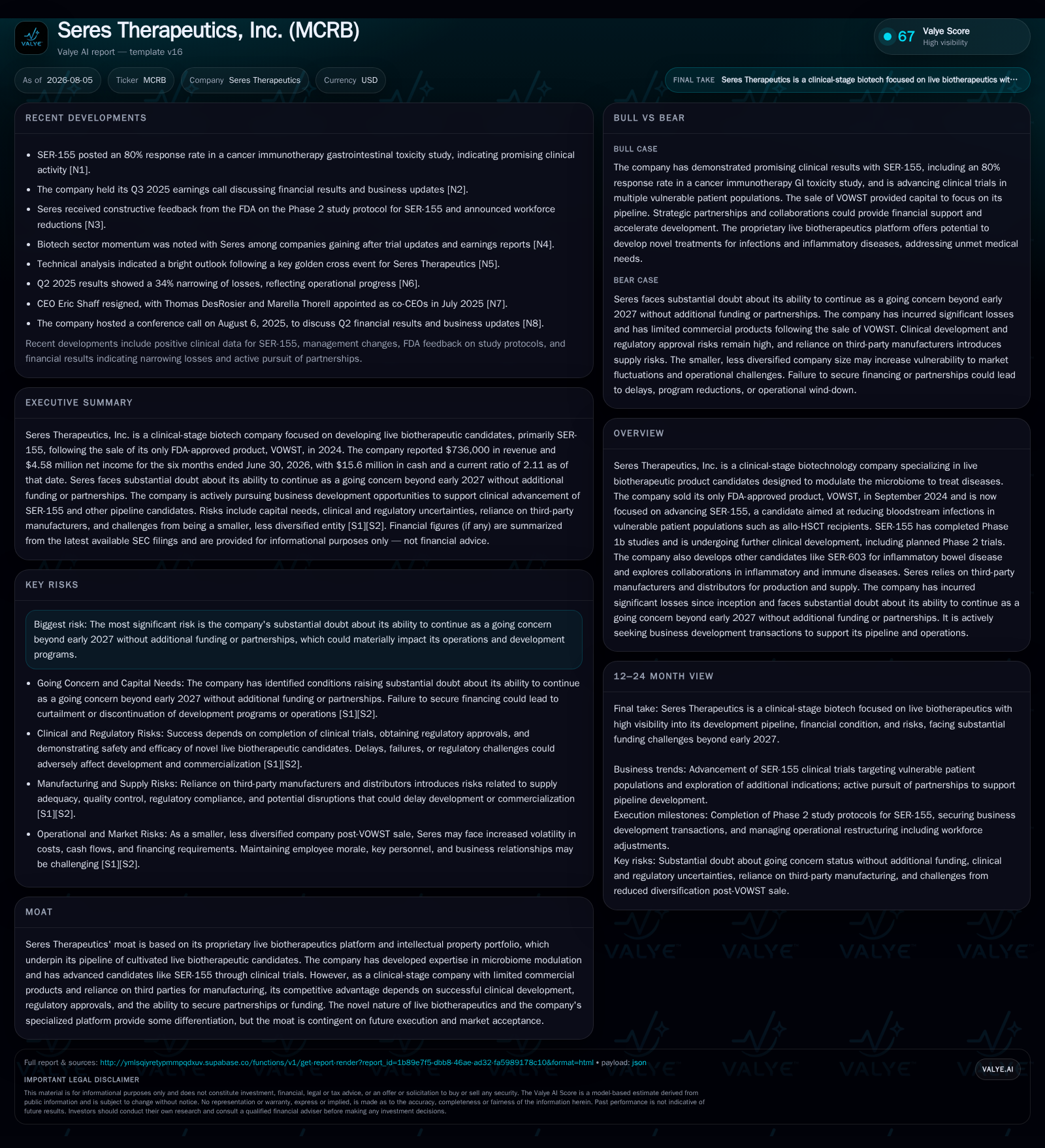
Seres Therapeutics, a clinical-stage biotech company focused on live biotherapeutic candidates, is advancing its key asset SER-155 with Phase 2 studies targeting bloodstream infections in immune-compromised patients. Following the sale of its only FDA-approved product VOWST, Seres currently depends on milestone payments and external funding to sustain operations. Its proprietary microbiome modulation platform remains strategically differentiated but execution risks and financial strain, including substantial doubt about its ability to continue as a going concern beyond early 2027, weigh heavily on its near-term outlook. The company’s reliance on third-party manufacturing and limited commercial footprint underscore critical vulnerabilities typical of early-stage biotech firms.
Recent Operating Update: Clinical Progress Meets Financial Constraints
Seres Therapeutics' latest quarterly filing dated August 5, 2026 provides a crucial update on the company's operational status amid challenging financial conditions [S2], [S3]. The company highlights ongoing advancement of SER-155, its lead pipeline candidate intended to reduce bloodstream infections in allogeneic hematopoietic stem cell transplant (allo-HSCT) recipients. Having completed Phase 1b studies, Seres is preparing to initiate Phase 2 clinical trials, signaling progress on a promising therapeutic front. This momentum is critical given that Seres divested its sole FDA-approved product VOWST in September 2024, leaving SER-155 as the centerpiece of future value creation [S1]. However, despite the development strides, Seres recorded substantial doubt about its ability to continue as a going concern beyond early 2027 due to funding pressures [S2]. A recent $12.5 million milestone payment from SPN extends runway slightly but additional financing remains imperative.
Business Model: Proprietary Microbiome Modulation Through Live Biotherapeutics
Seres operates within the niche yet rapidly evolving biotechnology domain of live biotherapeutics—cultivated microbial consortia designed to favorably modulate the human microbiome. The firm's pipeline is built around this platform technology focused on infectious disease risk reduction (SER-155), inflammatory bowel disease (SER-603), and potentially other immune-mediated conditions [S1]. Revenue historically derived from product sales (notably VOWST) has been supplanted by milestone payments linked to the VOWST sale transaction. Going forward, commercial revenue streams depend heavily on successful clinical progress and eventual regulatory approval of SER-155 or other candidates.
Manufacturing and distribution are fully outsourced to contract manufacturers and third-party logistics providers—a standard industry practice for clinical-stage biotechs lacking scale manufacturing infrastructure. This dependency introduces supply chain execution risks but allows capital light operations during R&D-intensive phases. Strategic partnerships remain vital both for funding clinical programs through milestone payments or licensing fees and for eventual commercialization capabilities.
Industry Structure and Competitive Position
Within biotechnology’s specialized segment targeting microbiome therapeutics, Seres faces peer companies like Finch Therapeutics and Rebiotix that similarly focus on microbial modulation therapy development. Traditional pharmaceutical firms offer alternative infectious disease treatments but do not compete directly on live biotherapeutic platforms.
Seres’ moat resides primarily in its intellectual property portfolio surrounding cultured live microbial therapeutics and accumulated clinical data supporting efficacy claims—particularly seen in SER-155’s trajectory through Phase 1/2 development stages [S1]. However, this competitive advantage is provisional on achieving positive late-stage clinical outcomes and securing subsequent FDA approval—both challenging hurdles given now well-documented regulatory caution over microbiome interventions.
Furthermore, Seres’ earlier exit from direct commercialization after selling VOWST reduces operational complexity yet limits near-term revenue generation potential compared with integrated biotech-commercial players like Gilead or Amgen who possess internal manufacturing and sales capacity.
Growth Drivers: Clinical Milestones and Partnership Potential
Successful progression of SER-155 into Phase 2 trials represents a pivotal inflection point signaling validation of Seres’ technology platform in a high-risk patient cohort. Positive trial outcomes would likely enhance financing discussions and attract strategic collaborations essential for continuing operations beyond the current cash runway.
Expansion into inflammatory bowel disease via SER-603 diversifies the pipeline but remains at an earlier developmental stage requiring significant R&D investment without guaranteed success. The company also pursues collaboration opportunities across immunology indications leveraging platform versatility.
Milestone payments—such as those recently received from SPN—temporarily bolster liquidity while underscoring dependency on external partner agreements for financial sustenance. Regulatory approvals remain an ultimate growth catalyst enabling commercialization revenue streams.
Risks and Constraints: Financial Viability Dominates Near-Term Concerns
The dominant risk facing Seres continues to be its fragile financial position with substantial doubt about continuation past early 2027 unless additional capital raises or partnerships materialize [S2]. With approximately $15.6 million cash at June-end against liabilities exceeding $20 million current, liquidity is constrained [F1].
Execution risk is elevated by dependence on successful SER-155 trials which are still mid-development stage; any trial delays or failures could impair fundraising capability further. Outsourcing manufacturing introduces vulnerability to supply disruptions or quality issues, typical risks in biotech reliant on CMOs.
Regulatory uncertainties specific to live biotherapeutics compound commercial risks since evolving standards could delay approvals or impose costly requirements [S10]. Further downward pricing pressures driven by healthcare reforms intensify challenges securing favorable reimbursement post-launch.
Finally, market acceptance remains unproven given live biotherapies' relative novelty; physicians’ prescribing behaviors, payer coverage decisions, and competitive alternative therapies all influence ultimate uptake dynamics.
What To Watch Next: Trial Milestones and Financing Events
Key near-term markers include official initiation dates for SER-155’s planned Phase 2 study in allo-HSCT patients along with enrollment progress reports [N1], which will indicate operational capability and scientific validation trajectory. Additional milestone payments tied to developmental achievements or partnership deals will be critical signals influencing liquidity trajectory.
Monitoring management communications around fundraising efforts or new alliance announcements will provide insight into strategic options pursued to mitigate going-concern risk. Any material updates related to regulatory feedback on ongoing programs will also merit close observation given their impact on time-to-market estimates.
Financial Profile Discussion
As of June 30, 2026, Seres held $15.6 million in cash and equivalents against current liabilities of approximately $20 million resulting in a current ratio of roughly 2.11—a moderate short-term liquidity cushion aided by continued receipt of milestone payments but below comfortable buffers typical for sustained biotech R&D cycles [F1]
Operating losses persist due primarily to high research and development expenses necessary for clinical programs advancement without offsetting commercial revenues post-VOWST divestiture [F1]. Cost containment efforts announced previously helped extend the cash runway into early Q1 2027 horizon; however pursuing further equity raises or business collaborations appears mandatory for ongoing survival per latest filings [S2], [S3].
In sum, while financial resilience has improved marginally via recent partnerships milestones inflows easing immediate pressure points, the capital-intensive nature of live biotherapeutic development coupled with narrow commercial footprint mandates vigilant liquidity management amid uncertain financing landscapes prevalent across early-phase biotech sector.
This analysis focuses strictly on available public disclosures within regulatory filings through August 2026 combined with established industry context; it does not constitute investment advice nor forecasts future securities performance. Readers should consider all relevant factors including intrinsic industry risks before drawing conclusions about enterprise value or operating outlook.
Disclaimer: This is research-only, informational analysis and not investment advice. It may include AI-generated interpretation and general industry context. Always verify important details using primary sources.

Comments