
Mastercard Expands Agentic Commerce and Stablecoin Integration as Cross-Border Payments Strengthen
Mastercard's Q2 2026 results highlight advances in emerging payment technologies and solid transaction volume growth, reinforcing its competitive moat.
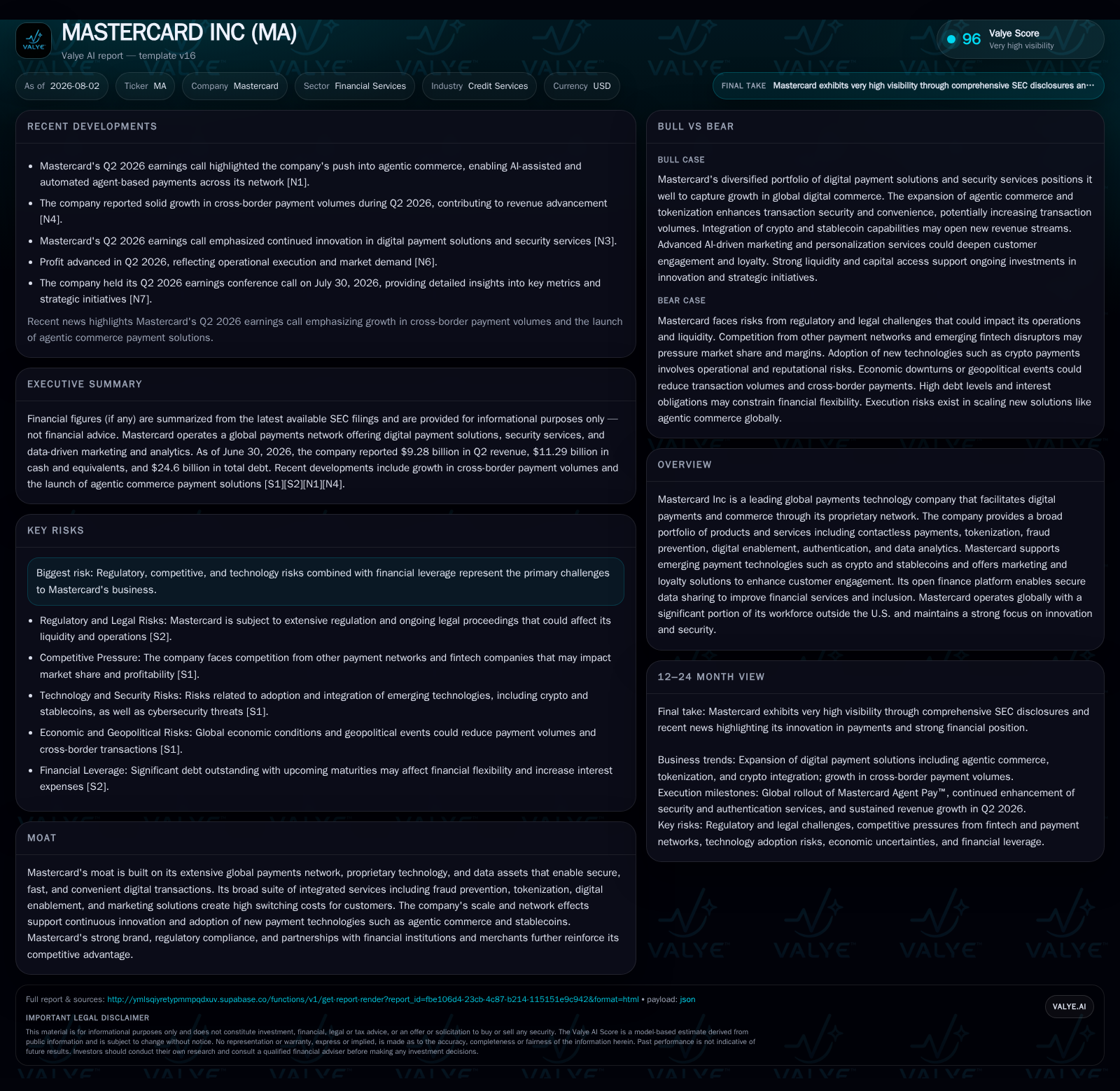
Mastercard’s latest quarterly filing reveals continued progress in launching its Agentic Commerce platform and expanding stablecoin usage across its network, key drivers for future transaction volume growth. Cross-border payments showed solid momentum despite macro uncertainties, supporting Mastercard's revenue base rooted in authorization fees and value-added security services. The company’s broad portfolio—including tokenization and fraud prevention—cements high switching costs in a fast-evolving payments ecosystem. Growing debt to fund share repurchases and investments merits monitoring alongside regulatory and cybersecurity risks that persist as structural challenges.
Recent Operating Update
Mastercard’s Q2 2026 filing dated July 30 reinforces its leadership stance in credit services by advancing nascent payment technologies and maintaining strong transaction volume growth amid a complex macro environment. The company’s launch of Mastercard Agent Pay™, a framework enabling scalable AI-assisted agentic commerce payments across its acceptance network, is a strategic milestone aimed at automating agent-based payment flows, reducing friction for merchants globally without substantial integration costs [S1][S2]. This rollout follows a successful U.S.-based pilot completed in 2025 and targets a global deployment beginning early 2026. Such advancement aligns with the industry push toward agentic commerce, an emergent paradigm where autonomous agents initiate payments on behalf of consumers or businesses.
Tokenization adoption continues to be substantial; approximately 40% of all Mastercard transactions are now tokenized, illustrating increasing reliance on this key security layer that replaces sensitive card details with unique digital tokens to reduce fraud risk during authorization [S1]. Concurrently, expansion in the cryptocurrency domain is evidenced by around 130 crypto co-branded card programs enabling spend of stablecoins across Mastercard’s merchant network and embedding these digital currencies into the Mastercard Move platform for seamless stablecoin transfers [S1]. This enables the company not only to capture incremental transaction volumes from crypto assets but also positions it within the expanding digital asset ecosystem.
Cross-border payments—a lucrative segment due to higher interchange fees—demonstrated solid performance despite some sector weakness reported by peers like Euronet [N4][N2]. Mastercard’s continued growth in international transaction volumes supports its revenue mix favorably relative to domestic-only alternatives. The company's emphasis on accelerating contactless payments, digital wallets, and open finance infrastructure enhances cross-border acceptance points while catering to increasingly mobile global consumer behaviors.
Business Model Analysis
Mastercard operates as a payment network intermediary connecting issuing banks (card issuers) with merchant acquirers via its proprietary network for authorization, clearing, and settlement of electronic transactions. Its revenues derive primarily from transaction fees, both fixed per-transaction and interchange percentage-based fees paid by financial institutions for access to the network and value-added services. Importantly, Mastercard does not issue credit or assume credit risk but focuses on providing the underlying technological platform plus security enhancements such as tokenization, fraud prevention frameworks leveraging advanced data analytics, secure checkout experiences like Click to Pay™, marketing solutions targeting customer acquisition/engagement, and credentials enablement for contactless payments including Tap on Phone technology [S1].
This model benefits from strong network effects: greater cardholder activation encourages more merchant acceptance points which further attracts more issuers forming a virtuous cycle sustaining volume growth. High switching costs linked to deep integrations in issuer processing systems, brand strength, regulatory certifications, proprietary anti-fraud tools, and expanding digital enablement solutions consolidate Mastercard’s moat.
Emergent capabilities around agentic commerce augment this model by enabling AI-driven payment automation that can increase transactional frequency without proportionate incremental cost — potentially lifting overall throughput per active cardholder.
Industry Structure and Competitive Position
The global credit services industry is dominated by a few major payment networks including Visa Inc., American Express (which has both network and issuer roles), PayPal among digital wallet competitors, plus fintech disruptors innovating new checkout experiences. Mastercard competes strongly based on scale (millions of merchants globally), advanced fraud control technologies which minimize losses for partners while maintaining authorization approval rates near industry optimums, breadth of value-added services beyond pure payment routing, and increasing footholds in crypto integration.
While Visa parallels similar scale and cross-border capabilities, Mastercard distinguishes itself via proactive incorporation of stablecoin payments within an institutional framework compliant with regulatory norms — offering issuers an avenue to engage crypto-savvy consumers while mitigating compliance risks. Furthermore, Mastercard’s marketing engagement tools leverage its extensive transaction data insight more aggressively than some peers focused narrowly on payment facilitation alone [S1].
Growth Drivers
Key industry-wide tailwinds include rising global digital payment adoption accelerated by e-commerce penetration increases post-pandemic shifts, broader contactless payment acceptance driven by consumer preferences for convenience and hygiene; expansion of emerging market financial inclusion efforts via smartphone penetration; regulatory endorsement of open finance models encouraging secure data sharing; and nascent yet promising uptake of stablecoins facilitating faster cross-border settlement.
Mastercard leverages these drivers through innovation platforms like Digital First™ that provide instant card issuance digitally paired optionally with physical cards responding to immediate user needs for speed/security/convenience; advancements in Tap on Phone lowering merchant hardware barriers especially for small businesses; continual improvements in fraud detection machine learning models enhancing trustworthiness without sacrificing user experience; plus scaling Agentic Tokens underpinning automated agent-based payments flawlessly integrated into existing infrastructure [S1][N1].
Continued geographic expansion of crypto-enabled co-brand cards also taps a specialized high-growth segment combining traditional finance with blockchain domains.
Risks and Watchpoints
Regulatory scrutiny remains a significant risk vector given evolving privacy laws worldwide (e.g., GDPR-like regimes), anti-money laundering frameworks tightening crypto activity oversight, heightening know-your-customer rules impacting issuance onboarding times/costs [S1][S16]. Legal risks linked to data breaches or alleged misconduct by third-party vendors persist alongside reputational vulnerabilities inherent in cybersecurity incidents despite heavy investment in defenses.
Operational resilience could face disruption from system outages caused by natural disasters or malicious cyberattacks targeting principal clearing infrastructure worldwide—risk addressed via extensive enterprise resiliency planning yet inherently unpredictable [S1].
Competitive pressure from agile fintech startups that bundle wallet/payment/funding functionalities in seamless app ecosystems continues eroding incremental margins unless Mastercard meaningfully partners or innovates continually. In addition, customer consolidation among banks could impair bargaining power balance necessitating flexible pricing or incentive schemes that might compress revenue margins short term [S21][S26]. Monitoring incentives paid is crucial since cash outflows toward customer rewards increased recently dampening operating cash flow despite earnings growth [S2]. Capital allocation must balance productive reinvestment against debt servicing given total debt nearing $25 billion with upcoming maturities clustered within one-to-five years horizon requiring refinancing discipline [F1][S2]
What to Watch Next
Upcoming milestones include global rollout status updates for Agentic Commerce beyond the U.S., detailed adoption metrics around stablecoin integrations within the Mastercard Move platform, quarterly transaction volume composition particularly growth speed in cross-border versus domestic segments — all indicators revealing whether innovation investments translate into sustained elevated top-line momentum.
Watch also trends in customer incentive spending levels relative to sales growth signalling pricing power sustainability; Fitbit-level cybersecurity incident disclosures if any arise; regulatory developments that might impose new compliance costs or restrictions on crypto/agentic models deployment; plus competitive announcements from Visa or key fintech entrants potentially affecting Mastercard’s market positioning.
Capital markets watchers should track debt issuance plans complementing or replacing recent $5 billion note issues along with share repurchase pace adjusting per market valuations [S2][S4][S5]
Financial Profile Discussion
As of June 30, 2026, Mastercard holds approximately $11.3 billion in cash and equivalents against total debt near $24.8 billion, resulting in net debt around $13.5 billion. The company maintains a current ratio of about 1.06, indicating adequate short-term liquidity relative to current liabilities near $25 billion [F1]. Approximately $2.5 billion of debt matures within one year, creating refinancing needs that are partially mitigated by an authorized $8 billion commercial paper program backed by an equal revolving credit facility expiring November 2030 [S2][S5].
It aims to contextualize Mastercard’s operational shifts within evolving market dynamics rather than offer investment guidance or price commentary.
Disclaimer: This is research-only, informational analysis and not investment advice. It may include AI-generated interpretation and general industry context. Always verify important details using primary sources.

Comments