
Lincoln Electric Strengthens Consumables and Automation Growth in Q2 While Managing Industry Cyclicality
Robust second-quarter gains anchored by consumables and automation segments highlight Lincoln Electric’s resilient market positioning amid sector headwinds.
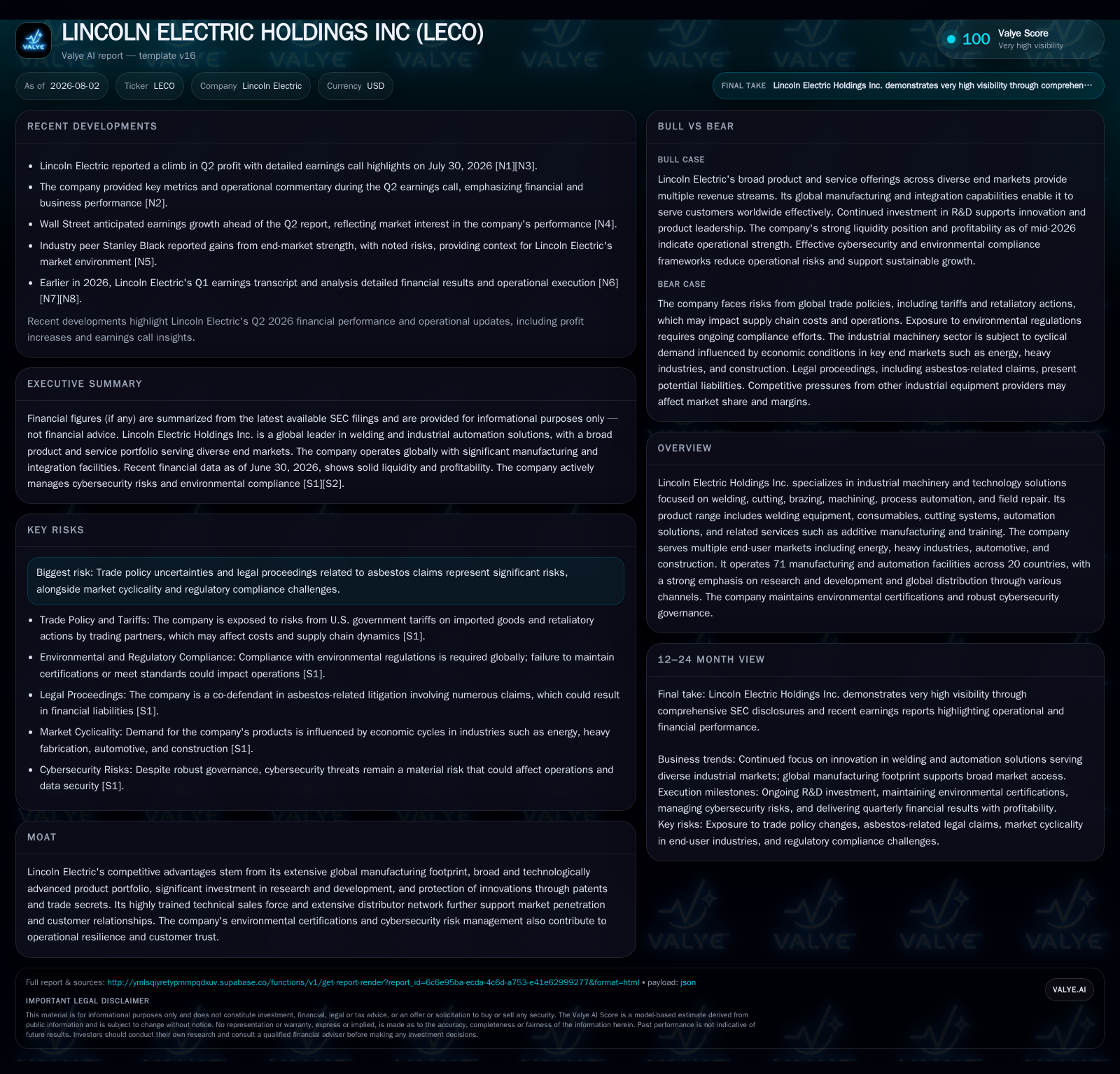
In the latest quarter ended June 30, 2026, Lincoln Electric Holdings Inc. reported sequential revenue growth led by a strong increase in consumables sales alongside steady automation segment expansion, underscoring the company’s durable demand structure and deep penetration across industrial end markets. The firm’s diversified business model, spanning capital equipment, recurring consumables, and integrated automation solutions with global manufacturing scale, continues to provide resilience amidst cyclical fluctuations in heavy industry sectors. However, trade tensions and asbestos-related legal proceedings remain material risks requiring monitoring. Lincoln Electric's solid balance sheet and investment in R&D reinforce its competitive moat, positioning it well for continued technology leadership and market share retention.
Recent Operating Update Highlights
Lincoln Electric Holdings Inc. reported strong second-quarter results in its 10-Q filed July 30, 2026 [S2], showcasing sustained momentum particularly in its consumables business. Consumables revenue rose to $688 million for the quarter, a roughly 16% increase from $594.6 million a year earlier, highlighting resilient recurrent demand for welding wire, electrodes, and related supplies typically consumed continuously in industrial applications. This segment's strength signals stable underlying volume from core end markets like energy infrastructure and heavy manufacturing where welding is essential.
The equipment segment contributed $302.6 million in the quarter, up from $277.6 million year-over-year. Growth here remains important but less volatile given the capital-intensive nature of welding machines whose purchase cycles are influenced by facility expansions or replacements rather than steady consumption patterns. This reflects the traditional cyclical exposure of factory equipment sales consistent with broader capital spending trends.
Meanwhile, automation solutions posted revenues of $229.1 million for Q2 compared to $216.4 million previously. This segment includes advanced system integration services for joining, cutting, material handling, plus software-enabled process automation. Its growing contribution evidences shifting customer preference toward higher-value digital transformation initiatives that optimize production efficiency—a key industry tailwind aligning with Industry 4.0 trends.
Operating under three main segments—Americas Welding (equipment & consumables), International Welding, and The Harris Products Group (specialty gases/regulators)—Lincoln Electric leverages a global distribution network supported by a technical sales force that drives customer engagement and complex solution deployment [S1], [S2]. The firm's strategic organization bolsters resource synergy across worldwide manufacturing facilities (71 plants across 20 countries), enhancing its supply chain resilience amidst ongoing disruption pressures.
Business Model Specifics
Lincoln Electric operates as an OEM providing welding equipment complemented by a stable recurring revenue stream from consumables—a critical margin-enhancing driver given replacement cycle frequency and steady consumption rates. In addition to hardware sales (machines & systems), automation represents a growing share of total revenue through integrated process solutions embracing software controls and robotics.
This tri-segment model balances capital expenditure cyclicality inherent in equipment businesses against more predictable consumable sales volume supported by anchor customers in energy production, automotive manufacturing automation lines, construction infrastructure projects, and fabrication industries requiring precision joining methods.
Value is further extracted via aftermarket offerings such as field repair services, wear solutions maintenance, training programs certifying skilled welders (critical amid acute labor shortages), and additive manufacturing capabilities for customized part fabrication—a convergence of hardware excellence with service-led customer retention levers [S1], [S2].
Lincoln's ability to maintain high gross margins benefits from proprietary technology protected by patents/trade secrets alongside efficient manufacturing capacity utilization driven by scale economies spanning multiple regions. Its distributor relationships expand reach into fragmented local markets while technical support ensures switching costs remain elevated.
Industry Structure and Competitive Position
The industrial equipment and welding sector is fragmented between specialized OEMs like Lincoln Electric (global leader), ESAB, Miller Electric for welding equipment; industrial automation players exemplified by FANUC or ABB; consumables specialists like Praxair; plus diversified toolmakers such as Stanley Black & Decker representing adjacent peer reference points.
Lincoln distinguishes itself via its broad portfolio ranging from basic welders to fully automated production cells emphasizing additive manufacturing innovations—areas where R&D intensity lays the foundation for technological differentiation. Its structure aligns closely with end-user value chains in heavy industries where quality certifications and safety standards underpin purchasing decisions alongside cost efficiency.
Investment decisions by customers in this sector often weigh not only upfront equipment cost but lifecycle value captured through uptime improvement granted by integrated automation packages or consistent welded component quality enhanced via consumable chemistry innovations—the latter cultivating repeat business critical to Lincoln’s margin stability.
Growth Drivers
Key growth drivers include accelerating adoption of automation solutions driven by Industry 4.0 digitization goals within industrial plants seeking cost reduction via improved joining repeatability and reduced manual labor dependence—segments where Lincoln’s offerings align well due to their modular system integration expertise.
Infrastructure development spending globally remains significant especially in emerging markets requiring reliable welding technologies for pipelines, power plants (including renewables), bridges, and buildings—all fueling baseline equipment replacement demand coupled with consumable usage expansion.
Ongoing innovation in additive manufacturing presents future upside opportunities leveraging Lincoln’s developments in precision fabrication services integrating metal deposition techniques complementary to traditional joining processes.
Moreover, stringent environmental regulations push customers towards certified sustainable welding solutions where Lincoln’s environmental certifications empower it against competitors lacking similar credentials. Training programs respond to skilled labor shortages—a structural constraint underpinning demand for certified educational offerings helping welders maximize productivity using Lincoln's equipment.
Risks and Watchpoints
Despite strengths, several risks warrant close monitoring:
- Trade Policy Uncertainty: Ongoing tariff dynamics impact raw material sourcing costs and global supply logistics challenging margin consistency despite localized manufacturing initiatives.
- Legal Liabilities: Asbestos-related claims continue as legacy issues potentially affecting liquidity or triggering contingent liabilities [S1].
- Cyclicality Exposure: Demand fluctuations in automotive or construction sectors subject Lincoln’s equipment sales to macroeconomic volatility.
- Raw Material Price Volatility: Fluctuating metal prices affect consumables cost structure which may compress margins if pass-through pricing lags.
- Technological Disruption: Emergence of novel fusion technologies or alternative joining methods could erode traditional welding market share if innovation pace slows.
- Cybersecurity Threats: Increasing connectivity of automated welding systems intensifies risk vectors necessitating robust IT risk management frameworks which Lincoln maintains actively.
Order backlog metrics along with customer renewal rates for training/services provide early indicators of sustained demand strength or softening signaling necessary course adjustments.
What to Watch Next
Upcoming milestones include monitoring integral quarterly KPIs such as consumables volume progression—a bellwether for enduring site activity levels—as well as automation system deployments validating strategic expansion efforts into digital solution domains.
Management commentary on navigating inflationary pressures or supply chain adaptations will reveal execution agility amid volatile input costs. Legal proceeding developments around asbestos claims bear watching due to cash flow implications.
Additional focal points entail new patent grants or R&D breakthroughs supporting pipeline refresh cycles along with any announced capacity expansions or plant rationalizations that could materially alter cost bases impacting margins.
Financial Profile Discussion
At June 30, 2026, Lincoln Electric held cash and equivalents near $242 million alongside total debt approximating $1.15 billion, yielding net debt around $908 million [F1], [S2]. Current assets of $1.76 billion and current liabilities of $888 million imply a current ratio near 1.98x for 2026-06-30 [F1].
In summary, Lincoln Electric combines robust financial footing backed by solid trading liquidity metrics with operational discipline navigating cyclical headwinds while investing strategically in innovation domains central to its long-term competitive moat.
Disclaimer: This is research-only, informational analysis and not investment advice. It may include AI-generated interpretation and general industry context. Always verify important details using primary sources.

Comments