
Oppenheimer Holdings Strengthens Compliance and Wealth Management Amid Regulatory Shifts
Oppenheimer’s Q2 2026 results reflect operational resilience with enhanced regulatory compliance and continued growth in financial advisory capabilities.
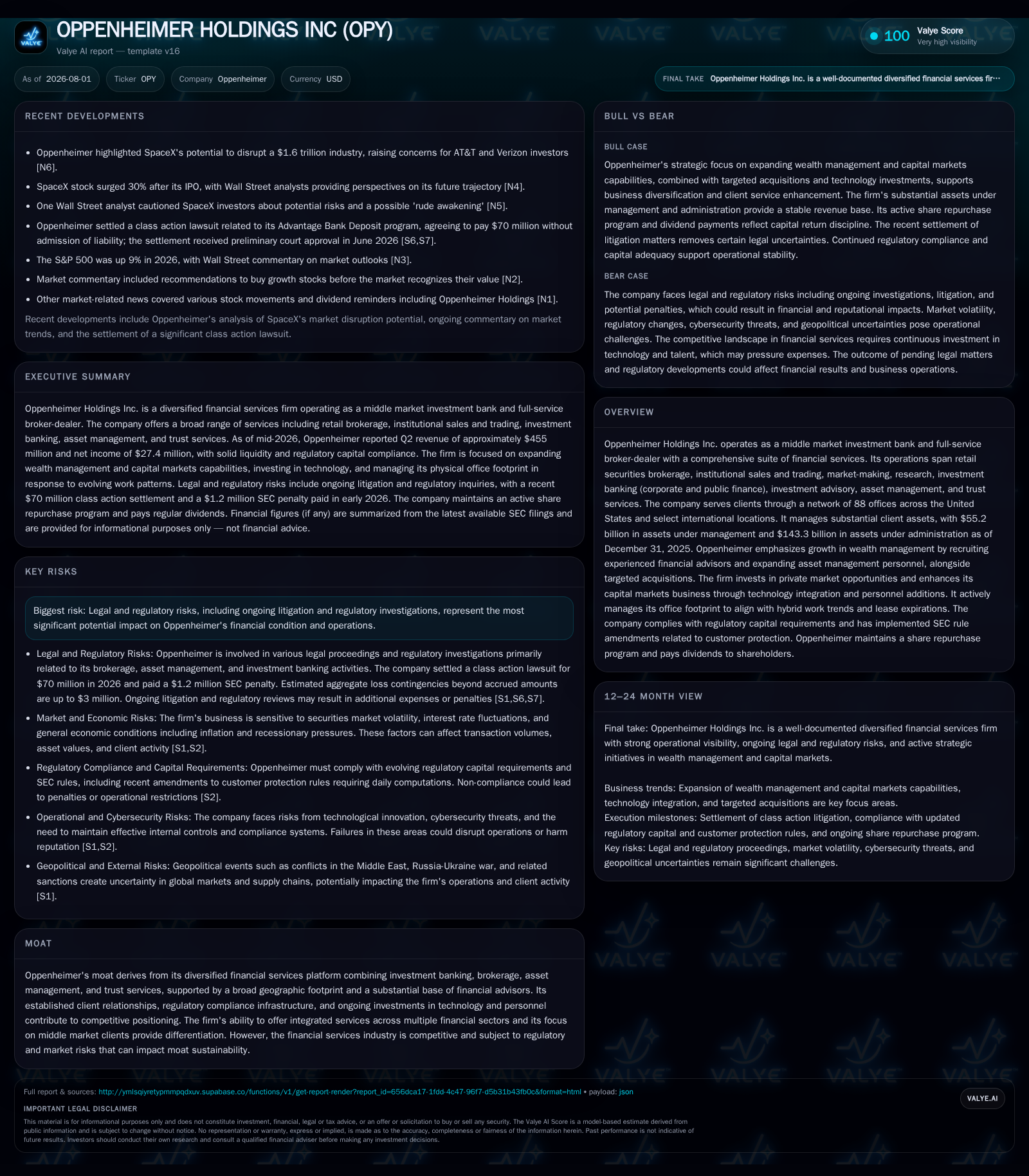
In its latest quarterly filing, Oppenheimer Holdings Inc. highlighted seamless implementation of new SEC customer protection rules alongside steady expansion in wealth management capabilities. The company operates a diversified financial services platform combining brokerage, investment banking, asset management, and trust services primarily targeting middle market clients. Despite legal and regulatory challenges, Oppenheimer maintains robust capital adequacy and focuses on recruiting advisors and augmenting assets under management. Key near-term risks include evolving tax legislation affecting executive compensation and ongoing litigation exposure.
Recent Operating Update
Oppenheimer Holdings reported its second quarter 2026 results with several strategic operational developments anchored by regulatory compliance enhancements. Of immediate note was the firm’s transition to performing daily computations for the customer protection reserve under the amended SEC Rule 15c3-3 effective June 30, 2026—a shift from the previous weekly schedule. This adjustment responds directly to new SEC mandates targeting broker-dealers with average total credits exceeding $500 million to improve customer asset safeguards [S2]. Such proactive adherence signals Oppenheimer's responsiveness to evolving regulatory frameworks that can materially affect operational processes at broker-dealer subsidiaries.
Beyond compliance, the July 31, 2026 earnings release reaffirmed ongoing strengths in wealth management expansion through continued recruitment of seasoned financial advisors alongside asset management team growth. These efforts aim to bolster the $55.2 billion in assets under management (AUM) and $143.3 billion in assets under administration (AUA) reported at year-end 2025 [S1]. The diversified client base served via its national network of approximately 88 offices supports stability across fluctuating markets while driving net new assets accrual—a critical growth lever in the wealth management domain.
Business Model Overview
Operating as a full-service middle market investment bank and broker-dealer, Oppenheimer’s revenue streams derive from multiple integrated sources. Retail brokerage commissions form a core component through execution services provided by a broad network of financial advisors. Institutional sales and trading functions generate transactional commissions and facilitate market-making activities that contribute trading profits. The investment banking segment earns advisory fees from equity/debt underwriting and corporate finance engagements focused primarily on middle market companies.
Additionally, wealth management contributes recurring fee income based on AUM growth plus performance-based incentives, while trust services monetize fiduciary responsibilities by offering estate planning and custodial arrangements. Proprietary trading activities, though less emphasized post-regulatory reform industry-wide, supplement revenue where judiciously managed.
This multi-vertical approach enhances revenue diversification mitigating reliance on any single line [S1]. It also aligns with client preferences favoring one-stop financial solutions that span securities brokerage through advisory to fiduciary services—an entrenched value proposition supporting retention and cross-selling opportunities
Industry Structure and Competitive Position
Within the competitive investment banking and brokerage landscape dominated by large global banks such as Morgan Stanley and Goldman Sachs alongside strong regional players like Raymond James Financial or Stifel Financial Corp., Oppenheimer positions itself as a middle market specialist with extensive retail distribution capabilities. Its roughly 88-office footprint balances geographic reach with focused service models catering to individual investors seeking personalized advisory alongside institutional entities requiring tailored capital raising.
The firm's established platform integrating research insights into advisory franchises bolsters competitive differentiation against pure-play brokerage firms or standalone asset managers that lack comprehensive middle market underwriting or trust capabilities. Moreover, regulatory capital strength—as evidenced by all regulated subsidiaries maintaining net capital above minimum requirements—enables sustained business scale without undue leverage pressure [S2].
However, competitor pressures manifest in talent acquisition dynamics where rival firms aggressively recruit financial advisors who translate directly into revenue generation capacity. Middle market corporate financing activity also presents tailwinds given stable deal flow for acquisitions or recapitalizations requiring bespoke advisory services typically underserved by larger bulge bracket institutions.
Cross-selling across wealth management and investment banking divisions further facilitates organic revenue synergies while private investments diversify risk profiles relative to traditional public markets exposure.
Risks and Watchpoints
Despite robust fundamentals, Oppenheimer contends with notable risks principally centered on legal/regulatory exposures that periodically result in significant accruals or settlements related to securities brokerage or asset management operations [S1]. Governmental investigations from bodies such as the SEC or FINRA alongside pending litigations inject earnings volatility potential. The company prudently accrues for loss contingencies when probable yet often faces inherent uncertainty estimating ranges given early investigation stages.
Regulatory reform also imposes rising compliance costs exemplified by enhanced computation frequency rules impacting operational workflows beginning mid-2026 [S2]. Additionally, changes effective January 1, 2027 expanding Internal Revenue Code Section 162(m) definitions will limit tax deductions on compensation paid above $1 million to a broader group of covered employees. This introduces potential incremental income tax expenses with magnitude dependent on evolving compensation structures within senior ranks [S2].
Market volatility remains a structural risk impacting trading commissions and investment banking fee generation since deal activity frequently correlates with broader capital market health. Operational risks including technology system failures or cybersecurity breaches could disrupt services or damage reputation—critical given the sensitive client data managed throughout trust and advisory functions.
Lastly, competition from fintech entrants increasingly digitizing wealth platforms challenges traditional broker-dealer incumbents like Oppenheimer to continually innovate user experiences or face clientele erosion over time.
What to Watch Next
Investors should monitor sequential quarterly updates for key KPIs such as net new assets flow rates within wealth management segments which drive steady-fee income growth potential. Investment banking deal pipeline health will signal cyclical resilience amid changing economic conditions influencing middle market financing demand.
Progress around advisor recruitment momentum—and retention metrics—will be telling indicators of sustained franchise strength especially as compensation cost headwinds from tax law changes materialize starting fiscal year 2027 [S2]. Regulatory developments relating to the SEC’s proposal permitting semiannual reporting may alter disclosure cadence but currently remain unlikely to reduce transparency levels significantly [S2].
Legal proceedings disclosures will warrant scrutiny for updates potentially affecting earnings visibility or capital adequacy depending on settlement scales accepted or arising penalties [S1]. Further traction deploying private market investments into client portfolios may unlock diversification benefits enhancing long-term competitive advantages if accretive contributions become quantifiable.
Financial Profile Discussion
As of June 30, 2026, Oppenheimer held $38.45 million in cash and cash equivalents providing near-term liquidity buffers supporting working capital needs [F1]. While total debt and net debt figures are only available from mid-2020, with total debt approximately $148.57 million and net debt about $110.12 million at that time, no recent filings indicate material changes to these levels [F1]. The firm confirmed all regulated subsidiaries satisfied net capital requirements comfortably as of Q2 close [S2].
Operating income realized $211 million over fiscal 2025 with revenue topping $1.64 billion emphasizing a stable profitability profile ahead of quarterly run-rates [F1]. Regulatory provisions for legal contingencies remain embedded within operating costs reflecting caution toward loss exposures detailed earlier [S1].
Given income tax expense pressures forthcoming from expanded Section 162(m) limitations combined with evolving compliance cost layers attached to broker-dealer activities, margin compression could surface without offsetting top-line growth accelerators or efficiency gains through technology enhancements and scale economies [S2]
Overall, Oppenheimer maintains a sound financial base enabling continued investment into strategic priorities such as advisor recruitment efforts and private market integration while navigating an increasingly intricate regulatory environment.
This analysis summarizes publicly filed information about Oppenheimer Holdings Inc., incorporates industry context relevant to the investment banking and brokerage sector without speculative forecasts or research views.
Disclaimer: This is research-only, informational analysis and not investment advice. It may include AI-generated interpretation and general industry context. Always verify important details using primary sources.

Comments