
Cohen & Steers Bolsters Liquidity Amid Market Sensitivity and Fee Pressure
The latest quarter highlights Cohen & Steers’ strategic use of product diversification and liquidity management to navigate fluctuating assets under management (AUM) amid market volatility.
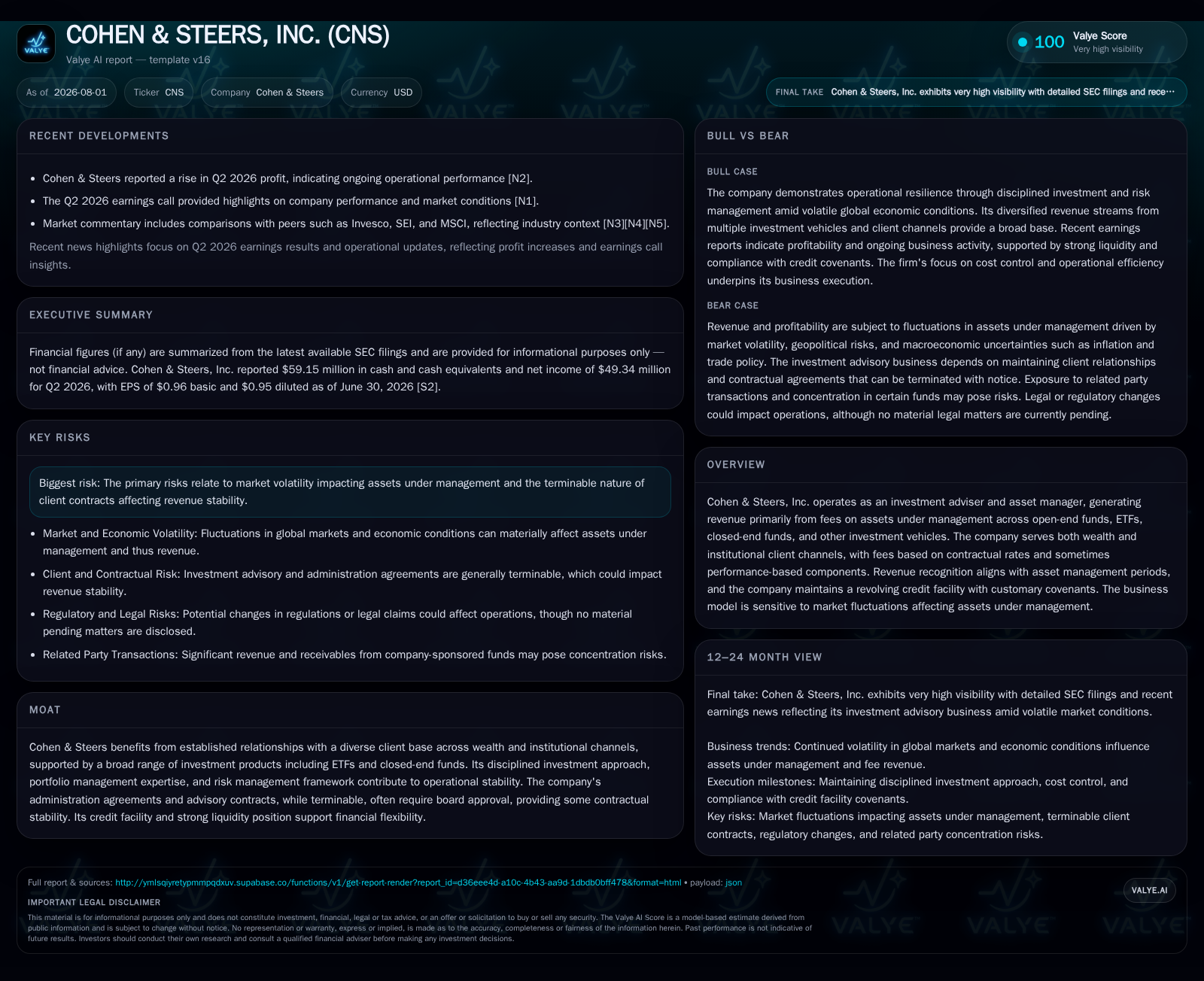
In its Q2 2026 filing, Cohen & Steers reports the operational impact of market-driven changes in AUM on fee-based revenue, reflecting typical industry sensitivity to asset valuations. The company’s increasing emphasis on active ETFs alongside legacy closed-end and open-end funds offers some revenue stability despite market headwinds. Its recent amendment of a $100 million revolving credit facility extends financial flexibility, ensuring resilience amid fee pressure and client contract risks. Monitoring net inflows and client retention will be key to confirming a durable recovery trajectory.
Q2: A Fresh View on Margin Revenue Under Market Flux
Cohen & Steers’ Q2 2026 results disclosed in the July 31 10-Q illustrate how market volatility continues to dictate the trajectory of assets under management (AUM), which fundamentally underpins its fee-based revenue streams [S2]. Management’s discussion highlights fluctuating total AUM influenced by macroeconomic uncertainty affecting portfolio valuations across real assets and alternative income strategies. Given that CNS charges management fees primarily as a percentage of these assets under open-end funds, ETFs, closed-end funds, and advisory mandates, the natural sensitivity to market valuation swings produces corresponding oscillations in top-line revenue. This cyclical dynamic is neither unexpected nor unique to Cohen & Steers but remains a defining feature that investors must weigh when assessing earnings stability.
Notably, CNS actively seeks to mitigate the full brunt of AUM swings through product diversification and disciplined portfolio management. Their mix includes expanding footprints in active exchange-traded funds (ETFs) such as the Short Duration Preferred & Income ETF and Infrastructure Opportunities Active ETF launched recently with meaningful ownership stakes noted at quarter-end [S2]. These newer vehicles tend to enjoy more stable fee arrangements than certain legacy closed-end funds whose valuations can be more volatile. The interplay between these products' growth offsets some decline potential from traditional segments.
Fee Structure and Product Mix: How Cohen & Steers Translates AUM Into Revenue Stability
Cohen & Steers monetizes its business primarily through management fees pegged to contractual rates on client assets under custody or advisory arrangements [S1]. While these fees are recurring by nature, their scale directly correlates with total AUM – making volume driven by markets and net flows critical. Additionally, selective performance fees supplement base revenues when CNS outperforms benchmarks on specific investment models or accounts
The company’s evolving product suite blends open-end funds catering mostly to institutional clients with an increasing push into ETFs appealing also to wealth-oriented channels. Closed-end funds remain material components but subject to distinct NAV revaluation dynamics impacting fee economics differently than constantly priced ETFs [S1][S2]. This multi-channel approach reflects an industry trend where active ETF adoption gains ground among asset managers such as BlackRock or T. Rowe Price due to regulatory tailwinds and investor preference for liquidity combined with active management.
Maintaining a balanced product mix is strategically significant because it cushions fee revenues from concentrated risks inherent in any single vehicle type or client cohort. Cohesion among fee types—management versus performance fees—and client segmentation defines operational leverage opportunities that underwrite margins.
Competitive Dimensions: Positioning Amongst Leading Asset Managers With Active ETF Growth Trends
Within the asset management landscape, Cohen & Steers occupies a specialized niche emphasizing real assets and alternative income products relative to broad-based managers like BlackRock or T [S1]. Rowe Price. Its focus on multi-strategy solutions leveraging private real estate, preferred securities, infrastructure equities alongside listed resource equities distinguishes its product set
Peer benchmarking reveals fee structure sensitivity common across firms where market-driven asset valuation changes strongly influence recurring revenues. However, CNS differentiates itself via selective active ETF innovation—an area rapidly scaling industry-wide due to cost transparency and liquidity advantages—while also navigating legacy closed-end fund exposure.
Investment performance relative to benchmarks remains central to sustaining pricing power and client retention within this competitive set. The company’s robust risk management framework supports steady adherence to regulatory compliance while seeking consistent outperformance that feeds performance-based contractual incentives.
Client Channels and Contractual Foundations: Balancing Wealth and Institutional Relationships in Volatile Markets
CNS serves both institutional clients managing large pools of capital via advisory mandates or open-end funds, plus wealth management segments accessing ETFs or mutual fund-like structures [S1]. Client contracts underpinning these relationships generally include provisions for termination but often require approval by respective boards of directors for administration agreement changes – adding layers of governance that help secure continuity.
Client retention rate thus emerges as a crucial KPI reflecting revenue predictability amid macro uncertainties. Diversification across institutional versus retail-oriented wealth channels offers resilience against isolated attrition events during downturns.
This structural balance enables CNS some insulation from full exposure should one channel experience disproportionate net outflows; however, sharp or prolonged market declines could still pose renewal risks.
Growth Trajectories: Innovation and Distribution Expansion Versus Market Headwinds
Looking forward, Cohen & Steers emphasizes expanding its active ETF offerings and multi-strategy products as key growth levers complemented by enhancing digital engagement tools aimed at improving client experience [S1][N1]. Geographic expansion via offices spanning New York City, London, Dublin, Hong Kong, Tokyo, and Singapore adds dimension for tapping new institutional pockets globally.
Successful product innovation coupled with strengthened distribution relationships remains vital given prevailing fee compression pressures across the industry broadly triggered by heightened competition from low-cost passive index alternatives.
Net inflow momentum into actively managed vehicles will serve as confirmation that CNS’s investment propositions resonate sufficiently despite heightened volatility in underlying markets.
Watchpoints: Client Retention Risks and Pressure Points from Market Volatility Detail How Fee Outcomes Could Evolve Next Quarter
Key risks include ongoing market-driven AUM contraction which would erode management fees materially absent offsetting net inflows or strong investment outperformance eliciting performance fees [S2][S3]. Regulatory developments potentially influencing allowable fee structures or product availability could compound headwinds.
Operationally, cybersecurity risk is acknowledged but well-managed through executive-led governance frameworks including a dedicated CISO team overseeing response plans – mitigating potential reputational damage although perpetual vigilance is warranted given increasing threat landscapes [S1].
Investor attention should closely track subsequent quarter metrics on net cash flow trends across key products plus client contract renewal patterns as leading indicators for revenue visibility.
Financial Profile Discussion: Capital Structure Resilience Reflecting Strategic Liquidity Management
The company reaffirmed its commitment to prudent capital allocation by amending its revolving credit facility with Bank of America extending maturity through August 2029 with $100 million capacity bearing variable interest linked to SOFR or base rate loans plus performance pricing spreads [S2]. This liquidity arrangement enhances operational flexibility supporting working capital needs amid episodic AUM fluctuation-related revenue impacts.
As of June 30, 2026, cash and cash equivalents stood at approximately $59 million providing additional buffer for general corporate purposes alongside the credit line [F1]
Overall, Cohen & Steers navigates an inherently volatile sector environment with tactical liquidity bolstering complemented by diversified fee sources rooted in evolving product innovations designed to smooth revenue cyclicality.
Disclaimer: This is research-only, informational analysis and not investment advice. It may include AI-generated interpretation and general industry context. Always verify important details using primary sources.

Comments