
Colgate Palmolive's Margin Resilience Through Strategic Segment Realignment and Pet Nutrition Growth
Q2 2026 filings reveal Colgate’s segment realignment and Australian pet nutrition acquisition underpin operational efficiency and market expansion.
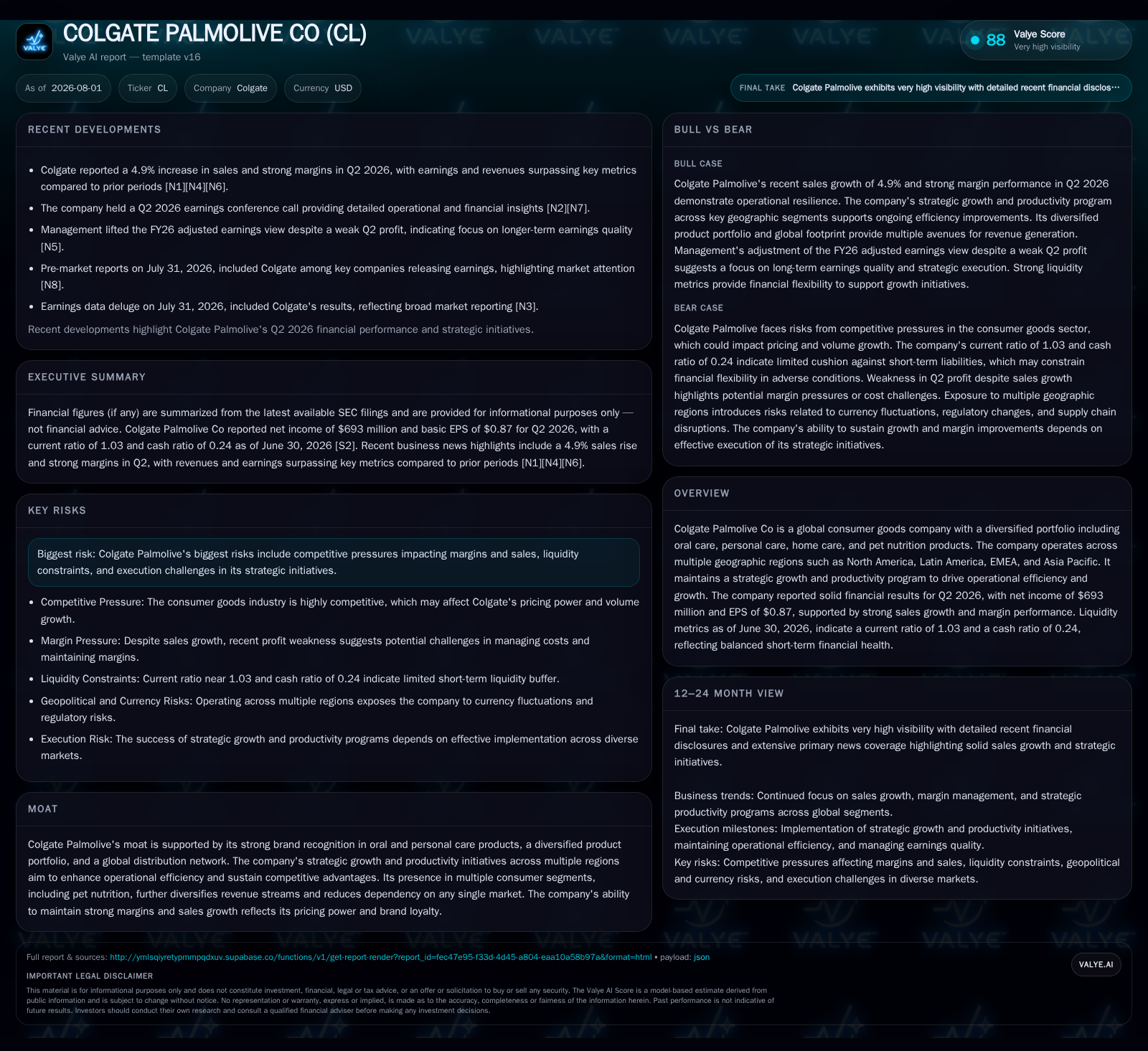
Colgate Palmolive’s Q2 2026 report highlights key operational shifts including the geographic realignment of its Oral, Personal and Home Care segments and the strategic acquisition of the Prime100 fresh pet food business in Australia. These moves are part of an expanded Strategic Growth and Productivity Program focused on SKU rationalization and supply chain optimization to sustain margin expansion despite inflationary headwinds. The diversified portfolio, anchored by strong brand equity across oral care and pet nutrition, supports pricing power and organic growth across heterogeneous global markets. Liquidity remains stable with a current ratio of 1.03 as the company balances investments for future competitiveness amid intensifying competition.
Q2 Operational Shifts: Realignment and Acquisition Strengthen Growth Platform
Colgate Palmolive's latest quarterly filing dated July 31, 2026, reveals substantive changes impacting its reporting structure and category footprint that directly influence its path to enhanced operational efficiency and regional growth [S2],[S3]. Effective March 31, 2026, the company realigned its geographical reporting segments within the Oral, Personal and Home Care business by merging Europe with Africa/Eurasia to better leverage scale advantages across these contiguous markets. Concurrently, Russia and Belarus shifted from Africa/Eurasia into Asia Pacific reporting—a move likely reflecting evolving geopolitical realities and supply chain logistics [S2]. This reorganization emphasizes management's intent to optimize resource allocation at a regional level given heterogeneous consumer behavior patterns.
In parallel to the structural realignment is Colgate’s April 30, 2025 acquisition of Care TopCo Pty Ltd, owner of Prime100—a premium pet food business specializing in fresh formulations—expanding the Hill’s Pet Nutrition segment strategically into Australia's fast-growing fresh pet food category [S2]. The integration offers exposure to higher-margin subcategories characterized by health-conscious consumer trends demanding premium, perishable products. Notably, this foothold could serve as a platform for broader international expansion within similar developed or emerging markets where fresh pet nutrition is gaining traction.
Brand Portfolio Dynamics: Diversified Segments Driving Pricing Power and Household Reach
Colgate’s business model spans two product segments: Oral, Personal and Home Care; and Pet Nutrition. The former is managed through four geographic lenses—North America, Latin America, EMEA (Europe/Middle East/Africa), and Asia Pacific—enabling tailored marketing approaches aligned with regional cultural preferences [S2]. Each segment benefits from leading brand equity cultivated over decades, granting robust household penetration crucial for maintaining steady revenue flows amid promotional fluctuations and competitor activity [S1]. This diversified offering mitigates risks associated with category-specific demand shocks while enhancing total revenue stability.
Pricing power is sustained through carefully balanced promotional intensity. Though discounting remains essential in competitive retail environments dominated by global conglomerates such as Procter & Gamble and Unilever, Colgate’s brands typically command premium positioning supported by perceived quality assurances. This dynamic helps preserve gross margins despite persistent input cost inflation — a key challenge across the Consumer Packaged Goods landscape [S1],[N1]. Furthermore, product innovation in both oral care (e.g., advanced formulations) and pet nutrition contributes differentiation that underpins willingness to pay beyond low-price alternative options.
Competitive Dynamics and Market Structure: Balancing Promotional Intensity and Margin Pressure
Within the broader competitive ecosystem, Colgate faces pressure from industry stalwarts such as P&G and Unilever who aggressively pursue geographical streamlining initiatives like those recently implemented by Colgate [S1]. These peers similarly emphasize SKU rationalization efforts coupled with supply chain optimization to counteract margin erosion driven by rising raw material costs (notably glycerin, flavor oils, packaging resin) [S1],[N2]. Church & Dwight serves as a relevant oral care-focused peer whose margin management strategies offer indirect comparatives.
Colgate’s ability to defend pricing while controlling promotional spend effectiveness directly impacts profitability metrics including operating income. The company’s layered approach—sustaining brand loyalty via household penetration yet flexibly adjusting channel mix away from deeply discounted outlets when possible—represents a core margin resilience mechanism against cyclical inflation cycles common in CPG sectors [S1],[N1],[N2].
Strategic Growth Initiatives: SKU Rationalization and Supply Chain Optimization Advances
Central to Colgate’s improvement agenda is its Strategic Growth and Productivity Program approved in mid-2025 but expanded in April 2026 targeting cumulative pre-tax charges between $350 million to $550 million alongside projected annualized savings of $200 million to $300 million post-implementation [S2],[S6]. Key initiatives focus on simplifying product portfolios through targeted SKU reduction strategies facilitating faster inventory turnover ratios—a metric indicative of working capital efficiency improvements—and direct cost savings on manufacturing complexity [S2],[N2].
Supply chain optimization efforts further target shrinkage of indirect expense lines including logistics consolidation, raw material substitution where feasible without compromising quality standards, and supplier consolidation leveraging volume-based purchasing terms [S6]. These systemic enhancements enable incremental funding capacity reinvested into innovation pipelines or marketing support enhancing growth prospects beyond cost containment.
Pet Nutrition Expansion: Fresh Category Entry Bolsters Hill’s Segment Positioning
The acquisition of Prime100 underscores Colgate’s strategic pivot toward premium pet nutrition categories aligning with shifting consumer preferences toward natural ingredients and fresh products—a segment notable for stronger gross margin profiles compared to traditional dry kibble or canned foods [S2]. This move brings diversification benefits reducing reliance on mature oral care categories subject to commoditization risk while tapping into an accelerating niche deemed both sustainable long term and scalable across other regions potentially following demonstration effects from Australian market acceptance.
Prime100's presence also heightens Hill’s competitive stance vis-à-vis major global players like Nestlé Purina which has invested heavily in health-oriented pet food lines; such expansions confirm industry-wide recognition of pet nutrition's growth potential vis-à-vis slower growing personal/home care businesses [S1]. The degree of integration success within Australia will materially affect timelines for replication internationally.
Emerging Market Penetration: Geographic Realignment Unlocks Regional Scale Efficiencies
Colgate’s segment reporting changes integrate operational realities whereby combining Europe with Africa/Eurasia clusters regional consumer bases exhibiting varied socio-economic profiles but sharing logistical infrastructure advantages [S2]. This rationalization supports economies of scale particularly relevant for distribution networks servicing densely populated European urban hubs alongside emerging African markets undergoing rising consumption rates.
Moving Russia/Belarus into Asia Pacific reflects strategic repositioning amid geopolitical uncertainty impacting trade flows—increasingly pushing these countries’ commercial activities towards APAC frameworks rather than traditional Eurasian corridors [S2]. This reclassification may enable more responsive local marketing programs optimizing channel mix amid differing consumer habits compared with Western Europe.
Risks On Horizon: Inflationary Pressures, Execution Risks, and Competitive Intensity
Despite clear strategic intent, Colgate faces several risks rooted fundamentally in macroeconomic volatility affecting raw material costs—including petrochemical derivatives critical for packaging—and fluctuating foreign exchange rates inherently tied to its global footprint [S1],[N1]. Execution complexities related to scaling up productivity initiatives pose timing risks; pre-tax charges booked during Q1-Q2 signal upfront investment but realization hinges on efficient project rollouts without disrupting ongoing operations [S2],[S6].
Competitive intensity among large multinational CPG firms sustains pressure on pricing power with retail giant relationships demanding volume discounts or increased promotional activity which can compress margins if not carefully managed. Additionally, sector-specific regulatory compliance around product safety or sustainability requirements could generate unforeseen costs.
What Investors Should Monitor Next: Guidance Signals, Sales Metrics, Productivity Milestones
Stakeholders should prioritize monitoring sequential organic sales growth figures differentiation between volume versus price/mix drivers reported quarterly along with gross profit margin trends indicating efficacy of inflation pass-through measures [N1],[S2]. In parallel, updates surrounding SG&A leverage resulting from productivity program implementation will signal progress toward sustainable expense control without impairing brand-building investments.
Household penetration changes within key geographies provide insight into brand loyalty shifts that underpin long-term demand stability; any acceleration could validate innovative launches or channel diversification strategies. Furthermore, competitive moves by peers in geographic segmentation or acquisitions may recalibrate market share dynamics warranting recalculation of strategic positioning benchmarks.
Financial Profile Discussion: Liquidity Stability Amid Investment for Future Growth
As of June 30, 2026, Colgate maintains a balanced liquidity profile evidenced by a current ratio approximating 1.03 supported by $1.37 billion in cash and equivalents against $6.15 billion current liabilities reflecting disciplined short-term asset-liability management aligned with operational cash flow generation capacity [F1],[S2]. Although net debt remains substantial—around $2.4 billion—the firm’s strong free cash flow generation historically enables manageable interest coverage facilitating strategic investments including capex targeted at high-growth segments like Pet Nutrition [F1],[S2].
Net income for Q2 reached $693 million with EPS of $0.87 supported by robust sales momentum (+4.9% sales rise reported) illustrating partial offset to cost pressures via pricing strategies integrated within segment realignments [N1],[S2]. These financial results underscore the synergy between operational changes documented earlier while indicating adequate cushion for dividends alongside share repurchase programs anchor investor confidence.
This analysis synthesizes publicly filed SEC data with sector-level insights typical for diversified global consumer packaged goods companies managing complex portfolios spanning mature oral care products through higher-growth pet nutrition categories. All financial metrics cited derive from latest source filings as referenced. No investment research views are made herein.
Disclaimer: This is research-only, informational analysis and not investment advice. It may include AI-generated interpretation and general industry context. Always verify important details using primary sources.

Comments