
IES Holdings Expands Market Reach Amid Cyclical Pressures and Contract Risks
The company’s Q3 2026 results show resilience through diversified segments and steady recurring revenue despite cyclical headwinds and fixed-price contract challenges.
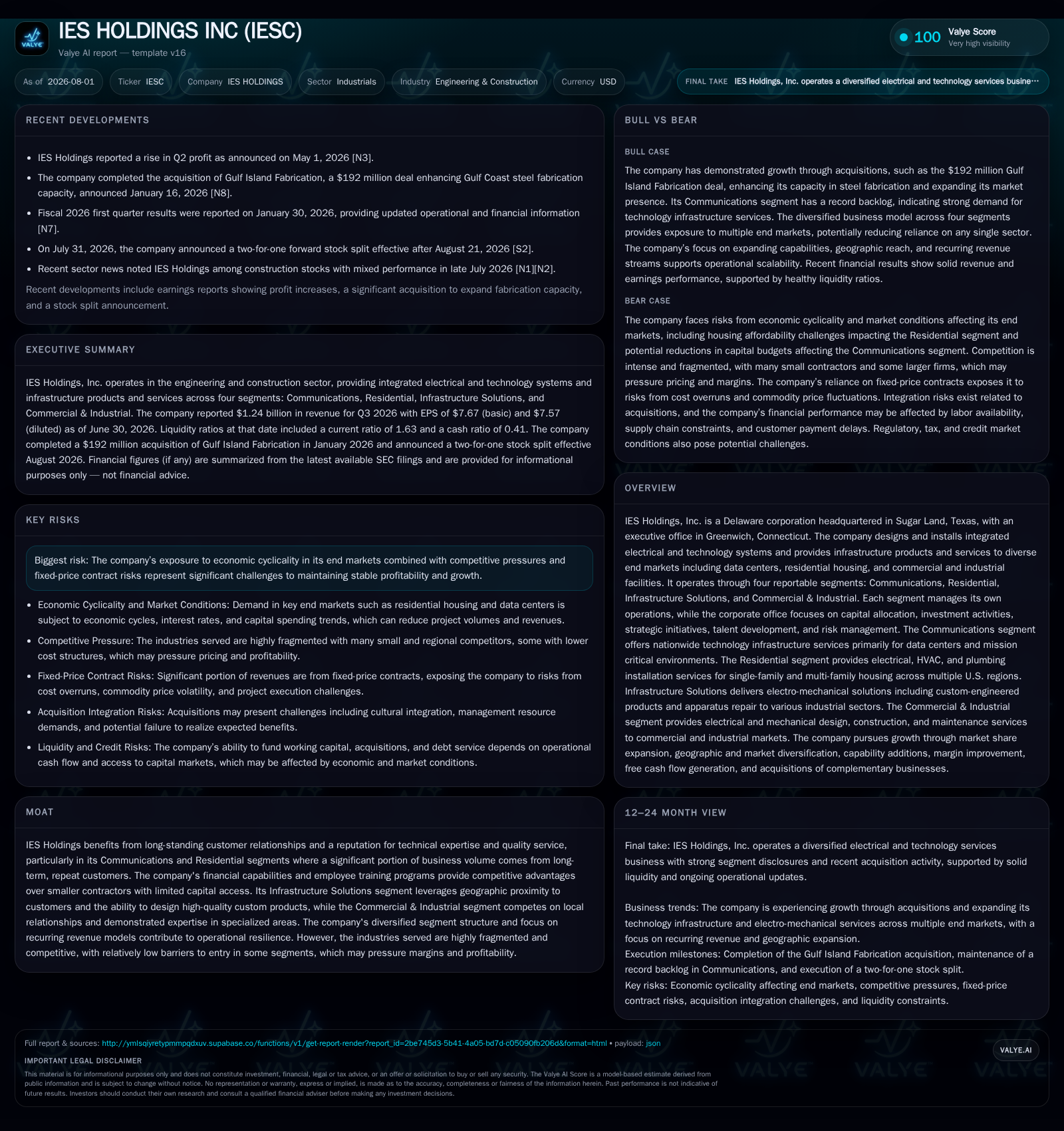
IES Holdings’ latest quarterly filing reveals that although economic cyclicality pressures some segments, particularly Residential and Communications, the company’s diversified business model anchored by recurring revenue streams in technology infrastructure and maintenance services supports stability. Backlog levels reflect cautious project timing but remain robust, while fixed-price contracts continue to present margin management challenges amid inflationary cost inputs. The company’s strategic capital allocation, including acquisitions, aims to expand geographic reach and capabilities to better weather competitive and market risks.
Q3 2026 Backlog Trends Signal Navigated Economic Cyclicality
The nature of the backlog is critical here: IES relies heavily on fixed-price contracts across its segments, meaning profit realization depends on accurate bid estimating during volatile input costs [S1]. As such, a stable or slightly growing backlog tempered with pricing discipline suggests risk-aware project intake management [S1,S2]. This approach is necessary given the historical volatility seen in technology infrastructure spending within the Communications segment and varying residential construction activity
Segment Revenue Dynamics Reflect Diverse End-Market Exposure and Recurring Streams
IES operates through four distinct reportable segments — Communications, Residential, Infrastructure Solutions, and Commercial & Industrial — each contributing differently to top-line resilience [S1,S10]. The Communications segment stands out as a nationwide provider of integrated technology infrastructure services focusing on data centers for large corporates and co-location clients. This segment benefits from long-term repeat customers who contract not only new buildouts but often maintenance services, thereby creating recurring revenue streams less sensitive to economic cycles [S5,S10]
Conversely, the Residential segment remains regionally focused on electrical installations as well as HVAC and plumbing in single-family homes and multi-family apartments. This segment reflects higher seasonal variability and sensitivity to housing market fluctuations influenced by mortgage rates and affordability constraints [S14,S15]. Recent declines in multi-family starts have pressured this segment's backlog while single-family demand remains geographically concentrated primarily in Texas and Florida [S14]
Infrastructure Solutions provides custom electro-mechanical products such as generator enclosures serving industrial customers including data centers—a high-technical-content niche offering manufactured equipment paired with repair services. Here, demand correlates with capital investments in power generation and industrial upgrades that tend to be lumpy but offer higher margin potential due to customization [S12,S15]
The Commercial & Industrial segment addresses a broad range of electrical and mechanical design-build projects for commercial buildings, manufacturing plants, healthcare facilities, wind farms, transmission lines, amongst others. This segment benefits somewhat from maintenance contracts alongside initial construction projects but faces cyclical pressure tied to regional economic activity [S18,S21].
Overall, this mix tempers volatility. While the Residential segment currently softens top-line growth due to housing slowdowns, recurring maintenance revenue especially in Communications is helping stabilize cash flows [S5]. Continued investment into expanding the maintenance base also supports margin sustainability by generating work less exposed to new build timing risks
Fixed-Price Contract Management Shapes Margin Sustainability Amid Input Cost Volatility
A significant portion of IES's revenues arise under fixed-price contracts where the company commits upfront pricing while bearing the risk of material cost inflation or labor shortages during execution [S1,S2]. This dynamic requires rigorous project bidding discipline coupled with proactive management of change orders and claims.
The recent quarter reflects ongoing margin pressure as inflationary wage escalations persist alongside supply chain delays prolonging project timelines. These factors increase direct costs which are difficult to fully recoup once contracts are locked in at fixed prices [S1]. Operating leverage helps absorb some input cost increases during higher volume periods; however uneven project scheduling reduces this benefit occasionally.
The company’s ability to maintain profitability depends heavily on accurate pre-bid cost forecasting including commodity price trends (especially copper, steel), skilled labor availability, and effective change management practices during construction phases [S19]. While macroeconomic pressures are externalities beyond direct control, IES's scale compared with smaller contractors grants some negotiating power over suppliers potentially mitigating input price spikes relative to peers lacking similar purchasing leverage.
Capital Allocation Strategy Supports Growth Through Acquisitions and Market Expansion
Corporate strategy emphasized in both annual reports and recent event disclosures affirms a disciplined capital allocation approach favoring acquisitions complementary to existing segments enabling service breadth expansion or geographic reach extension [S1,S4].
IES targets businesses with proven management teams willing to stay post-acquisition along with sustainable competitive advantages such as specialized product offerings or proprietary engineering expertise—factors reducing technological obsolescence risk while enhancing cash flow stability [S4]. Given the fragmented nature of many served markets dominated by smaller local competitors lacking scale or financial backing, acquisitions serve as an organic growth accelerator alternative when organic bidding environments are highly competitive.
Financial strength discussed below supports this strategic posture as zero reported debt at year-end 2025 heightens capacity for selective bolt-on deals without over-leveraging balance sheet health [F1]. Syndicated credit lines or cash reserves provide additional optionality should larger platform acquisitions arise.
Competitive Position Hinged on Technical Expertise and Long-Term Customer Relationships
IES distinguishes itself in a fragmented industry landscape dominated by numerous small private contractors through sustained investment in its workforce technical training programs combined with deep-rooted client relationships particularly within data center communications infrastructure projects known for mission-critical reliability demands [S5,S10].
These relationships often translate into preferred provider status fostering repeat business reinforcing revenue visibility beyond transactional new build work alone. Financial capability allows absorption of project execution risks smaller rivals cannot shoulder easily given capital constraints—a critical advantage when fixed-price contracting magnifies exposure.
Furthermore, the company's ability to produce custom-engineered products close to customer sites coupled with rapid response apparatus repair strengthens reputation for quality service delivery unmatched by vendors reliant purely on commoditized offerings or remote production hubs [S16,S17]
Labor Market Conditions and Supply Chain Factors Impact Execution Cost Profiles
Like many peers in engineering construction sectors, IES faces heightened execution risks stemming from tight skilled labor markets driving wage inflation plus supply chain delays stretching equipment lead times beyond historical norms [S1,S2,S19,S21]. For instance:
- Delays sourcing metal-enclosed bus duct components or switchgear extend project schedules increasing indirect costs.
- Wage escalation impacts both field labor utilized across installations as well as shop craftsmen engaged in manufacturing custom parts.
Though some inflationary costs are offset through contract change orders or escalator clauses where possible, opaque downstream supplier pricing introduces earnings variance unpredictability necessitating careful margin monitoring at both job-level accounting systems as well as consolidated operating results.
Risks Emanate From Pricing Pressure, Contract Timing, And Economic Uncertainty
Challenges remain entrenched given low entry barriers especially in certain residential electrical contracting markets promoting intense price competition potentially constraining profitability if market share gains require aggressive bidding [S1,S26]. Additionally:
- Economic cycles materially influence demand reflecting sensitivity of sectors served including housing starts or corporate capex budgets.
- Fixed-price contracting inherently exposes margins when input assumptions prove inaccurate compounded by inflationary volatility.
- Geographic diversification provides some buffer but regional recessions could still depress multiple segments simultaneously.
- Regulatory compliance complexity with operations spanning numerous states invites operational risk interruption potential. Overall risk mitigation hinges on maintaining pricing discipline backed by technical excellence ensuring customer retention plus flexible cost structures adaptable across cycles.
"What to Watch" Next: Bid Pipeline Development & Strategic Acquisition Progression
Critical near-term indicators will revolve around the health of IES’s bid pipeline—a forward-looking metric foreshadowing future backlog growth or contraction—disclosed periodically through investor presentations and earning calls scheduled following fiscal quarters ending September 30th annually [S2,S3]. Monitoring shifts there will clarify demand trends essential for forecasting subsequent quarterly revenues amid prevailing economic uncertainties.
Acquisition announcements or integration progress updates will also shape investor sentiment toward growth trajectory prospects given corporate emphasis on inorganic expansion strategies documented prior years with no material recent change in policy direction noted yet continued capital readiness [S4,S6,S7].
Financial Profile Discussion: Strong Liquidity Enables Flexibility
As of June 30th, 2026 balance sheet highlights reveal $77.3 million cash & equivalents alongside current assets totaling approximately $1.53 billion versus current liabilities around $942 million resulting in a healthy current ratio of approximately 1.63 indicating solid short-term liquidity integrity supporting operational requirements comfortably [F1]. Notably zero reported long-term debt at December 31st 2025 further underscores a clean leverage profile providing substantial financial flexibility for capital investments including acquisitions or buffering against any cyclical downturn shocks factoring into working capital needs [F1].[S2]
This conservative capital structure contrasts favorably against some peers within broader electrical contracting industries where leveraged balance sheets introduce refinancing risk under interest rate hikes. Free cash flow generation remains an important metric linked closely with sustaining deleveraging momentum enabling reinvestment capacity importantly aligned with stated corporate strategies focused on margin improvement alongside measured growth via talent investment plus select business combinations [S1,S4]
This analysis synthesizes publicly filed documents without speculative assumptions; it aims to aid understanding of IES Holdings’ position within an economically sensitive yet opportunity-rich engineering and construction niche emphasizing electrical contracting and technology infrastructure installation services. Readers should consider published data as sources underpinning the insights herein.
Disclaimer: This is research-only, informational analysis and not investment advice. It may include AI-generated interpretation and general industry context. Always verify important details using primary sources.

Comments