
OLIN's Strategic Shift: Merger, Margins, and Market Mix in Q2 2026
OLIN reports widening Q2 loss amid raw material cost pressures while advancing a transformative merger with Huntsman.
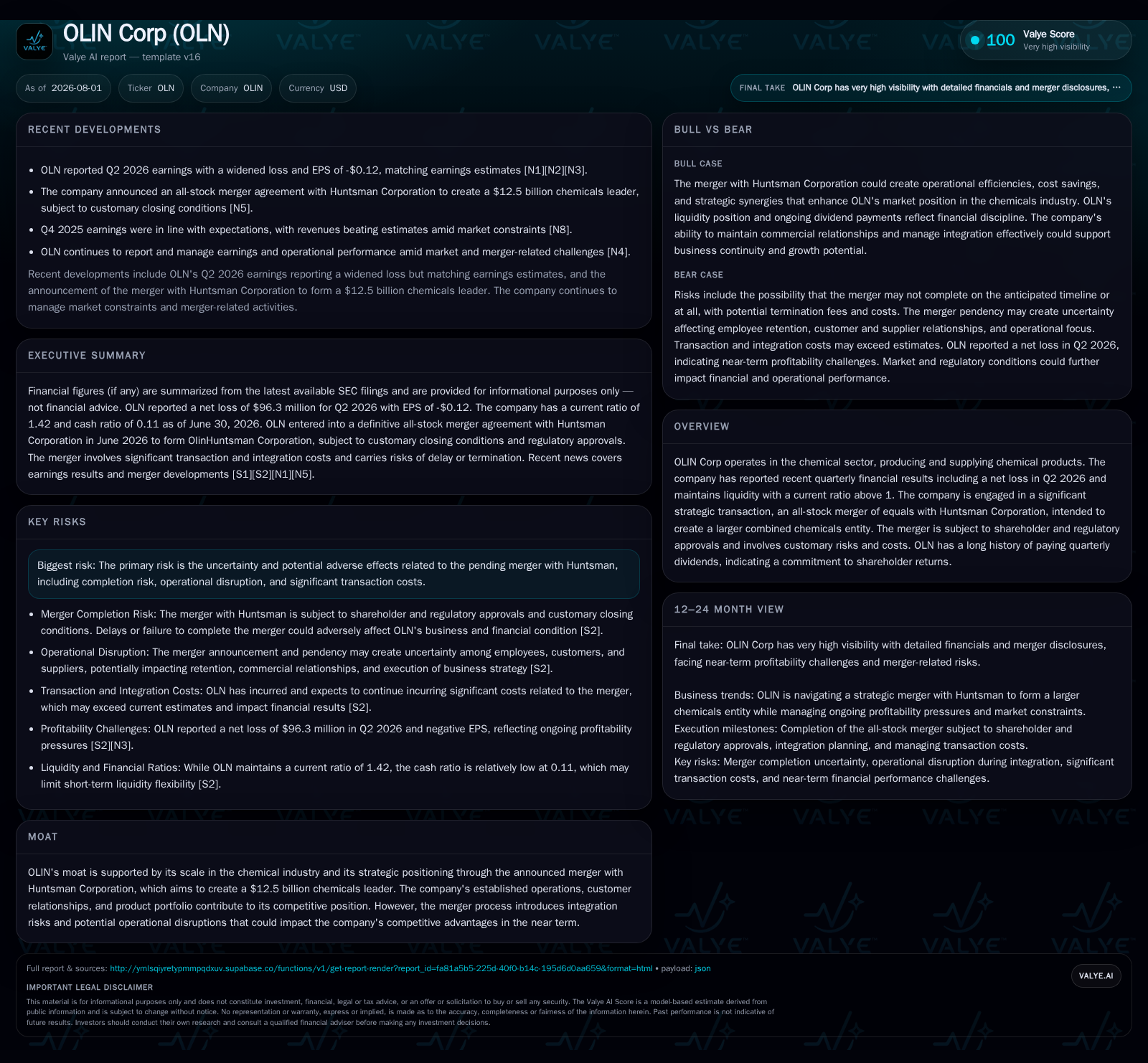
In its Q2 2026 filing, OLN reported a net loss reflecting margin compression from elevated feedstock costs and operational challenges. The company’s ongoing all-stock merger with Huntsman Corporation aims to create scale synergies but introduces execution and integration risks. OLN’s business blends commodity chlor-alkali products with specialty chemicals, exposing it to volatile input costs balanced by industrial customer contracts and capacity utilization trends. Key near-term milestones include regulatory approvals and synergy realization.
Q2 Margins under Pressure Amid Feedstock Cost Trends
OLIN Corporation’s second quarter of 2026 revealed margin pressures manifesting in a widened net loss, reflective primarily of escalating feedstock costs that squeezed operating income. The company’s commodities-oriented chlor-alkali segment—which includes caustic soda production—faces tight input cost dynamics typical of basic chemical manufacturing [S2][S3][N6]. This segment’s heavy dependence on raw materials links profitability closely to raw material cost per unit metrics, where sharp rises can outpace customer pricing adjustments due to contract terms or market cyclicality. Consequently, revenue growth reliant on production volume and average selling price per unit is vulnerable when capacity utilization softens or feedstock prices spike without commensurate pricing power.
The recent earnings announcement highlighted how these pressures offset stable or modestly growing volumes, underscoring the criticality of operating margin management in OLN's value chain positioning as a chlor-alkali producer supplying industrial end markets reliant on consistent supply agreements [S3]. Industry peers such as Westlake Chemical have similarly experienced margin fluctuations tied to commodity cost swings, emphasizing sector-wide challenges in balancing volume leverage against cost inflation.
Strategic Impact of Huntsman Merger: Scale Gains vs. Integration Challenges
A pivotal development shaping OLIN's strategic outlook is its announced all-stock merger agreement with Huntsman Corporation—a leading diversified chemical manufacturer—intended to create a combined entity valued at approximately $12.5 billion [S2][S3]. The transaction represents a "merger of equals," aiming to harness transaction synergies through enhanced scale in basic and specialty chemicals. This consolidation seeks to optimize capital expenditures by leveraging combined production capacity and broaden the product portfolio across chlor-alkali intermediates and specialty formulations including epoxy resins.
However, the filing emphasizes notable integration risks: delays or failure to satisfy regulatory approvals or shareholder votes could forestall completion while also engendering operational disruptions that may dampen capacity utilization rates or jeopardize contract renewal stability during transition phases [S2]. The required management attention diversion towards merger execution potentially detracts from day-to-day operational focus. Moreover, transaction-related advisory, legal, and integration planning expenses weigh on near-term financial results regardless of closure outcome [S2]. These factors underscore a significant risk dimension intertwined with strategic consolidation benefits.
Business Model Analysis: Balancing Commodity Exposure with Specialty Chemicals
OLIN's business architecture is defined by a dual exposure to commodity-based chlor-alkali products—chiefly caustic soda—and formulated specialty chemicals such as epoxy resins serving diverse industrial applications [S1]. Revenue flows derive principally from volume sales backed by long-term supply contracts with industrial clientele across sectors like automotive manufacturing, agriculture, construction materials, and consumer goods production.
Price realization hinges upon both prevailing commodity market conditions for the bulk chemicals side and differentiated specialty chemistry offerings where innovation can support premium pricing [S1][S2]. The company's capital-intensive operations necessitate ongoing maintenance and expansion capital expenditures to sustain plant uptime and capacity utilization—a key performance indicator directly linked to fixed-cost dilution and margin enhancement
Operating margin volatility correlates strongly with feedstock costs per unit; hence active procurement strategies and supply agreements are vital for cost control. Capacity utilization rate fluctuations directly influence production volumes measured in tons or pounds produced, impacting topline revenue density and cash flow conversion kinetics inherent in the chemical manufacturing value chain.
Industry Context: Consolidation and Competition Among Basic and Specialty Chemicals
Within the evolving landscape of basic and specialty chemicals, OLIN's positioning amid increasing industry consolidation exemplified by its Huntsman merger aligns with broader sector trends favoring scale economies for cost containment and portfolio diversification [S1][S2]. Peers including Dow Inc., Westlake Chemical, Axiall Corporation, and LyondellBasell Industries similarly pursue integrated operations spanning chlor-alkali products through specialty chemistries to maintain competitiveness.
Competitive pressures arise from excess industry capacity that can constrain pricing power across commodity segments alongside innovation imperatives within specialty chemicals to differentiate offerings. Integration into a larger combined entity theoretically enhances negotiating leverage over raw material suppliers and broadens geographic market reach—both crucial for sustaining contract renewal rates essential in the industrial goods supply chain.
Growth Drivers: Capacity Utilization Improvements and Market Expansion Potential
Growth vectors for OLIN are grounded in incremental gains from higher capacity utilization rates which amplify fixed-cost absorption benefits thereby improving operating margins per ton produced. Enhanced plant uptime reliability metrics serve as operational performance levers enabling increased throughput without proportionate incremental capex.
Additionally, the firm has avenues for expanding within specialty chemical markets where innovation-driven demand growth persists particularly in emerging geographies serviced by durable industrial sectors such as automotive assembly lines or agricultural inputs manufacturers seeking high-performance chemical intermediates [S1]. This specialization affords some insulation from raw material price cyclicality prevalent in bulk chemical production.
Risks Spotlight: Merger Execution Risk, Commodity Volatility, Regulatory Compliance
Primary risk considerations revolve around the successful consummation of the Huntsman merger given its dependence on multi-jurisdictional regulatory clearances and affirmative shareholder votes from both parties [S2][S7]. Delays jeopardize anticipated strategic benefits while concomitantly imposing ongoing transactional costs that erode short-term earnings quality.
The chemical sector’s inherent susceptibility to feedstock volatility remains acute; spikes in natural gas or chlorine feedstock prices elevate unit costs abruptly undermining flexible pricing mechanisms especially under long-term supply agreements or contracted volumes [S7]. Environmental compliance expenditures and potential legal contingencies further add complexity given rigorous regulations governing hazardous chemical manufacture coupled with evolving public policy demands.
Cyclicality within end markets intensifies these risks as economic slowdowns reduce downstream demand volumes complicating order backlog health or contract renewal prospects critical to revenue visibility.
Next Milestones to Watch: Merger Approvals, Synergy Realization Phases
Key near-term events shaping OLIN’s trajectory include pending regulatory approval processes scheduled through late 2026 alongside corresponding stockholder meetings expected to vote on the proposed transaction terms [S2][S3]. These steps act as gating factors for merger closure timing which will determine integration commencement windows.
Early phases of synergy realization—including cost savings through consolidated procurement functions or streamlined capital expenditure programs—will offer tangible indicators validating strategic assumptions underlying the transaction rationale. Monitoring metrics such as adjusted EBITDA margins post-close will provide insight into operational integration success while balancing integration overhead absorption.
Financial Profile Discussion: Liquidity Amid Merger Costs and Margin Compression
At quarter-end June 30, 2026, OLN maintained a current ratio of approximately 1.42 supported by current assets totaling about $2.19 billion versus current liabilities near $1.54 billion evidencing adequate short-term liquidity buffers [F1]. This cushion is essential given anticipated ongoing transaction-related expenditures coupling substantial advisory fees with internal resource allocations towards integration planning outlined in recent filings [S2][S3].
Overall earnings have reflected strain with reported net losses during recent quarters allied to input cost pressures; hence free cash flow generation remains sensitive to operational efficiency gains linked closely to capacity utilization improvements or successful synergy captures post-merger close [F1]
This analysis synthesizes publicly available filings without speculation on undisclosed future outcomes. It focuses on key structural factors shaping OLIN Corp’s business amid transitioning industry dynamics triggered by significant strategic consolidation moves.
Disclaimer: This is research-only, informational analysis and not investment advice. It may include AI-generated interpretation and general industry context. Always verify important details using primary sources.

Comments