
Church & Dwight's Q2 2026 Growth Driven by Brand Strength and Margin Management
Latest quarter shows strong organic sales growth balanced by commodity cost pressures in household and personal care categories.
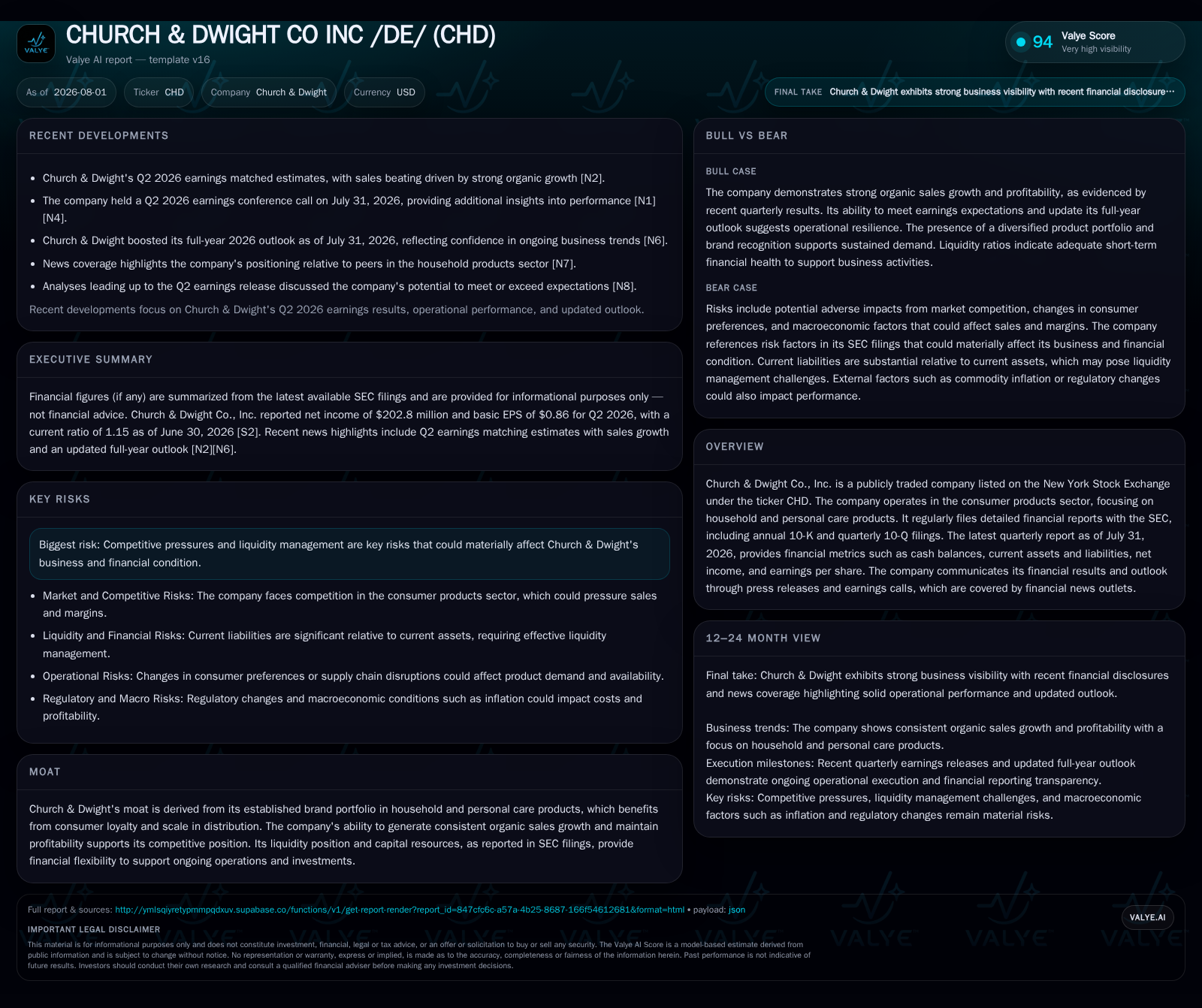
In its Q2 2026 filing, Church & Dwight demonstrated robust organic sales growth supported by effective brand portfolio management and expanded retail distribution. The company maintained profitability despite inflationary input costs through pricing actions and supply chain efficiencies. Its financial position remains solid with a current ratio above 1 and manageable leverage, underpinning capacity for continued innovation and strategic investments. Competitive dynamics in household and personal care products persist, with private label competition and promotional spending remaining notable risks.
Recent Operating Update: Q2 2026 Performance Highlights
Church & Dwight reported Q2 results on July 31, 2026, revealing continuing strength in organic sales growth across its branded household and personal care product lines. The quarter delivered revenues ahead of consensus estimates driven primarily by core brands benefiting from consumer loyalty and solid retail presence [S2][N1][N2]. This performance underscores the value of Church & Dwight’s broad portfolio that includes products ranging from cleaning agents to personal hygiene items.
Despite persistent commodity inflation impacting cost of goods sold (COGS), the company managed margin pressures through a combination of strategic price increases and SKU rationalization efforts designed to improve product mix. While gross margin faced some contraction relative to prior periods, these measures appear effective in stabilizing profitability under inflationary cost environments typical in this sector [S2][S3]. Maintaining pricing power is critical given ongoing competitive intensity from private label brands within major retail chains.
Advertising spend remained robust as the company prioritizes sustaining brand equity amid aggressive trade promotions within its category. The marketing investments are consistent with industry practice where brand recognition heavily influences consumer buying decisions in grocery and mass merchandiser channels [S1][S2]. Elevated advertising-to-sales ratios signal management’s commitment to defending market share.
Distribution channels remain a key pillar of Church & Dwight's strategy. Extensive relationships with retailers combined with growing e-commerce penetration enable multi-channel access to end consumers—a factor that supports volume resilience even as channel mixes evolve [S1]. Continued expansion into digital platforms aligns with shifting consumer purchase behaviors favoring online convenience.
Business Model Overview: Consumer Brands Anchored by Scale and Innovation
Church & Dwight operates as a manufacturer and marketer of branded household and personal care products sold mainly through retail channels to final consumers. Revenue generation hinges on selling proprietary formulations such as laundry detergents, oral care products, cleaning solutions, and health-related items that benefit from strong brand recognition. The company monetizes primarily through direct sales to major retailers who then sell to end users.
Key drivers impacting revenue include product innovation which can command premium pricing, distribution breadth encompassing both brick-and-mortar stores and digital storefronts, volume growth fueled by consumer loyalty, and occasional price adjustments responding to inflation or competitive factors [S1]. Operationally, margin variability stems largely from commodity costs (e.g., raw materials like surfactants), advertising spend levels which build brand equity but dilute short-term profit, trade promotions negotiated with retailers that affect net realized prices percentage-wise versus list prices, and supply chain execution efficiency
Church & Dwight continuously manages SKU portfolios focusing on rationalization to eliminate lower-margin or redundant offerings while investing in new launches that resonate with evolving health-conscious trends or sustainability preferences. Private label competition remains an enduring pressure necessitating differentiated innovation or targeted marketing support.
Industry Structure and Competitive Positioning
The household and personal care consumer products sector is characterized by moderately stable demand patterns due to essential usage but faces competitive churn driven by innovation cycles, private label encroachment, and shifts in distribution strategy such as increased e-commerce adoption. Large multinational players like Procter & Gamble and Colgate-Palmolive serve as notable peers who compete broadly on scale advantages across multiple categories.
Church & Dwight maintains competitive advantages through its diverse yet complementary brand portfolio that spans multiple consumer need states enabling cross-selling synergies within retail partners’ assortments. Strong relationships with key retail chains coupled with curated digital presence help mitigate channel risk concentration issues common within this industry. Unlike some peers with very wide global footprints, Church & Dwight’s core domestic market focus facilitates tighter control over supply chain resilience amid global disruptions.[S1]
Advertising efficiency—measured as advertising-to-sales ratio against peer benchmarks—and its ability to deploy effective trade promotions impact market share gains or losses substantially. Church & Dwight’s rationalized SKU approach contributes positively by simplifying production complexity while enhancing customer retention via better shelf-space optimization.
Growth Drivers
The primary growth engines for Church & Dwight encompass innovation in formulations responding to wellness trends (e.g., natural ingredients), packaging redesign aligned with sustainability demands, penetration into emerging digital commerce models such as direct-to-consumer platforms alongside traditional retail expansion, demographic tailwinds favoring personal care consumption among aging populations, premiumization of select product lines that offer higher margins per unit sold, plus strategic acquisitions aimed at filling portfolio gaps or entering adjacencies.[S1]
The steady organic sales growth reported in Q2 signals that these initiatives are gaining traction alongside maintaining core category relevance through consistent marketing investment [N1]. Continued product pipeline success rates—not explicitly disclosed—will be critical to sustaining momentum amid evolving consumer preferences.
Risks and Watchpoints
Risks outlined in recent filings reiterate sector-wide vulnerabilities including commodity cost inflation which can erode gross margins without sufficient price recovery; intense competition particularly from private label brands that can undercut pricing; supply chain uncertainties especially given raw material sourcing concentration; changing regulatory requirements influencing product formulation approvals or labeling; dependency on a limited number of large retailers whose purchasing policies may shift unexpectedly; currency fluctuations affecting any international volumes; brand reputation risks arising from quality issues or recalls; effectiveness of trade promotion spend balancing volume gains against margin dilution; plus managing liquidity under the capital-intensive nature of marketing campaigns [S1][S2]
Watchpoints center on whether the company can sustain its organic growth trajectory beyond current quarters amidst pricing pressures. Margin trends over the next few quarters will signal if cost containment efforts offset inflationary inputs successfully. Advertising efficiency metrics such as return on marketing investment also loom large for assessing long-term profitability sustainability.
What to Watch Next
Future monitoring should focus on incremental quarterly organic sales growth rates distinguishing volume-driven expansion versus pure price effect changes [N1]. Management commentary during earnings calls regarding supply chain status—especially any raw material shortages—and plans for promotional spending adjustment will be instructive.
Observing continued execution on SKU rationalization alongside new product launches tied closely to consumer health/wellness themes will provide insight into portfolio innovation effectiveness. Channel mix shifts favoring e-commerce penetration merit watching for potential margin impact given different cost structures versus traditional retail [N2]
Finally, tracking leverage ratios relative to earnings before interest suggests capacity for further strategic acquisitions or capital expenditures targeting sustained competitive advantage development [F1]
Financial Profile Discussion
As of June 30, 2026, Church & Dwight held approximately $255 million in cash and equivalents against total debt approximating $2.21 billion resulting in a net debt position near $1.95 billion [F1]. The current ratio stood at a healthy 1.15 reflecting adequate liquid assets relative to short-term obligations [F1]. This liquidity profile supports operational flexibility allowing ongoing investments in research & development for product innovation plus funding elevated advertising spend necessary for defending market share.
This analysis is based solely on publicly available information including SEC filings dated through July 31, 2026, supplemented by recent market commentary from credible financial news sources without reliance on non-public data or forward guidance forecasts.
Disclaimer: This is research-only, informational analysis and not investment advice. It may include AI-generated interpretation and general industry context. Always verify important details using primary sources.

Comments