
Mercantile Bank’s Merger Expansion and Regional Banking Dynamics Shape Q2 2026 Operating Landscape
Q2 results and ongoing merger integration advance Mercantile Bank's regional banking footprint in Michigan amid typical industry challenges.
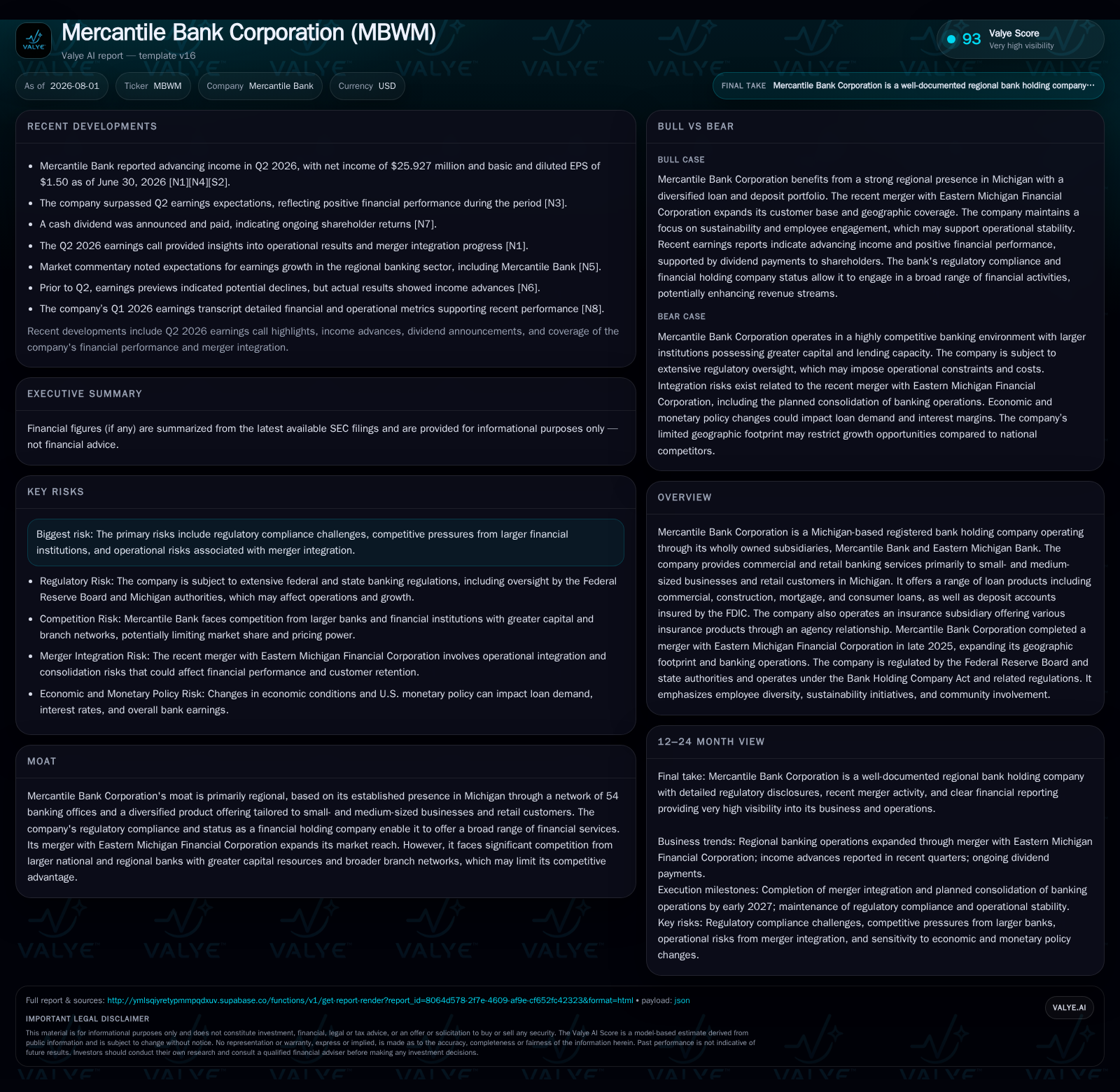
Mercantile Bank Corporation, a Michigan-focused regional bank holding company, reported its latest quarterly results highlighting the operational impact of its December 2025 merger with Eastern Michigan Financial Corporation. The combined entity operates through 54 branches targeting small- and medium-sized businesses alongside retail customers. While loan portfolio quality remains stable with low nonperforming assets, merger integration continues as a key near-term focal point, including a core processor conversion planned for early 2027. Competitive pressures from larger banks and regulatory compliance remain persistent challenges as Mercantile seeks scale benefits and deposit growth to support profitability.
Recent Operating Update
Mercantile Bank Corporation's Q2 2026 results showcased operational progress following its December 31, 2025 merger with Eastern Michigan Financial Corporation. The consolidated entity now operates a network of 54 banking offices across Michigan, significantly expanding its geographic reach primarily via the integration of Eastern Michigan Bank's footprint in Eastern Michigan alongside Mercantile's established presence in West and Central Michigan [S1][S24]. The merger received Federal Reserve Board approval in December 2025, allowing the combined institution to operate as two separate banks until merging their operations fully post-core processor conversion targeted for Q1 2027 [S1].
Financially, the bank surpassed second-quarter earnings estimates, driven by stable net interest income and prudent credit management despite ongoing macroeconomic uncertainties [N3][S3]. Management highlighted consistent loan demand predominantly from commercial clients in small- to medium-sized businesses, supporting loan growth momentum. Nonperforming loans remained low at approximately 0.2% of total loans as of end-2025, underscoring effective underwriting standards and active credit risk monitoring despite a concentration in commercial real estate loans exceeding half the portfolio [S20][S22].
Business Model Framework
Mercantile Bank acts as a regional bank holding company through its wholly owned subsidiaries—Mercantile Bank and Eastern Michigan Bank—operating under state charters regulated by the state's Department of Insurance and Financial Services along with federal oversight including the Federal Reserve Board for holding company activities [S1]. The bank’s revenue is primarily generated through net interest income derived from lending activities encompassing commercial loans (including construction and real estate), consumer loans, and mortgage loans. These loans are funded mainly by customer deposits insured by FDIC coverage.
Fee income contributes via deposit account services and ancillary financial products such as insurance offered by Mercantile’s insurance subsidiary operating through agency relationships [S1][S27]. This business model relies heavily on maintaining a balanced loan-to-deposit ratio while managing credit risk within regulatory capital frameworks. Cross-selling insurance complements banking revenues but primarily operates as an adjunct service rather than a core profit driver.
The company monetizes lending through floating or variable-rate loan products tied mostly to benchmarks like the Wall Street Journal Prime Rate or SOFR, which helps mitigate interest rate risk in the current rate environment [S10]. Commercial lines commonly have shorter terms (12-24 months) with amortization schedules structured to reduce balloon risk. Consumer loans carry generally higher yields but greater credit risk, emphasizing careful underwriting focused on borrower income stability and collateral adequacy [S20].
Industry Structure and Competitive Position
Within the regional banking industry geared toward small- and medium-sized market segments, Mercantile Bank competes against larger regional players such as Fifth Third Bancorp, Huntington Bancshares, Regions Financial Corporation, KeyCorp, and Citizens Financial Group that benefit from greater scale economies, larger branch networks, advanced technology platforms, and broader product suites. Mercantile’s competitive advantage is its strong local market knowledge in Michigan communities where it maintains entrenched relationships.
Nonetheless, post-merger challenges include achieving operational efficiencies via core systems consolidation scheduled for early 2027 alongside integration risks typical in multi-bank mergers [S15][S24]. Regulatory compliance also imposes ongoing capital requirements mandating Tier 1 capital ratios above regulatory minimums while controlling exposure concentrations such as commercial real estate lending capped under FDIC guidance at less than three times regulatory capital
Technology investments remain critical to remain competitive not only on transaction efficiency but also on cybersecurity resilience. Mercantile’s recent Board appointment of a director with cybersecurity expertise reflects heightened focus on mitigating operational risks including potential cyber threats that pose reputation and regulatory scrutiny risks prevalent across regional banks [S1].
Growth Drivers
Economic growth trends within Michigan serve as a foundational driver for Mercantile’s loan demand expansion particularly among small- to medium-sized enterprises seeking working capital or commercial real estate financing. The merger enlarged customer reach geographically enabling cross-selling opportunities for both deposit accounts and insurance products through established agency agreements.
Deposit base growth fuels lending capacity while improving funding stability in an environment where wholesale funding can be more costly or volatile. The integration process aims to harvest cost synergies by consolidating back-office functions post-core processor conversion expected Q1 2027 which if executed efficiently should enhance the efficiency ratio—a key profitability metric among regional banks.
Furthermore, net interest margin (NIM) management remains vital; floating rate structures dominate loan portfolios facilitating quicker response to rising rates but exposing some interest rate risk if deposit costs accelerate disproportionately. The combined entity adheres to risk-based capital guidelines maintaining total risk-based capital ratios at or above the mandated minimum of 12% alongside controlling non-performing assets relative to tangible equity below regulator-mandated limits (no more than 12%) ensuring financial soundness.
Efforts remain underway to improve operating efficiency ratios characteristic of community-focused regional banks through branch rationalization post-merger once core system consolidation completes. Return on assets (ROA) targets institutionalized via regulatory covenants aim for at least 0.80%, demonstrating disciplined profitability benchmarks enforced on management [S15]. While detailed second-quarter financial metrics await formal filings beyond preliminary earnings calls data, early signals from recent presentations suggest steady improvement trajectories consistent with strategic merger rationales incorporating scale advantages yet mindful of integration costs [N3][S3].
This analysis synthesizes Mercantile Bank Corporation’s public SEC disclosures alongside recent investor communications to provide an industry-informed perspective on its current operating status within the regional banking sector in Michigan. It refrains from speculative interpretations or forward-looking investment research views adhering strictly to verified company data and relevant industry standards.
Disclaimer: This is research-only, informational analysis and not investment advice. It may include AI-generated interpretation and general industry context. Always verify important details using primary sources.

Comments