
Perella Weinberg Partners Leverages Independence in Volatile Deal Market
The firm’s latest quarterly results underscore persistent revenue volatility from transaction timing uncertainty, highlighting the strategic importance of its independent advisory platform and talent retention.
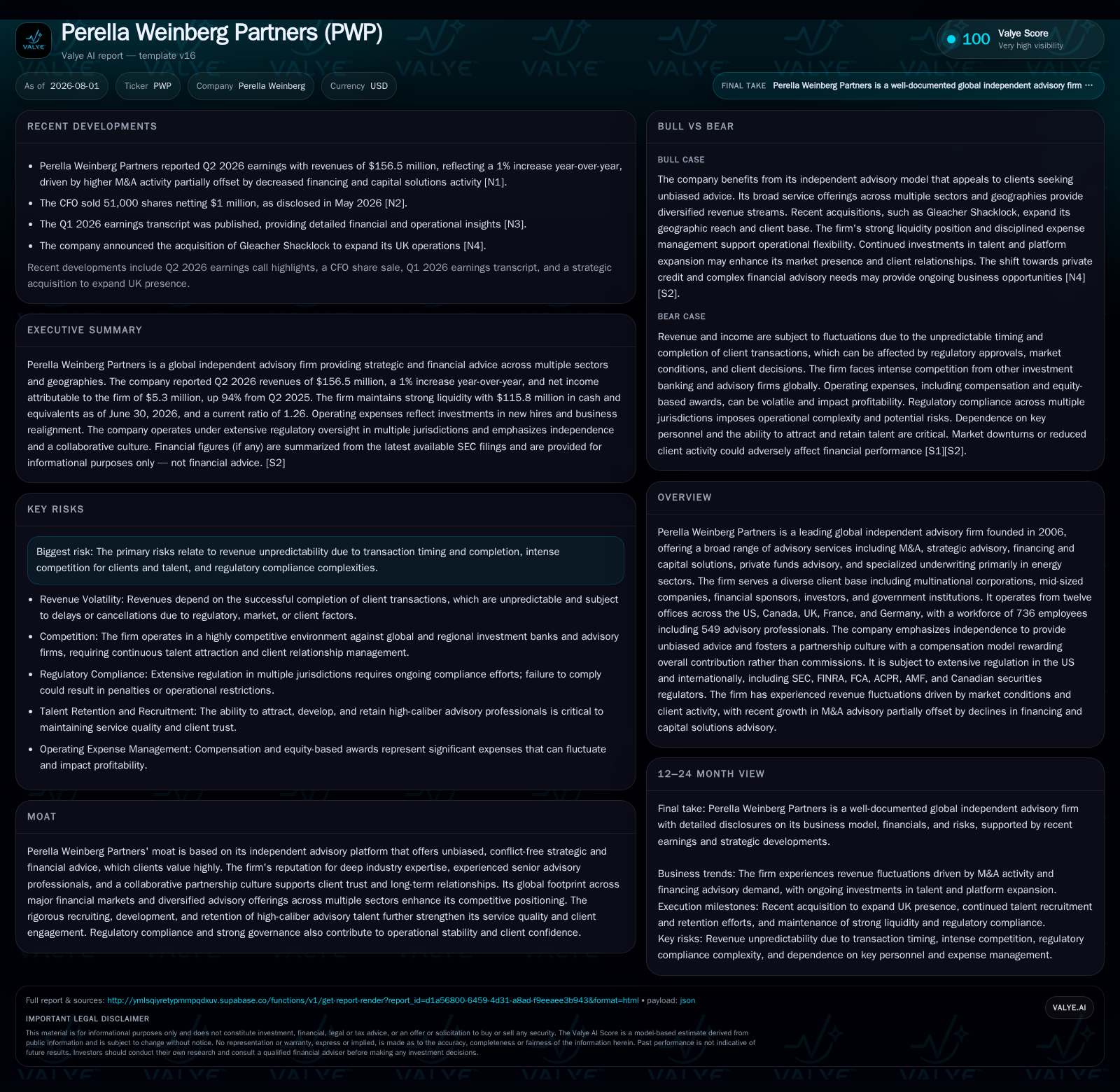
Perella Weinberg Partners’ Q2 2026 results reveal the ongoing challenge of unpredictable revenue linked to deal closures, a common industry dynamic accentuated by larger, complex transactions. The firm’s business model, built around independent, conflict-free advisory services across M&A, restructuring, and capital solutions, supports client trust and engagement despite cyclical headwinds. Growth levers center on expanding senior advisory headcount, diversifying services into private funds and energy underwriting, and a global footprint that enables access to diverse client segments. Key risks persist around transaction completion uncertainty, talent competition, and regulatory demands. Liquidity remains robust with a net cash position and disciplined compensation expense management bolstering operating margins.
Q2 Operating Realities Highlight Revenue Timing Variability
Perella Weinberg Partners (PWP) reported Q2 2026 results reflecting a familiar challenge for independent advisory firms: volatile revenue streams driven by uncertain transaction timing [S2]. Advisory fees depend primarily on completed deals across mergers and acquisitions (M&A), restructuring, capital raising, and capital solutions engagements. The firm disclosed that delays in closing due to regulatory approvals or financing issues continue to inject unpredictability into near-term revenue recognition [S2]. This episodic volatility is magnified by larger transaction sizes that take longer to consummate. While ongoing active client discussions and pipeline development remain priorities for sustained growth, PWP recognizes that fluctuating quarter-to-quarter revenues are intrinsic to its fee-for-service business model where contingency fees dominate [S2]. Concurrently, potential fees may be reduced or limited to retainers if deals fail or stall entirely due to external conditions such as adverse market sentiment or litigation barriers [S1]. These patterns underscore the cyclical nature of investment banking services compounded by macroeconomic factors affecting capital markets.
Operating Model Rooted in Independent Advisory Value Proposition
Founded on independence principles since 2006, PWP positions itself distinctly from bulge bracket firms burdened by conflicts arising from diversified financial businesses [S1]. The firm’s core strength lies in providing conflict-free strategic advice grounded in unbiased perspectives valued by multinational corporations, mid-sized enterprises, financial sponsors, investors, and governments globally. Its integrated advisory platform spans M&A execution, shareholder engagement advisory, financing strategies emphasizing restructuring and liability management, capital markets work including private funds advisory and private placements plus specialized underwriting—primarily focused on energy-related sectors [S1]. This breadth of services caters to clients through an experienced pool of senior advisors who collaborate cross-functionally rather than compartmentalizing by product lines. Consequently, PWP does not break down revenues by advisory type given the complexity of bundled engagements requiring multifaceted expertise [S1].
Crucially, compensation aligns with this partnership culture rewarding overall contribution beyond mere transactional volumes. Salary structures incorporate discretionary bonuses alongside equity-based awards subject to vesting conditions tied to long-term performance outcomes [S1]. This approach incentivizes retention of seasoned professionals whose relationships are central to deal origination and execution quality.
Competitive Landscape: Independence versus Scale Trade-offs
PWP operates within a competitive arena characterized by global investment banks like Goldman Sachs and Morgan Stanley offering massive scale yet less independence due to diverse financial services businesses [S1]. In contrast, PWP’s moat revolves around its independent advisory positioning akin to peers such as Lazard or Evercore but with more limited geographic footprint—currently spanning twelve offices across the US, Canada, UK, France, and Germany—and fewer total advisory partners (549 professionals including 75 partners) compared with top-tier independents [S1].
This size differential limits absolute deal flow but allows PWP enhanced pricing power among clients seeking conflict-free advice without cross-selling pressures common at larger banks. Regulatory compliance frameworks across jurisdictions (SEC/FINRA in the US; FCA in the UK; ACPR & AMF in France; Canadian securities regulators) further underscore trust-building dynamics essential for high-stakes advisory work [S1]. Reputation for deep industry expertise combined with rigorous governance support client confidence amidst evolving global capital markets.
Growth Catalysts Emerging from Talent, Service Diversification, and Geographic Reach
Key growth vectors center on expanding high-caliber senior advisor ranks leveraged across broader service lines including recent acquisition expansions such as Devon Park Advisors enhancing private funds advisory capabilities [S1], [S2]. Increasing specialization within restructuring and capital solutions tailored primarily for energy sectors also deepens PWP’s differentiated offering mix.
New client acquisition is fostered via robust relationship networks cultivated over years alongside efforts at cross-selling complementary services within existing accounts—a strategy aimed at elevating revenue per advisor metrics [S2]. Geographically diverse offices facilitate coverage of multinational corporations needing seamless cross-border advisory support.
Given the premium placed on independent advice amid complex regulatory environments post-2008 crisis-era reforms and sustained geopolitical uncertainty affecting deal activity globally, demand for trusted advisory platforms like PWP remains structurally supported despite cyclical headwinds [S1], [N1].
Key Risks: Transaction Cyclicality, Talent Retention, Regulatory Demands
Volatility in realized revenues is inherent due to reliance on transaction completion which can be impaired by failures to secure board approvals or financing arrangements—risks highlighted repeatedly in PWP’s filings [S1], [S2]. Additionally, intense competition persists for senior advisory talent where poaching or attrition can adversely affect client retention given the personal nature of client relationships.
Complex multi-jurisdictional regulations impose significant compliance costs while necessitating continuous updates in internal controls—failure of which also risks reputational harm or sanctions [S1]. Moreover, equity-based compensation adds further expense variability tied closely to share price fluctuations thereby influencing operating margin stability.
These factors collectively frame near- and medium-term watchpoints underpinning operational performance metrics such as deal pipeline conversion ratios and net new client wins which stakeholders must monitor attentively.
Upcoming Milestones to Gauge Deal Pipeline Conversion
Investor attention should focus on indicators related to pipeline size shifts disclosed during earnings calls or filings alongside qualitative commentary on expected transaction closures [N1], [S2]. Such disclosures typically presage upcoming revenue realization patterns instrumental for quarterly forecasting. Likewise critical are announcements surrounding significant new mandates or expansions within core sectors especially energy where PWP holds underwriting specialization.
Tracking headcount trends among senior advisors provides another dimension reflecting capacity for taking advantage of robust market opportunities when conditions improve substantially. Overall cadence of deal flow amidst macroeconomic backdrop will remain deterministic.
Financial Profile Discussion: Liquidity, Compensation Expense Dynamics, Operating Profit Implications
As of June 30, 2026, Perella Weinberg held $115.8 million in cash with no reported debt leveraged against this liquidity buffer underscoring solid financial flexibility [F1], [S2].
Compensation expense remains the largest operating cost component fluctuating materially based on realized revenues directly tying profitability swings closely with fee income variability inherent in transactional timing uncertainties described earlier [S2], [S1]. Yet the firm reported positive net income in recent full-year results indicating an ability to manage compensation leverage effectively when market conditions permit successful deal completions [F1]. Non-compensation expenses benefit from controlled reductions balancing travel increases tied to international business expansion efforts.
This analysis reflects information available as of August 2026 based on official SEC filings complemented by recent earnings commentary. It does not constitute investment advice but aims to provide a detailed operational insight grounded in documented facts.
Disclaimer: This is research-only, informational analysis and not investment advice. It may include AI-generated interpretation and general industry context. Always verify important details using primary sources.

Comments