
Metropolitan Bank Holding Corp.’s Stable Credit and Capital Position Underpin Q2 2026 Operating Resilience
Q2 2026 results highlight disciplined credit risk management, a stable deposit base, and ongoing shareholder returns for Metropolitan Bank Holding Corp.
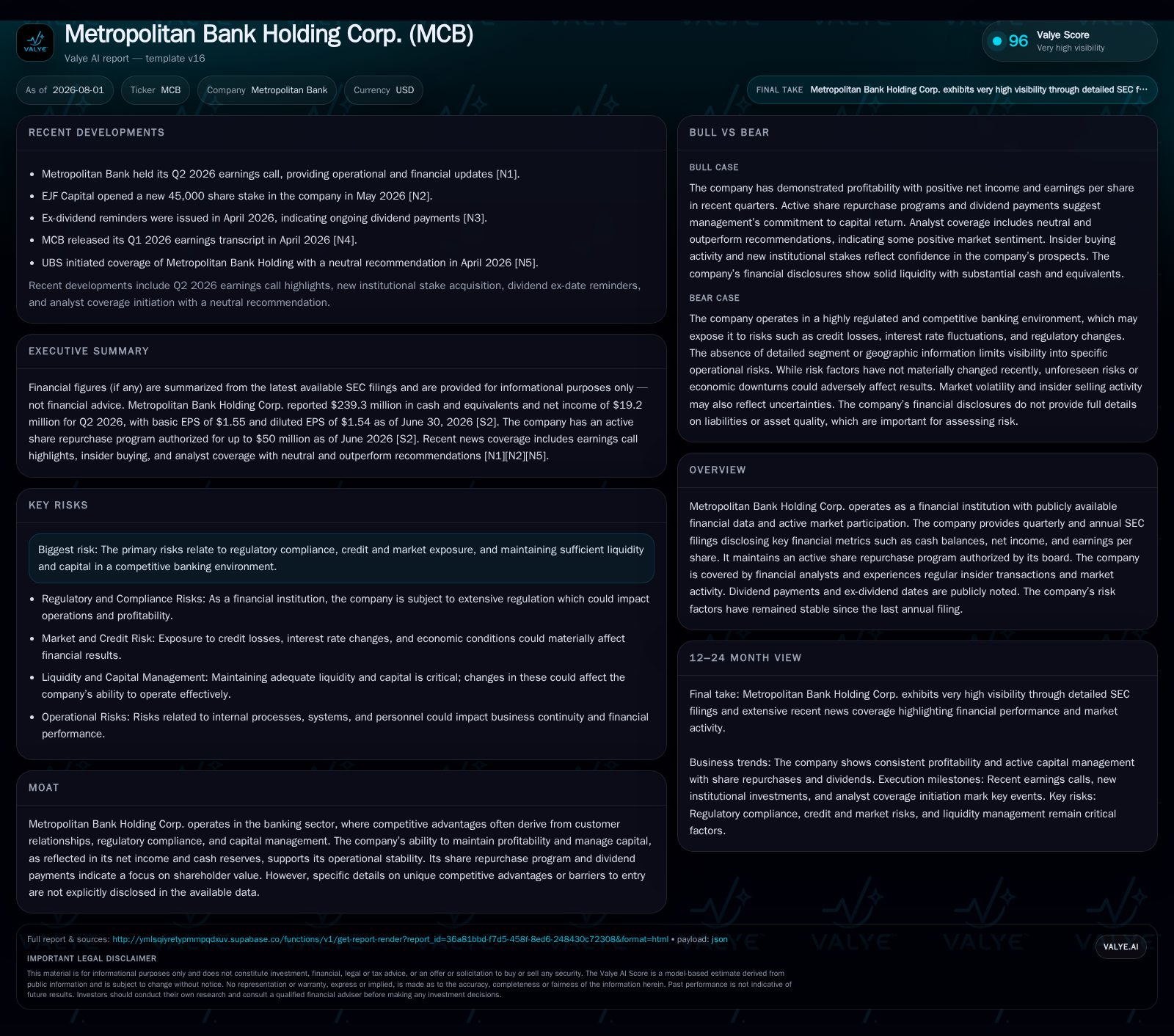
Metropolitan Bank Holding Corp. reported no material changes to its risk factors in Q2 2026, maintaining strong credit risk practices and capital adequacy amid a diverse loan portfolio concentrated in commercial real estate and commercial & industrial loans. The company’s deposit funding remains robust, supported by seven strategically placed banking centers in the New York metropolitan area which cater to corporate, retail, and specialized clients. Recent board authorization of a $50 million share repurchase program emphasizes a continued commitment to shareholder returns. While regulatory and market risks persist broadly in banking, Metropolitan’s operating model centered on relationship banking and selective lending confers resilience.
Recent Operating Update
Liquidity remains strong with $239 million in cash and equivalents as of June 30, suggesting prudent asset-liability management amid a complex rate environment [F1]. Moreover, no defaults or senior security issues were noted during the quarter confirming sound financial discipline at this point [S2]. An external event filing from July 21 reiterated these points alongside the Q2 earnings press release emphasizing resilient core operations despite sector headwinds [S3].
Business Model Overview
Metropolitan Bank operates as a bank holding company serving the New York metropolitan statistical area with seven strategically located banking centers—primarily four in Manhattan plus centers in Brooklyn, Lakewood NJ, and Great Neck Long Island—targeting commercial clients as well as affluent individuals and institutions [S1]. This geographic concentration allows the bank to cater to densely populated urban sectors with substantial corporate deposit bases.
The bank’s revenue generation hinges largely on net interest income derived from lending activities [S1]. Its loan portfolio centers on commercial real estate (CRE) loans—which include acquisition loans, refinancing, construction loans across asset types like healthcare facilities (notably skilled nursing homes), multi-family residential buildings, office spaces, retail properties and warehouses—and commercial & industrial (C&I) loans mostly composed of working capital lines secured by business assets including accounts receivable and inventory with extensive use of personal guarantees from principals
Deposit funding comes from a diverse set of customer segments: borrowing clients who also maintain deposits; non-borrowing retail clients serviced through technology-enabled platforms; corporate cash management clients managing large transactional deposits; local government entities requiring tailored financial solutions; plus escrow accounts for EB-5 foreign investment programs facilitating USCIS-approved projects—all contributing to a stable liquidity base without heavy branch dependence [S4], [S11]. This deposit diversification reduces concentration risks typical among peer regional banks.
Credit risk management is integral to the bank's operating model. Loans undergo rigorous underwriting focused on borrower cash flow stability and collateral quality. CRE loans rely heavily on property income streams for repayment validation but frequently include personal guarantees especially when properties are transitional or under renovation stages. C&I loans are extended primarily to companies with revenues under $400 million possessing predictable growth profiles mitigated through collateralized assets and guarantor commitments. Internal grading coupled with independent third-party loan reviews supports early problem loan identification with ongoing allowance for credit losses maintained conservatively based on portfolio expectations [S1], [S8], [S13].
Operational differentiation comes from focused client relationships allowing swift decision-making combined with deep industry specialization—particularly within healthcare lending where bankers possess specialized expertise managing portfolios tied to skilled nursing facilities encompassing both property and operating company assets backed mainly by owners' personal guarantees [S5], [S13]. This enhances credit assessment quality relative to peers lacking similar domain depth.
Industry Structure and Competitive Position
Metropolitan Bank fits within the regional/community bank category serving niche urban markets. Its operational scale is modest relative to national giants like JPMorgan Chase but benefits from proximity advantages similar to Signature Bank or First Republic’s focused geographies albeit without exclusive wealth-management emphasis.
Competition arises from larger national banks providing broad commercial banking solutions as well as non-bank financial institutions increasingly active in CRE and C&I lending due to technology-driven efficiencies. Additionally, fintech entrants pose alternative financing options impacting traditional community bank segments.
Metropolitan’s competitive strengths lie in its localized branch network that emphasizes personalized service blended with modern digital capabilities enabling deposit capture beyond physical branches—a structural advantage against purely branch-dependent peers. Its balanced loan portfolio concentrated heavily in CRE—with particular expertise in healthcare real estate—and diverse deposit sources underpin revenue resilience.
However, the relatively concentrated regional footprint subjects it to localized economic downturn risks disproportionately compared to more geographically diversified banks.
Growth Drivers
Key growth drivers for Metropolitan Bank include sustained economic expansion within the New York metro area fueling demand for commercial real estate financing—particularly multifamily housing development given urban housing shortages—and incremental business activity supporting C&I lending.
Rising interest rates benefit net interest margin components by widening spreads on newly originated loans versus existing deposit costs, although margin gains depend on repricing speed relative to liabilities.
Cross-selling treasury management services alongside lending reinforces client stickiness while tapping fee income opportunities diversifies earnings beyond interest spreads. Continued investment in digital channels improves client acquisition efficiencies addressing evolving customer preferences for online banking conveniences.
Moreover, strategic deployment of capital through share repurchases signals management’s confidence in generating shareholder value potentially attracting long-term equity investors aligning external financing cost advantages with organic growth initiatives.
Risks and Watchpoints
Despite evident strengths Metropolitan faces typical risks for regional banks: credit risk remains foremost given exposure to CRE sectors vulnerable to economic cycles or regulatory changes affecting property valuations or tenant demand; notwithstanding prudent underwriting practices there is inherent vulnerability if macroeconomic conditions deteriorate sharply increasing non-performing loan ratios.
Interest rate risk persists as shifts could compress net interest margins if liability costs rise faster than asset yields or impact borrowers’ repayment capabilities. Regulatory compliance—the bank being subject both to NYDFS state regulators and Federal Reserve scrutiny—is another critical factor requiring ongoing investments in controls; any lapses could trigger fines or restrictions impeding growth.
Competitive pressures from fintech lenders require vigilance lest market share erodes especially among smaller C&I borrowers valuing speedier approvals.
Cybersecurity incidents represent operational hazards capable of disrupting client services or damaging reputation necessitating continuous safeguards implementation.
Watchpoints include monitoring trends in allowance levels for loan losses relative to actual delinquencies indicating sufficiency of credit buffers plus quarterly retention rates of core deposits reflecting funding stability amid shifting market dynamics.
What To Watch Next
Upcoming milestones include analysis of subsequent quarter filings for signs of loan portfolio quality shifts measured by non-performing assets ratios or charge-offs. Capital adequacy maintenance aligned with Tier 1 ratios will be critical as market conditions fluctuate given regulatory expectations.
Execution metrics around share repurchase activity pace versus authorizations will shed light on management’s balancing act between growth investments and returning capital. Announcements regarding further branch expansion or technology upgrades may provide insight into efforts targeting broader client bases beyond current geographies.
Earnings calls focusing on commentary about CRE market developments—particularly healthcare sector dynamics—and depositor behavior post recent rate moves could clarify demand sustainability assumptions supporting near-term forecasts.
Overall performance relative to peer regional banks will also indicate whether Metropolitan can preserve its niche positioning under intensifying competitive forces.
Financial Profile Discussion
As of June 30, 2026, Metropolitan Bank Holding Corp.’s liquidity position reflects $239 million in cash and equivalents providing operational flexibility amidst uncertain economic conditions [F1]. Year-end net income stood at approximately $71.1 million as per latest available data supporting profitability continuity but lacking intermediate quarterly breakdown limiting granular margin trend analysis at this time [F1].
Ongoing equity buybacks authorized up to $50 million indicate constructive capital management balancing reinvestment needs against enhancing shareholder returns via share count reduction which may support earnings per share trends over time [S2]. Absence of defaults or covenant breaches affirms conservative leverage policies while regulatory filings confirm compliance engagement mitigating supervisory risks today [S2], [F1].
In conclusion, Metropolitan Bank Holding Corp.’s current financial standing along with its demonstrated operational discipline positions it well within its regional banking peer group despite competitive headwinds faced across the commercial banking landscape.
Disclaimer: This is research-only, informational analysis and not investment advice. It may include AI-generated interpretation and general industry context. Always verify important details using primary sources.

Comments