
Cboe Global Markets Leverages Options Momentum and Strategic Realignment to Enhance Trading Infrastructure
Cboe’s Q2 2026 results underline robust options trading and strategic cost-efficiency moves that strengthen its market leadership and operational resilience.
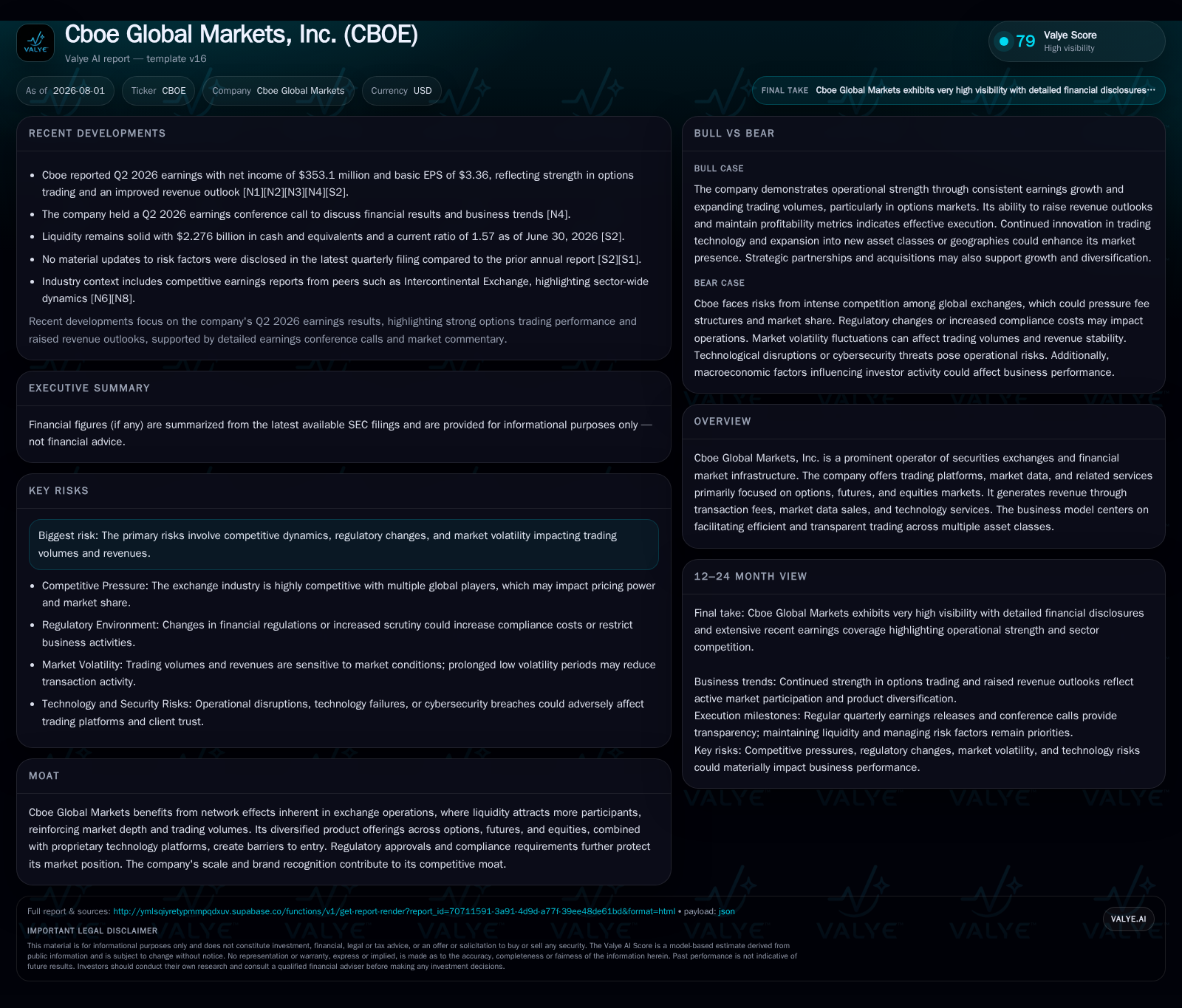
Cboe Global Markets reported stronger-than-expected options trading volumes in Q2 2026, driving transaction fee revenue growth amid a broader strategic realignment focused on workforce reduction and technology investment. The company’s diversified exchange infrastructure benefits from network effects that bolster liquidity and pricing power. While regulatory risks and clearinghouse dependencies remain industry-wide challenges, Cboe’s balance sheet strength positions it well to sustain competitive advantage and pursue growth through product expansion and global reach.
Q2 Options-Led Volume Growth Drives Transaction Revenue Expansion
Cboe Global Markets’ Q2 2026 filing revealed a notable increase in options trading activity which served as the primary driver of improved transaction revenues. The company reported sequential volume growth in options contracts, a segment known for generating disproportionately high transaction fees due to greater complexity and margin requirements compared to equities or futures trades. This momentum translated into net transaction revenue gains, affirming the structural importance of options markets to Cboe's earnings profile [S2], [N1]. Maintaining or growing average daily volume (ADV) in options is crucial given it underpins fee income and operating margins resilient to cyclical pressures. Observing whether this volume strength persists in subsequent quarters will be key to assessing the durability of Cboe's revenue base.
Strategic Realignment Enhances Cost Efficiency While Supporting Technology Investment
Complementing top-line progress, Cboe disclosed execution of a comprehensive strategic realignment that involves an approximate 20% reduction in workforce headcount alongside organizational optimization efforts announced earlier. The initiative entails expected pre-tax restructuring charges between $36 million to $46 million during 2026 but is designed to yield $40 million to $50 million in ongoing annualized cost savings. Such actions improve operating leverage by cutting fixed expenses while reallocating capital toward technology investments essential for sustaining platform reliability and low-latency trade execution—an important differentiator against peers like Nasdaq and CME Group that constantly innovate to capture order flow share [S5], [N1]. Monitoring margin expansion trends post-realignment will signal successful resource reallocation.
Network Effects Cement Position Amid Competitive Financial Exchange Landscape
Market Data and Connectivity Services Bolster Diversified Revenue Streams
Beyond transaction fees, Cboe continues expanding revenues from market data licensing and technology-enabled connectivity services that offer recurring income less sensitive to short-term volume fluctuations. Its proprietary data feeds serve broker-dealer algorithms and institutional clients requiring real-time information critical for market making and risk management. The company noted steady growth in market data subscriptions during Q2, reflecting broader industry demand for analytics amidst increasingly complex market conditions. This diversification shields Cboe from episodic declines in trading activity seen during low volatility periods while strengthening EBITDA margins through higher-margin software-like offerings [S1], [S2].
Regulatory Environment Shapes Fee Structure and Trading Access Risks
Regulatory risk remains an influential factor shaping Cboe’s business model. Ongoing rulemakings at the SEC concerning market structure reforms—including potential fee caps or altered rebate regimes—could affect the economics of exchange-operated venues. Additionally, clearinghouses such as OCC have introduced new margin add-ons (Intraday Risk Charge) which may elevate clearing member costs for products like SPX options; this could indirectly pressure traded volumes if participants opt for alternative venues or reduce activity due to heightened costs. These challenges are not unique to Cboe but are shared industry concerns impacting peer groups including CME Group and ICE derivatives markets. The company continues compliance investments while monitoring legislative developments closely as regulatory changes could redefine competitive positioning or cost structures over time [S6], [S10], [N14].
Growth Catalysts: Product Expansion, Retail Participation, and Global Reach
In pursuit of sustained growth, Cboe is advancing multiple frontiers: broadening its product suite across options, futures contracts, and ETFs tailored for both institutional investors and expanding retail participation spurred by macro adoption trends documented industry-wide. Retail traders increasingly utilize options strategies facilitated by scalable electronic platforms providing ease of access—an important revenue vector as it drives incremental order flow. Furthermore, strategic initiatives aim at globalization through cross-border market access enabling foreign investor entry into U.S.-based products or vice versa via licensed platforms under regulatory frameworks. Planned upgrades to connectivity infrastructure also promote scalability that can accommodate surging volumes without degradation of service quality—key for client retention amid intensifying competition between exchanges globally [S1], [S2], [N11].
Risks to Monitor: Clearing Dependencies, Market Fragmentation, and Volatility Cycles
Among notable industry-specific risks are operational dependencies on third-party clearinghouses whose technological migrations or policy changes could disrupt seamless clearing services vital for settlement finality—a foundational pillar for trust in listed derivatives/ securities markets. Moreover, increasing fragmentation with alternative trading systems (dark pools) can dilute liquidity pools affecting spreads and trade execution quality on primary exchanges such as Cboe's. Legal liabilities stemming from litigation related to regulatory compliance also pose recurrent threats requiring vigilant governance frameworks. Finally, inherent volatility cycles drive uneven transaction revenues: spikes boost fees substantially whereas calm markets suppress trading frequency challenging topline stability despite underlying platform fixed costs—necessitating effective management strategies combining diversified revenues with operational discipline [S1], [S6], [S10].
Key Milestones Ahead: Volume Trajectory, Technology Upgrades, and Regulatory Developments
Looking forward into late 2026, critical milestones include quarterly volume reports across core asset classes which will validate whether recent options volume gains extend beyond transient factors. Rollout of new technology enhancements aimed at improving latency metrics will be scrutinized by customers highly sensitive to execution speed—a parameter influencing venue selection amid fierce peer rivalry from Nasdaq’s technologically advanced offerings. Equally important are anticipated regulatory rulemakings around market structure reform with implications for access pricing necessitating adaptive strategies by management. Regular investor conference calls provide transparency on these fronts helping track if the company meets outlined strategic objectives within stated guidance ranges [S3], [N4], [N14].
Financial Profile Discussion: Solid Liquidity Underpins Strategic Flexibility
As of June 30, 2026, Cboe held approximately $2.28 billion in cash and equivalents against total debt near $1.45 billion resulting in a net cash position of around $826 million according to companyfacts filings—reflecting a conservative balance sheet posture conducive to weathering geopolitical or market shocks while funding technology investments or acquisitions if opportunities arise.[F1] The current ratio stands at a comfortable 1.57 indicating sufficient short-term asset coverage relative to liabilities.[F1] The cost-saving measures from strategic realignment incurred manageable restructuring charges without impairing financial flexibility.[S2] This liquidity cushion combined with EBITDA margins supported by recurring data/technology revenues strengthens overall resilience amidst sector cyclicality.
Disclaimer: This report is an independent analysis based solely on publicly available filings dated through July 31, 2026. It does not constitute investment advice or research views regarding the securities discussed herein.
Disclaimer: This is research-only, informational analysis and not investment advice. It may include AI-generated interpretation and general industry context. Always verify important details using primary sources.

Comments