
Enterprise Financial Services Strengthens Regional Foothold Through Branch Expansion and Credit Management
EFSC’s latest quarter highlights operational resilience amid credit normalization and capital management in competitive regional banking.
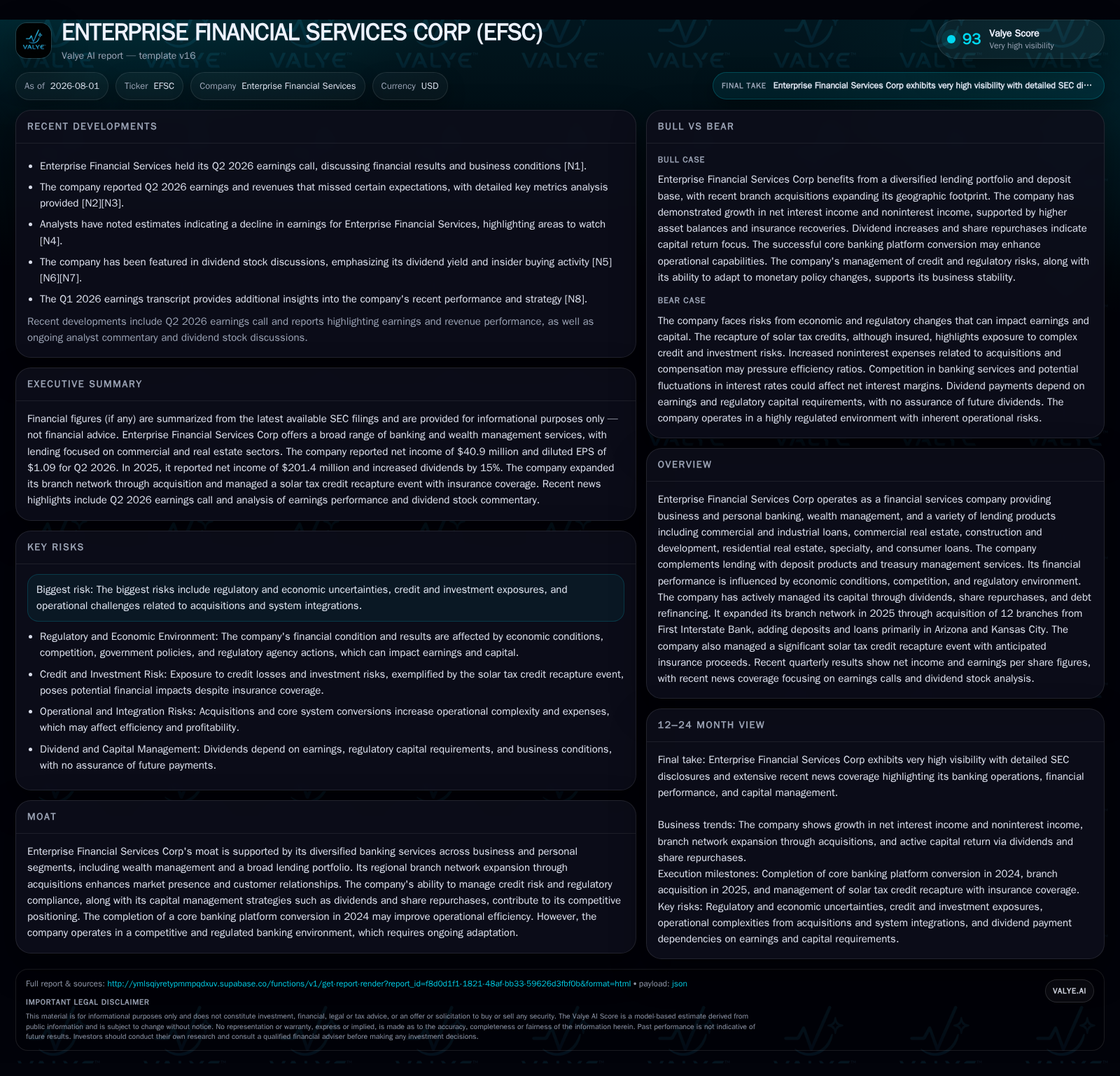
Enterprise Financial Services Corp (EFSC) reported Q2 2026 results reflecting ongoing credit recovery and steady operational execution following a branch acquisition that expanded deposits and loans primarily in Arizona and Kansas City. The company’s diversified lending portfolio, supplemented by wealth and treasury management fee income, positions it well within the regional banking landscape. Its core banking platform conversion in 2024 supports efficiency gains, while disciplined capital management including dividends and share repurchases enhances shareholder returns. Key risks stem from evolving credit conditions, regulatory complexity, and integration of prior acquisitions.
Recent Operating Update
Enterprise Financial Services Corp’s Q2 2026 quarterly filing reveals modest but meaningful improvements in credit quality marked by $17.5 million in nonperforming loans being fully paid off early this year [S2]. This is a continuation of the recovery trend noted since the end of 2025 when certain troubled but well-collateralized commercial real estate loans went on nonaccrual. That EFSC expects full collateral recovery on these indicates disciplined underwriting and asset management amid regional economic uncertainties [S1]. Additionally, the bank’s acquisition-driven expansion strategy demonstrated traction after integrating 12 branches acquired from First Interstate Bank during 2025 primarily in Arizona and Kansas City. This acquisition added both deposits and loan portfolios—a key lever for increasing low-cost core deposits which support net interest margin preservation amidst competitive pressures [S1][N1]. The operational integration appears stable as no material issues were flagged in recent filings.
Business Model
EFSC operates a classic regional banking model capturing spread revenue predominantly through interest earned on a diversified loan portfolio against interest paid on deposits. The lending book spans commercial & industrial loans, commercial real estate, construction & development loans, residential real estate financing, specialty lending segments, and consumer credit. This breadth affords diversification benefits to cyclicality affecting individual sectors while leveraging collateral-focused underwriting practices reduces expected loss severity [S1]. Revenue is further bolstered by fee-based services including treasury management for business clients and wealth management offerings targeted at personal banking customers, delivering stable noninterest income streams that temper reliance on net interest margin volatility.
Deposit generation via both transaction accounts and core savings deposits is essential to funding loan assets cheaply; EFSC’s recent branch network extension has augmented this deposit base geographically beyond its Missouri roots—particularly into higher growth Arizona markets—enhancing competitiveness versus comparable regional peers such as Regions Financial or Fifth Third Bancorp with broader footprints but different cost structures. The company monetizes these relationships through bundled banking and financial advisory products often cross-sold to increase customer wallet share.
A notable operational enabler is EFSC’s completion of its core banking platform conversion in 2024 [S1]. This strategic IT investment promises improvements in processing efficiency, customer experience agility, product rollout cadence, and enhanced data analytics capabilities for better risk management—all key factors in maintaining a cost-effective operating model when benchmarked against similarly sized regional banks
Capital allocation remains balanced: the company declared consistent dividends driven by earnings performance yet remains prudent due to regulatory capital constraints typical for financial holding company status. Concurrently it pursues share repurchases authorized up to two million shares at variable paces depending on market conditions and internal assessments of capital adequacy [S1].
Cybersecurity features prominently within operational risk controls—in line with regulatory expectations—where EFSC maintains a comprehensive information security program led by a CISO who coordinates incident response planning aligned with Federal guidelines. Monthly phishing tests across all associates and regular penetration testing reinforce defenses against data breaches that could disrupt operations or damage reputation [S1].
Industry Structure and Competitive Position
Regional banks like EFSC occupy the intermediary role between local/regional depositors seeking safe yields and borrowers requiring accessible credit facilities tailored to their communities. They compete not only amongst themselves but also face pressure from large national banks offering scale advantages alongside fintech entrants advancing digital-only lending solutions. EFSC’s strategy to grow through targeted branch acquisitions places it within a cohort that includes names such as KeyCorp or Regions Financial—banks leveraging niche geographic strengths backed by diversified product bundles.
Financial performance hinges on maintaining attractive net interest margins while controlling credit losses under cyclical economic swings. Fee income sources like wealth management division help stabilize revenue diversity but require scale investment relative to pure-play wealth managers. EFSC’s recent footprint expansion attempts to enhance market penetration without incurring disproportionate overheads; thus efficiency ratio improvements post-platform conversion will be telling relative to peers.
Credit portfolio mix matters: concentration risks exist especially in commercial real estate or specific industry sectors vulnerable to downturns. EFSC’s emphasis on collateralized lending reduces risk but monitoring the evolution of nonperforming loans remains critical.
Growth Drivers
Expansion of the branch network via acquisition underpins deposit base enlargement—a foundational lever for supporting loan growth without expensive external funding. With added presence in Arizona's growing metro markets plus Kansas City penetration from the First Interstate Bank deal, customer acquisition pipelines should deepen over time [S1][N1].
Diverse loan products spanning commercial/industrial to residential real estate provide avenues to adjust portfolios dynamically according to local economic shifts. Growing fee-based revenue components through wealth management enhancements and treasury services further diversify earnings away from interest rate sensitivity.
The technological upgrade via the core platform conversion enhances scalability allowing quicker deployment of new products or services tailored for both business clients needing sophisticated treasury solutions and personal customers seeking personalized wealth advice.
Capital discipline balancing dividends with opportunistic buybacks offers shareholder value continuity which can support market valuation stability amid uncertain macroeconomic conditions.
Risks / Watchpoints / Growth Constraints
Economic cyclicity poses ongoing risk of increased credit losses especially if regional industries tied to commercial real estate slow down unexpectedly. While current nonperforming loans have improved notably—with $17.5 million paid off—the pipeline could fluctuate with macro volatility [S2].[S1]
Regulatory capital requirements continue shaping dividend flexibility; stress scenarios or adverse exam findings could pressure retained earnings or constrain growth capital.
Operationally, integrating acquired branches without disrupting client relationships or losing deposit/loan retention poses execution risk common to acquisition-led strategies [S1]
Technology upgrades carry implementation challenges though EFSC reports significant progress; service disruptions or system failures could impact customer satisfaction or compliance effectiveness.
Deposit growth rates post-branch integration signal success in capturing local market share vs peers.
Nonperforming loan ratios trajectory will gauge credit quality normalization beyond isolated payoffs—watch for any reacceleration indicative of stress.
Capital adequacy ratios such as CET1 underpin dividend capacity assessments; maintaining regulatory buffers supports strategic flexibility.
Fee income percentage changes reveal progress toward diversification goals especially wealth segment metrics relative to broader regional market benchmarks.
Operational commentary around continued technology enhancements or cybersecurity incidents will highlight risk controls maturity.
Financial Profile Discussion
Dividend policies remain dependent on earnings strength balanced against regulatory capital needs; previous repurchase programs sanctioned up to two million shares indicate a shareholder-return philosophy adaptive to business conditions [S1].
Overall, EFSC demonstrates a resilient financial footing within its competitive set supported by balanced capital use strategies aimed at preserving long-term shareholder value while accommodating regulatory constraints prevalent across the regional banking sector.
Disclaimer: This is research-only, informational analysis and not investment advice. It may include AI-generated interpretation and general industry context. Always verify important details using primary sources.

Comments