
AllianceBernstein Sustains AUM Momentum with Strategic Client Mix and Fee Profile
Q2 2026 results reflect robust asset growth supported by diversified institutional and retail inflows, maintaining fee revenue resilience despite market fluctuations.
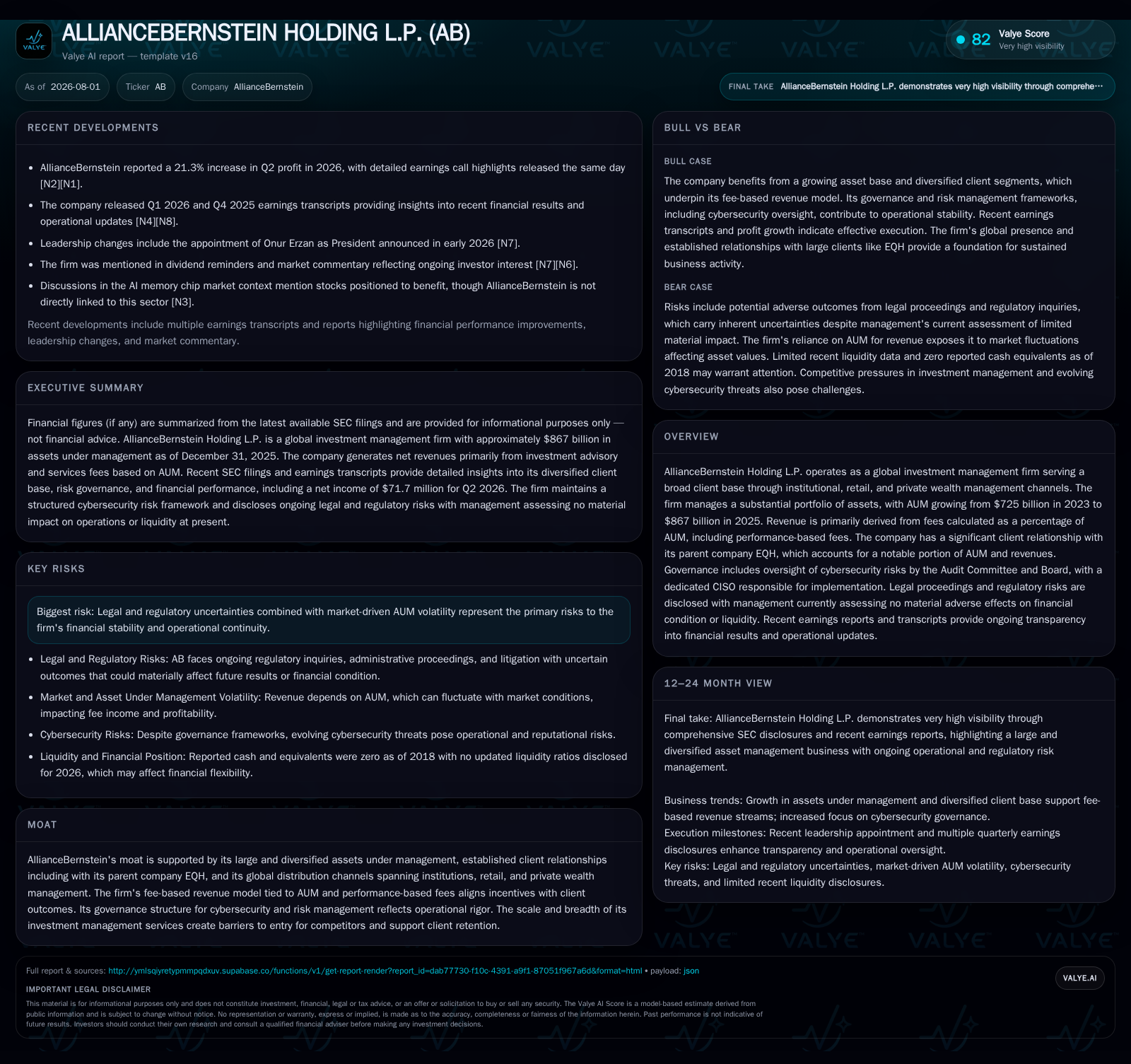
AllianceBernstein Holding L.P. reported steady growth in assets under management (AUM), reaching approximately $867 billion as of mid-2026, up from $792 billion a year prior. This increase underpins stable fee-based revenues, driven by a broad client base spanning institutional, retail, and private wealth channels. While the firm’s largest client remains its parent company EQH, representing about 16% of AUM and 4% of net revenues, diversification across other segments provides revenue stability. Governance practices emphasize cybersecurity risk oversight amid regulatory uncertainties. The firm’s ability to sustain client retention and performance-linked fees will be critical amid ongoing market volatility.
Second Quarter Results Highlight Resilient AUM Growth Through Diverse Channels
In its latest quarterly disclosure ending June 30, 2026, AllianceBernstein Holding L.P. (AB) reported that its total assets under management expanded to approximately $867 billion, up from $792 billion a year earlier [S2], [S21]. This solid growth reflects sustained positive net new asset flows across the firm's multiple distribution channels—encompassing institutional clients, retail investors, and private wealth management segments. The firm’s reputation for diversified offerings across asset classes has helped maintain momentum despite ongoing global market volatility that typically impacts AUM valuations.
Notably, AB continues to benefit from a mix that mitigates overreliance on any single customer segment or geography. Institutional investments remain a substantial contributor to overall flows, supported by AB's strong track record in fixed income strategies complemented by evolving alternative product suites favored by retail and private wealth clients. This multi-channel approach reduces sensitivity to cyclical swings affecting specific investor types or regions.
Although AB's parent company EQH affiliates hold roughly 16% of the total AUM—concentrated primarily in fixed-income assets—and generate about 4% of net revenues consistently over recent years, this relationship does not expose AB to excessive concentration risk given the broader portfolio diversity [S1], [S21]. Management’s ongoing efforts to broaden the client base enhance revenue stability tied predominantly to fees calculated on AUM balances.
Business Model Anchored in Fee Income: Assessing Revenue Quality and Concentration Risks
AllianceBernstein's core source of revenue lies in investment advisory fees charged as a percentage of assets under management alongside performance-based fees contingent upon achieving specified investment returns [S1]. This dual fee model creates an inherent alignment between AB's success and its clients’ outcomes, fostering client retention through shared objectives.
The firm's fee income benefits from structural durability due to its global scale and multi-tiered client relationships spanning institutions, individual investors via retail channels, and high-net-worth private wealth clients. While EQH represents a stable but sizable portion of AUM (circa 16%) and contributes around 4% of net revenues each year consistently from 2023 through 2025, this dependence appears manageable within the context of AB’s broader diversified book [S1], [S22]. The persistence of these percentages suggests stable contractual terms or ongoing mandates with the parent conglomerate.
However, because advisory fees are directly linked to AUM levels, market downturns can negatively affect this revenue stream temporarily unless offset by strong net inflows or outperformance-linked incentives. Performance fees represent an incremental lever that can enhance overall fee yield but introduce greater earnings variability tied closely to fund returns relative to benchmarks.
Competitive Footprint Amid Global Asset Managers: Scale Meets Client Diversification Tradeoffs
Within the highly competitive global asset management industry—populated by peers such as BlackRock, Vanguard, and Fidelity—AllianceBernstein occupies a mid-to-large scale position with approximately $867 billion in managed assets as of mid-2026. The firm leverages diversified distribution across institutional mandates and retail/private wealth frameworks that few boutiques or niche players fully match.
Unlike some mega-asset managers emphasizing ETF niches or passive strategies at razor-thin margins, AB maintains a focus on active management disciplines spanning fixed income, equities, alternatives, and multi-asset strategies which often command higher fee rates including performance fees. Its geographic reach into emerging markets complements traditional US and European mandates enhancing its relative appeal.
This breadth infuses certain competitive advantages like client stickiness based on differentiated product expertise that supports retention during volatile markets. Yet it also introduces complexity inherent in global regulatory environments as well as operational demands—such as compliance infrastructure—that only firms with sufficient scale can absorb efficiently.
Growth Levers: Distribution Expansion, Steady Net Flows, and Fee-Linked Incentives
Key growth drivers for AB remain centered on maintaining steady positive net new asset flows across all distribution channels alongside leveraging strong investment performance to fuel performance fee realization. Recent quarterly earnings call highlights underscore management’s commitment to expanding penetration within retail markets through tailored product innovation while deepening institutional relationships globally [N1].
The firm's capabilities in ESG-oriented products and alternative investments also position it well where long-term investor demand is increasing. Retention metrics are supported by fiduciary alignment reinforced through performance-based compensation structures ensuring adviser incentives dovetail with client outcomes.
By diversifying across geographies—including emerging markets exposures per MSCI indexes—and focusing on strategic partnerships along with technology adoption enhancing client servicing efficiency, AB seeks sustainable expansion paths beyond purely market appreciation effects on AUM.
Risk Factors Spotlight: Market Volatility and Governance Oversight Including Cybersecurity
The primary financial risk lingering for AllianceBernstein relates to market-driven fluctuations impacting AUM volumes directly tied to fee income generation. Heightened geopolitical tensions or macroeconomic shocks could result in rapid outflows or valuation contractions affecting quarterly revenues.
On the operational side, AB demonstrates robust governance protocols around cybersecurity risk—a critical concern given sensitive client data stewardship inherent in asset management firms. The Audit Committee oversees enterprise-wide risk frameworks including IT security policies while a seasoned Chief Information Security Officer leads implementation supported by specialized committees focusing on risk assessment initiatives [S1], [S23].
Maintaining proactive risk management remains vital both for regulatory compliance adherence and reputational defenses crucial for client trust continuity.
Looking Ahead: Key Milestones for Client Retention and Performance Metrics Monitoring
Upcoming quarters will be pivotal for assessing whether AB sustains positive flow momentum evidenced since early 2026 as well as how effectively it translates investment performance into realized performance fees amid varying market conditions. Observing Q3 asset inflow figures announced in subsequent releases will be instructive alongside monitoring incremental changes in fee rate compositions captured through quarterly disclosures or investor communications [N1], [S2].
Furthermore, tracking retention rates among institutional mandates coupled with expansion within retail platforms will serve as barometers for channel health. New product launches or geographic expansions may also emerge as catalysts underpinning future top-line growth validations thus warranting close observation.
Financial Profile Discussion: Stability in Fee Income Amid Market Pressure
The balance sheet does not appear burdened with material debt concerns based on available public metrics suggesting prudent capital management supporting operations without excessive external financing reliance. Continued focus on expense control alongside investment in technology platforms likely enhances operational efficiency thus reinforcing margin sustainability moving forward.
This analysis leverages AllianceBernstein’s latest SEC filings through Q2 2026 combined with public earnings commentary to evaluate its current business model trajectory within the broader asset management sector context. While historical industry headwinds such as fee compression persist broadly, AllianceBernstein’s diversified channel approach coupled with governance rigor comprise stabilizing factors amid uncertain macroeconomic cycles. Observers should prioritize upcoming flow trends and fee structure evolution for further clarity on long-term earnings durability.
Disclaimer: This report is an analyst-style company and industry summary for informational purposes only without investment research views.
Disclaimer: This is research-only, informational analysis and not investment advice. It may include AI-generated interpretation and general industry context. Always verify important details using primary sources.

Comments