
Stryker's Q2 2026 Surge Reflects Strong Innovation and Operational Execution
Stryker posts robust Q2 growth fueled by innovation in robotic-assisted surgery and operational leverage, strengthening its leadership in medical technologies.
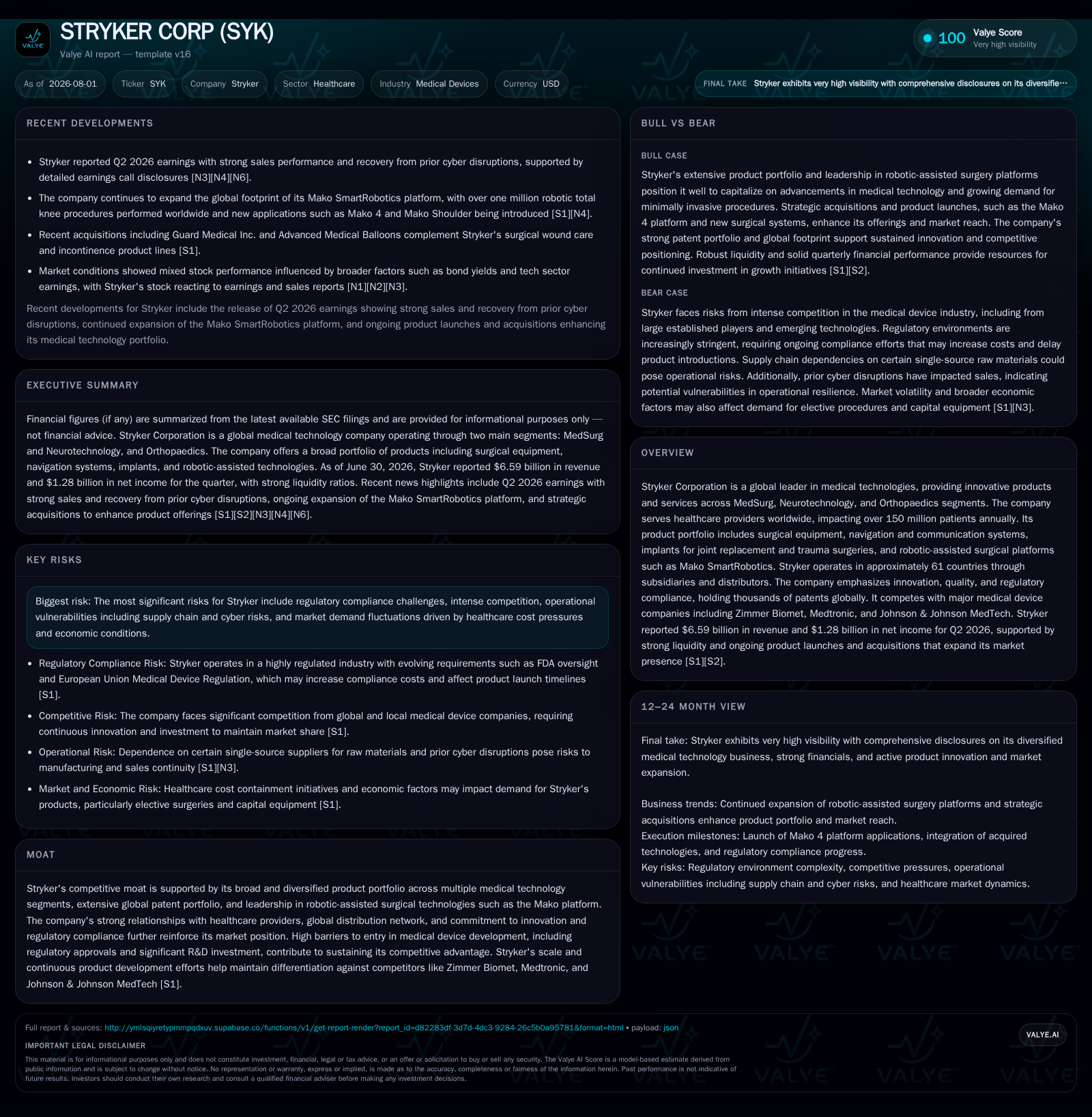
In Q2 2026, Stryker Corporation delivered a 9.4% increase in net sales and expanded adjusted operating margins by 170 basis points, reflecting sustained demand for its diversified product portfolio and accelerated adoption of its Mako robotic surgical system. MedSurg & Neurotechnology segment drove much of the growth, while Orthopaedics remained resilient amid ongoing innovation and service integration. The company’s strong global patent portfolio and regulatory expertise underpin its competitive moat versus peers like Zimmer Biomet and Intuitive Surgical. Key risks include regulatory complexities, supply chain pressures, and competitive pricing headwinds. Capitalized by strong liquidity and low leverage, Stryker is positioned to leverage emerging market penetration and continued R&D investment toward expanding market share and improving clinical outcomes.
Q2 Operating Momentum Anchored by Innovation and Margin Expansion
Notably, adjusted net earnings per diluted share rose nearly 18% to $3.69 reflecting disciplined cost management alongside top-line strength [S2]. These results suggest the company is converting innovation-driven volume into sustainable profitability enhancements rather than volume-driven margin erosion. This combination of accelerating organic sales growth with margin expansion emphasizes durable underlying business momentum that aligns with shifts toward minimally invasive surgery modalities employing robotic assistance.
Diversified Portfolio: Balancing MedSurg Innovations with Orthopaedic Strength
Stryker’s revenue diversification splits roughly between two reportable segments: MedSurg & Neurotechnology accounted for approximately 62% of total sales in recent years, while Orthopaedics contributed around 38% [S1]. The MedSurg & Neurotechnology segment encompasses surgical equipment including navigation systems, endoscopy devices, emergency medical equipment, vascular intervention tools primarily acquired via Inari deal focused on venous thromboembolism treatment, plus neurovascular products. Within this broad scope, the Mako robotic-arm assisted system plays a pivotal role as a technology platform that differentiates Stryker in joint replacement procedures through enhanced precision and reproducible clinical outcomes that surgeons increasingly favor [N3], [S1].
The Orthopaedics segment delivers implants for hip, knee, shoulder replacements, trauma surgeries as well as instruments that saw organizational consolidation under the "Ortho Tech" business unit early this year which aims to simplify customer engagement pipelines by integrating robotics, power tools, enabling technologies, and specialized instrumentation under one strategic umbrella [S14]. This restructuring suggests an increased focus on accelerating innovation cycle time for orthopaedic devices benefiting from integrated R&D efforts.
Customer buying behavior centers around hospitals, surgical centers, and clinics utilizing bundled capital equipment purchases paired with recurring implant consumables usage; long device lifecycle management supported by service contracts also heightens switching costs encouraging retention across both segments [S1]. The geographic reach across about 61 countries implemented through subsidiaries or distributors ensures exposure to mature markets like the U.S., Europe yet captures incremental growth opportunities in emerging healthcare infrastructures globally.
Defensible Competitive Position Amid Rigorous Regulatory and Market Pressures
As a leading entity in the medical devices industry marked by significant regulatory oversight, Stryker maintains a formidable moat through sustained R&D investment reflected in a vast patent portfolio securing proprietary designs especially in robotic surgery automation and orthopaedic implants [S1]. Barriers to entry are heightened given stringent medical device regulatory approvals demanded worldwide — including FDA clearance processes that prolong development cycles but deter commoditization — preserving premium pricing capabilities.
Compared against peers such as Zimmer Biomet (specializing in orthopaedic implants), Medtronic (diversified neurovascular device offerings), or Intuitive Surgical (robotic surgery pioneer), Stryker blends breadth across multiple clinical areas with depth in tech-led solutions like Mako SmartRobotics providing both scale economies and clinical differentiation advantages absent in niche competitors or pure implant manufacturers.
However, evolving reimbursement challenges from public/private health payers exert persistent pressure on procedure pricing economics which could constrain willingness to adopt newer costly technologies without demonstrated superior payer coverage or ROI implications for providers. Risk mitigation entails proactive engagement with regulatory bodies plus continuous clinical outcome data publication underscoring value proposition.
Growth Vectors: Robotics, Emerging Markets, and Clinical Adoption Patterns
Prominent growth drivers extending Stryker's runway include rapid expansion of robotic-assisted surgeries notably powered via the Mako platform whose adoption accelerates as surgeons seek minimally invasive procedures yielding faster recovery times linked to better patient outcomes [N3], supported by stable R&D spending maintaining around mid-single-digit percentage of sales devoted to pipeline development ensuring continuous intellectual property generation.
Geographically, increased penetration into emerging markets driven by upgraded local healthcare infrastructure presents outsized potential given demographic trends featuring aging populations increasingly requiring orthopaedic interventions globally; Stryker's distribution network through subsidiaries/distributors facilitates such market access enhancing geographic revenue diversification beyond mature regions where growth is slower paced but more predictable financially [S1], [S2].
Furthermore, customer adoption rates for new technologies serve as critical operating KPIs; renewed emphasis on service contract renewals tied to installed base usage strengthens recurring revenue streams augmenting product sales cyclicality smoothing effects common in capital equipment businesses.
Risks to Sustained Growth: Regulatory Complexity, Supply Chain Vulnerabilities, and Pricing Pressure
Despite operational strengths, Stryker faces several downside risks impacting its growth profile. Regulatory complexities including increasingly rigorous audits for AI-enabled medical technologies introduce uncertainty around approval timelines potentially delaying new product launches or increasing compliance costs substantially over forecast budgets [S1]
Supply chain stress remains notable especially after reported cybersecurity incidents earlier this year that temporarily disrupted production capacity — although addressed diligently — underscore vulnerability to operational interruptions risking inventory shortage or delivery delays that could erode hospital customer satisfaction if prolonged [N2], [S16]. Raw material price volatility may further squeeze gross margins absent adequate pricing pass-through mechanisms given competitive environment sensitivities.
Pricing pressure intensifies due to aggressive reimbursement cuts or provider budget constraints particularly within public payer systems challenging premium positioning on innovative devices without compelling health economics evidence; these factors collectively necessitate continued innovation coupled with cost discipline to preserve profitability gains achieved recently.
What Comes Next: Execution Indicators and Market Milestones to Watch
Near term performance will hinge on several execution milestones including forthcoming regulatory approvals for pipeline products expected within next few quarters which could broaden addressable markets or open new procedure categories using enhanced robotics capabilities; successfully onboarding these into existing customer workflows will be critical to sustain organic momentum measurable via quarterly sales lift metrics reported segmentally.
Emerging market revenue contributions will serve as bellwethers for global expansion strategy efficacy signaling whether healthcare infrastructure investments translate into real procedural uptake benefiting implant volumes; tracking such geographic mix shifts is important for foresight on macroeconomic exposure.
Free cash flow generation patterns reflecting operational efficiency improvements alongside steady R&D investments represent financial signals supportive of sustained innovation leadership allowing strategic acquisitions adding complementary tech assets aligned with long-term growth objectives. Competitor moves particularly from Intuitive Surgical's robotics advances warrant vigilance given possible encroachment into overlapping procedure domains demanding repeat validation of differentiation claims from Stryker’s platforms [N3], [S3].
Financial Profile Discussion: Capital Structure Supports Strategic Flexibility
At quarter-end June 30, 2026, Stryker reported liquidity characterized by cash equivalents totaling $3.39 billion against nominal reported debt levels historically approximated at about $24 million—a figure likely understated given data vintage but validated broadly by debt disclosures confirming low leverage bearings consistent with investment-grade credit status facilitating access to capital markets without strain [F1], [S2].
This conservative balance sheet posture provides strategic optionality enabling continuous funding of substantial R&D outlays vital for sustaining technological edge while affording appetite for bolt-on acquisitions such as Inari completed recently reinforcing peripheral vascular product breadth within MedSurg & Neurotechnology segment contributing incremental earnings diversification cushioned from core orthopaedic cyclicality risks.
In sum, prudent capital structure management complements robust operational execution positioning Stryker favorably amid dynamic market environments requiring agility both commercially and financially.
Disclaimer: This is research-only, informational analysis and not investment advice. It may include AI-generated interpretation and general industry context. Always verify important details using primary sources.

Comments