
Air Products & Chemicals Navigates Portfolio Reshaping with Steady Industrial Gases Core
Latest quarterly results reveal volume-driven growth counterbalanced by project impairments and elevated costs, underscoring Air Products’ pivot to core gas operations amid hydrogen project exits.
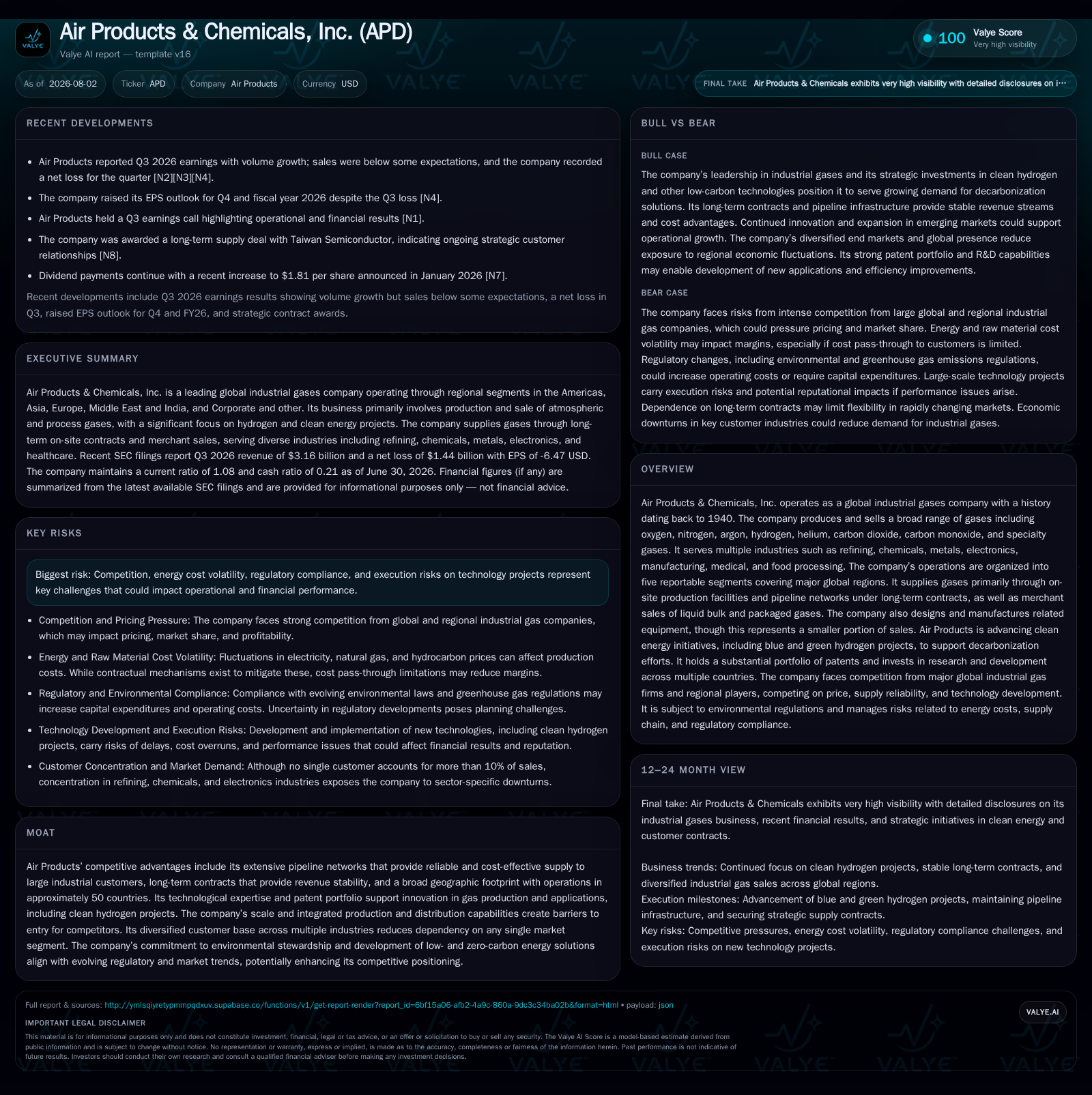
In Q3 2026, Air Products & Chemicals demonstrated revenue growth supported by increased volumes and pricing, despite posting a net loss influenced by significant non-recurring impairment charges. The company is sharpening its focus on its foundational industrial gases business, underpinned by resilient on-site production contracts and robust pipeline infrastructure. While the clean hydrogen segment faces strategic retrenchment following portfolio pruning, Air Products maintains competitive advantages in scale and contract stability across multiple global markets. Key risks include energy cost volatility and execution challenges tied to large-scale projects, with future performance hinging on operational efficiency and hydrogen market development.
Recent Operating Update
In its latest quarterly filing for Q3 ended June 30, 2026, Air Products & Chemicals reported sales of $3.161 billion, up modestly from $3.023 billion in the same quarter last year due primarily to volume growth and improved pricing dynamics within both on-site production and merchant sales channels [S2]. However, the period also included substantial non-operating charges totaling approximately $2.9 billion related to business and asset actions tied predominantly to prior-year clean energy project impairments initiated during fiscal 2025 [S2]. Consequently, the quarterly results reflected a net loss despite positive operational momentum.
This quarter's performance underscores the transitional phase Air Products is navigating as it concentrates resources on its core industrial gases operations while selectively exiting or downscaling certain clean energy initiatives that no longer meet rigorous capital return criteria set under new leadership since early 2025 [S1][N1]. The balance sheet remains solid with cash and equivalents of $980 million against current liabilities near $4.6 billion as of June 30, supporting liquidity for ongoing operations and selective investments [S2][F1].
Business Model Analysis
Air Products’ industrial gases segment forms the bedrock of its business model, which revolves around supplying atmospheric (oxygen, nitrogen, argon) and process gases (hydrogen, helium, carbon dioxide) through a mix of on-site production facilities directly linked to customer plants under long-term contracts and merchant bulk/liquid deliveries via pipeline networks or cryogenic transport [S1]. Approximately half of revenue is generated from these long-term on-site supply agreements that typically include pass-through clauses enabling cost recovery for variable inputs like energy—a critical margin stabilizer given volatile fuel prices globally [S1].
Revenue recognition hinges not just on volumes sold but on multi-year contracts that embed inflation-linked price adjustments. This contractual structure confers revenue visibility and earnings resilience uncommon among commodity chemical suppliers without similar infrastructure scale. Merchant sales supplement the base through spot or short-term bulk deliveries offering flexible customer solutions albeit at lower margin profiles.
Additionally, Air Products generates auxiliary revenue from specialized equipment manufacturing—such as turbomachinery and membrane systems—which although representing a smaller fraction of total sales adds technology differentiation and deepens customer relationships in niche markets [S1]. This diversified product mix widens economic moats around the company’s integrated supply chain capabilities.
Industry Structure and Competitive Position
The industrial gases sector is typified by high capital intensity due to substantial infrastructure investments encompassing cryogenic air separation plants, dedicated pipelines spanning industrial clusters, storage terminals, and sophisticated logistics networks. Success in this field demands optimal capacity utilization alongside stringent safety compliance given the hazardous nature of gases handled.
Air Products competes against global peers such as Linde plc—recognizable for its extensive pipeline assets—and Air Liquide with notable clean hydrogen ventures. Compared to regional operators like Messer Group or Taiyo Nippon Sanso that have narrower footprints or specialty niches respectively, Air Products’ geographic spread across approximately 50 countries grants it broad exposure while mitigating industry cyclicality through customer diversity spanning refining/chemicals (largest usage sectors), metals processing, electronics manufacturing, healthcare gases for medical use, and food processing applications [I-Knowledge Layer; S1].
Its large-scale pipeline network creates high barriers to entry by offering direct-to-plant delivery models lowering customer switching costs relative to competitors reliant solely on merchant bulk deliveries. This network advantage permits tighter integration with client production processes enhancing retention rates tied to multi-decade contracts.
Technology investments emphasizing efficiency gains—such as advances in cryogenic distillation processes—further position Air Products favorably with respect to production costs per unit gas delivered compared to smaller rivals bearing less operational leverage.
Growth Drivers
Key growth catalysts are rooted primarily in rising industrial activity within end markets like petrochemicals refining upgrades driven by environmental compliance needs; electronics manufacturing requiring ultra-pure specialty gases; and expanding medical oxygen demand amid healthcare sector trends [S1]. Organic volume growth benefits from incremental contract wins alongside existing plant expansions contributing margin-accretive scaling.
Simultaneously, Air Products is leveraging its expertise toward emerging clean energy opportunities where decarbonization policies accelerate demand for blue (natural gas reforming with CCS) and green (electrolysis-based) hydrogen projects—particularly targeting heavy-duty transport fuel supply chains as well as industrial feedstocks replacing fossil-based hydrogen sources [S1]. Although pass-through contractual provisions mitigate immediate margin erosion risk, prolonged structural inflation could strain customers’ budgets thus impacting renegotiation cycles or volume commitments adversely [S7][S8]
Project execution risk looms over large-scale clean energy developments where engineering complexities can lead to delays or cost overruns impacting ROI realization timelines. Regulatory uncertainties—including shifting emission standards globally—can lead to additional compliance expenditures or retrofitting requirements burdening capital expenditure plans.
Customer concentration risks persist due to sizeable exposure within refining/chemical sectors susceptible to industry-specific downturns or technological substitution impacting gas usage patterns unfavorably. Additionally geopolitical tensions affecting global trade can disrupt supply chain continuity for critical feedstocks or specialty gases deployed internationally.
Finally, residual litigation exposure tied to environmental remediation obligations at historical manufacturing sites requires ongoing monitoring although current estimated financial impacts are believed non-material per company disclosures [S7][S8].
What To Watch Next
Operational indicators warrant attention around volume trends across key segments notably Asia’s growing electrolytical hydrogen demand versus merchant gas supply stability amid macroeconomic fluctuations. Contract renewal rates over upcoming years will give insight into customer loyalty amidst inflationary pressures.
Technological innovation updates particularly regarding scaled membrane systems improving hydrogen purity or proprietary turbomachinery advances could indicate pathway enhancements reducing energy intensity per unit output serving key competitiveness metrics.
Capital expenditure pacing guided toward pipeline expansion projects versus new electrolyzer deployments will signal resource prioritization between legacy infrastructure scaling versus emerging green-growth bets.
Finally management commentary post-fiscal Q4 reporting aligning outlook on earnings recovery trajectory impacted by past non-operating charges provides forward clarity critical for assessing transition success from impaired legacy projects toward a sustainable earnings model anchored on core capabilities [N2][N3]
Financial Profile Discussion
As of June 30, 2026 balance sheets reveal cash reserves of approximately $980 million against current liabilities near $4.6 billion yielding an acceptable current ratio above 1.0 albeit suggesting working capital constraints typical in capital-intensive sectors reliant on receivables collections from large industrial customers [F1][S2]
Trailing twelve months operating income was under pressure due mainly to extraordinary project-related impairments but adjusted operating margins stabilized near 24% range supported by pricing power embedded within contractual frameworks that include energy cost recoveries providing resilient cash flow conversion potential despite raw material cost fluctuations [S19][N3]. R&D spend remains focused yet contained around breakthrough gas technologies consistent with medium-term innovation horizons supporting differentiation without excessive capital strain [S2][S19].
Taken together financial positioning aligns with a transition strategy balancing disciplined cost control against strategic investment selectively targeted toward evolving clean energy market opportunities while preserving core industrial gas business cash flow generation capacity necessary for sustaining returns on invested capital above industry hurdle rates.
Disclaimer: This analysis is intended solely for informational purposes reflecting an expert interpretation of publicly filed data and industry context; it does not constitute investment advice or research views regarding any securities mentioned.
Disclaimer: This is research-only, informational analysis and not investment advice. It may include AI-generated interpretation and general industry context. Always verify important details using primary sources.

Comments