
Rush Street Interactive Expands Market Reach with Proprietary Platform Innovation
RSI’s Q2 2026 results emphasize accelerated market expansion underpinned by its proprietary gaming platform and robust customer engagement strategies.
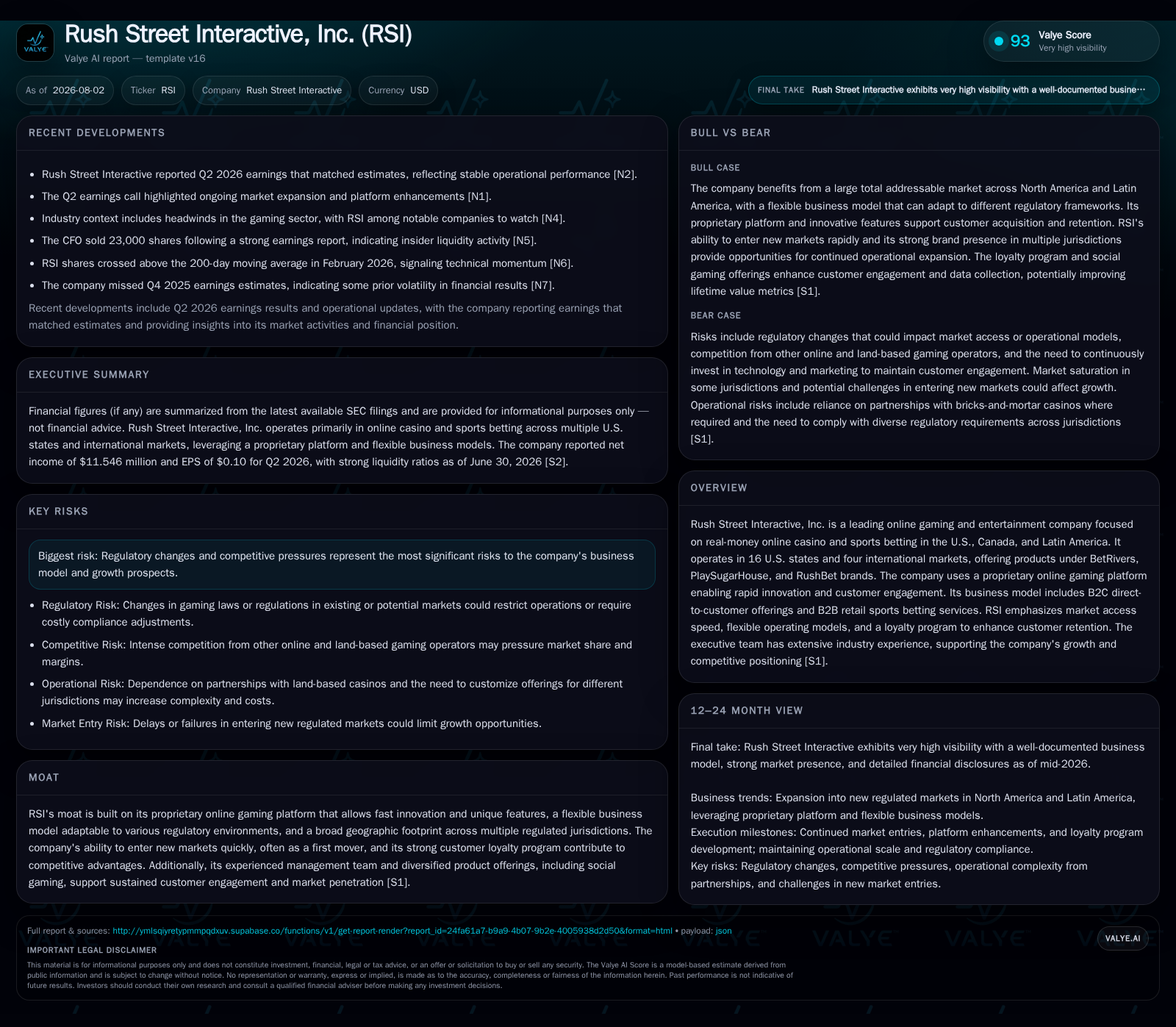
Rush Street Interactive (RSI) reported operational progress in Q2 2026, demonstrating steady growth across its multi-jurisdictional online casino and sports betting footprint. Leveraging a proprietary technology platform, RSI sustains rapid market access and product innovation, supported by a tiered loyalty program that enhances customer retention. Regulatory dynamics, competitive intensity, and hold rate variability remain key industry risks, while ongoing geographic expansion and B2B partnerships underpin near-term growth potential.
Q2 Operational Momentum Highlights Market Expansion Progress
Hold percentage—a critical driver of net gaming revenue reflecting the operator's share of wagers retained after payouts—was highlighted as variable but generally within targeted ranges suggesting disciplined risk management. Given the inherent volatility of hold rates industry-wide due to variance in customer wagering behavior and sporting event outcomes, RSI’s ability to maintain relative stability here is an important operating performance signal [S2]. Moreover, management commentary during the Q2 earnings call underscores improvements in average revenue per user (ARPU) linked to feature enhancements enabled by RSI’s proprietary platform technology [N1].
Differentiated Business Model Anchored by Proprietary Platform
Central to RSI’s competitive positioning is its proprietary online gaming platform that supports both real-money casino games and sports betting products. This technology foundation allows rapid product rollout customized to diverse regulatory requirements across jurisdictions ranging from U.S. states with varying compliance regimes to Canadian provinces and Latin American countries [S1]. Investors benefit from RSI's platform-driven agility manifesting in quicker time-to-market relative to operators reliant on third-party software providers or legacy systems.
This platform also facilitates simultaneous support of two complementary business lines: B2C direct-to-customer offerings underhouse brands such as BetRivers (U.S./Canada), PlaySugarHouse (U.S.) and RushBet (Latin America), alongside B2B retail sportsbook technology services deployed through physical casino partners’ sportsbooks. This dual model diversifies revenue sources by capturing wallet share both online directly and via retail venues through turnkey technology solutions that integrate with partners' front-end operations [S1]. Together these expand addressable market reach while preserving gross margin flexibility as customer acquisition cost dynamics differ between direct digital marketing versus retail partnership channels.
Competitive Landscape: Technology Leadership amid Industry Titans
In a highly competitive ecosystem dominated by major players like DraftKings and FanDuel who command leading shares of U.S. mobile sports betting volumes, RSI distinguishes itself through technological nimbleness rather than sheer scale or vertical integration [S1],[N1]. Its emphasis on proprietary software bespoke for each jurisdiction contrasts with white-label or third-party dependent operators potentially prone to slower innovation cycles.
However, this approach also exposes RSI to challenges around achieving scale economies seen at larger competitors able to leverage vast marketing budgets or integrated physical-virtual ecosystems like Caesars Entertainment. Consequently, RSI must rely heavily on faster innovation cadence supported by its executive team’s deep sector expertise—including executives formerly at Scientific Games—to build differentiated user experiences fostering loyalty amid high promotional spend environments [S1]. The company's expansive geographic footprint across emerging legalization hotspots also provides first-mover advantages critical to forming early customer habits prior to intensified competitive entries.
Loyalty Programs Enhance Player Engagement and Retention Dynamics
A cornerstone of RSI’s strategy involves a tiered loyalty program structured to enhance retention through meaningful rewards distributed over extended periods—tiers last up to 12 months providing stability that can reduce churn risk common in the highly promotional online gaming realm [S1]. Players earn tier points for all real-money bets placed across casino or sports betting verticals unlocking benefits spanning bonus dollars, exclusive prize-linked games accessible via proprietary bonus stores, and other incentives.
This loyalty framework is crucial given the high customer acquisition cost (CAC) typical of the sector; retaining existing players ensures better lifetime value (LTV) economics offsetting upfront marketing investments. By driving habitual engagement through exclusive content experiences only available within the loyalty scheme, RSI strengthens switching costs making it harder for players to defect despite promotional offers from competitors. Such program effectiveness is visible through improving retention rates referenced indirectly by management commentary on sustained ARPU increases linked to loyalty-enhanced play patterns [S1]
Regulatory Environment: Risks versus Opportunity in Multijurisdictional Models
The evolving regulatory landscape remains the primary systematic risk confronting RSI. Operating across multiple U.S. states plus international territories demands continuous compliance adaptation encompassing licensing renewals, tax obligations ranging widely by jurisdiction, anti-money laundering protocols, responsible gaming standards enforcement, and reporting transparency requirements [S1],[S2]. Any lapses can lead to fines or license revocations seriously affecting operating continuity.
Additionally, delays or failures in legalization efforts—be it slower state-by-state approval processes for mobile gaming licenses or shifting regulatory interpretations—could limit market access windows vital for capturing early adoption benefits. Tax regime variability adds complexity as higher effective tax rates can compress margins materially given the sector’s moderate gross margin profiles excluding variable marketing expense impact.
Nonetheless, these regulatory constraints simultaneously act as barriers deterring less compliant entrants thereby protecting established operators like RSI who develop trusted compliance frameworks. The company's expanding footprint especially into newer markets evidences its capacity to secure requisite approvals even amid tightening control scrutiny [S2]
Growth Catalysts: Geographic Expansion, Product Innovation & B2B Partnerships
Key levers behind anticipated RSI growth include continued entry into newly regulated states such as recent containment expansions in Michigan and Pennsylvania alongside deeper penetration into Canadian Ontario province and Latin American countries like Mexico where digital wagering regulations are advancing [S1],[N4].
Product innovation enabled by the proprietary platform allows RSI not only to roll out classic casino titles but also novel offerings personalized via data analytics enhancing user experience stickiness which supports higher ARPU levels seen in recent quarters [N1],[N4]. Cross-selling between social (free-to-play) games toward real-money wagering presents an incremental conversion funnel augmenting core monetization pathways.
In the B2B segment, expanding partnerships with retail sportsbooks consolidate RSI’s presence offline tapping into consumer segments less inclined toward pure digital channels thereby capturing complementary revenues while improving overall margin contribution through higher incremental utilization of existing technology infrastructure [S1],[N4].
Constraints & Risks: Compliance, Competition & Hold Rate Volatility
Despite promising fundamentals, several constraints may impair results trajectory. Sustained intense competition necessitates elevated marketing spend elevating CAC suppressing adjusted EBITDA margins relative to more mature peers benefiting from scale advantages [S1],[S2].
Hold rate volatility remains a fundamental operational uncertainty since short-term adverse shifts can materially depress net gaming revenue unpredictably complicating quarterly performance forecasting even absent underlying volume changes. Moreover, reliance on third-party mobile ecosystems means disruptions or policy shifts could impede app distribution or functionality impacting customer acquisition/retention mechanics.
Licensing risks persist where failure in timely renewals or modifications due to regulator discretion could stall expansion efforts or limit existing operations thereby constraining growth visibility beyond currently accessible markets [S2].
Near-Term Watchpoints: KPIs & Market Entries Confirming Growth Trajectory
Monitoring forthcoming active player counts by state coupled with ARPU trends will provide early confirmation of product-market fit consistency amid new market launches [N4],[S2]. Customer acquisition cost efficiency metrics will gauge whether marketing spend remains sustainable relative to lifetime value gains generated from loyalty programs.
Progress against pipeline licensing milestones especially internationally will indicate momentum toward further geographic diversification crucial for reducing dependency on saturated U.S. markets where incumbents dominate direct digital sports betting channels. Also important are hold percentage trajectories which must be observed closely given their outsized influence on short-term net gaming revenue fluctuations constraining predictability despite stable bet volumes.
Financial Profile Discussion: Liquidity Strength Underpinning Growth Execution
RSI exhibits a healthy liquidity position evidenced by cash & equivalents totaling approximately $340 million as of June 30, 2026, paired with a current ratio of 2.12 reflecting conservative working capital management relative to near-term liabilities [F1]. This financial strength provides operational flexibility supporting elevated marketing expenditures needed during aggressive market entries as well as buffering regulatory compliance costs typically front-loaded during new jurisdiction launches.
The company has no material debt disclosed currently mitigating financial risk linked to leverage while supporting balance sheet characteristics conducive to funding platform enhancements plus potential mergers/acquisitions should strategic opportunities arise.
This analysis is based strictly on cited public disclosures from Rush Street Interactive's SEC filings and associated news sources without investment research views or speculative projections.
Disclaimer: This is research-only, informational analysis and not investment advice. It may include AI-generated interpretation and general industry context. Always verify important details using primary sources.

Comments