
Terex Corp Advances Post-Acquisition Strategy Amid Solid Liquidity and Digital Focus
Q2 2026 results reveal Terex's integration progress of REV Group acquisition, stable balance sheet, and digital initiatives shaping its industrial equipment business.
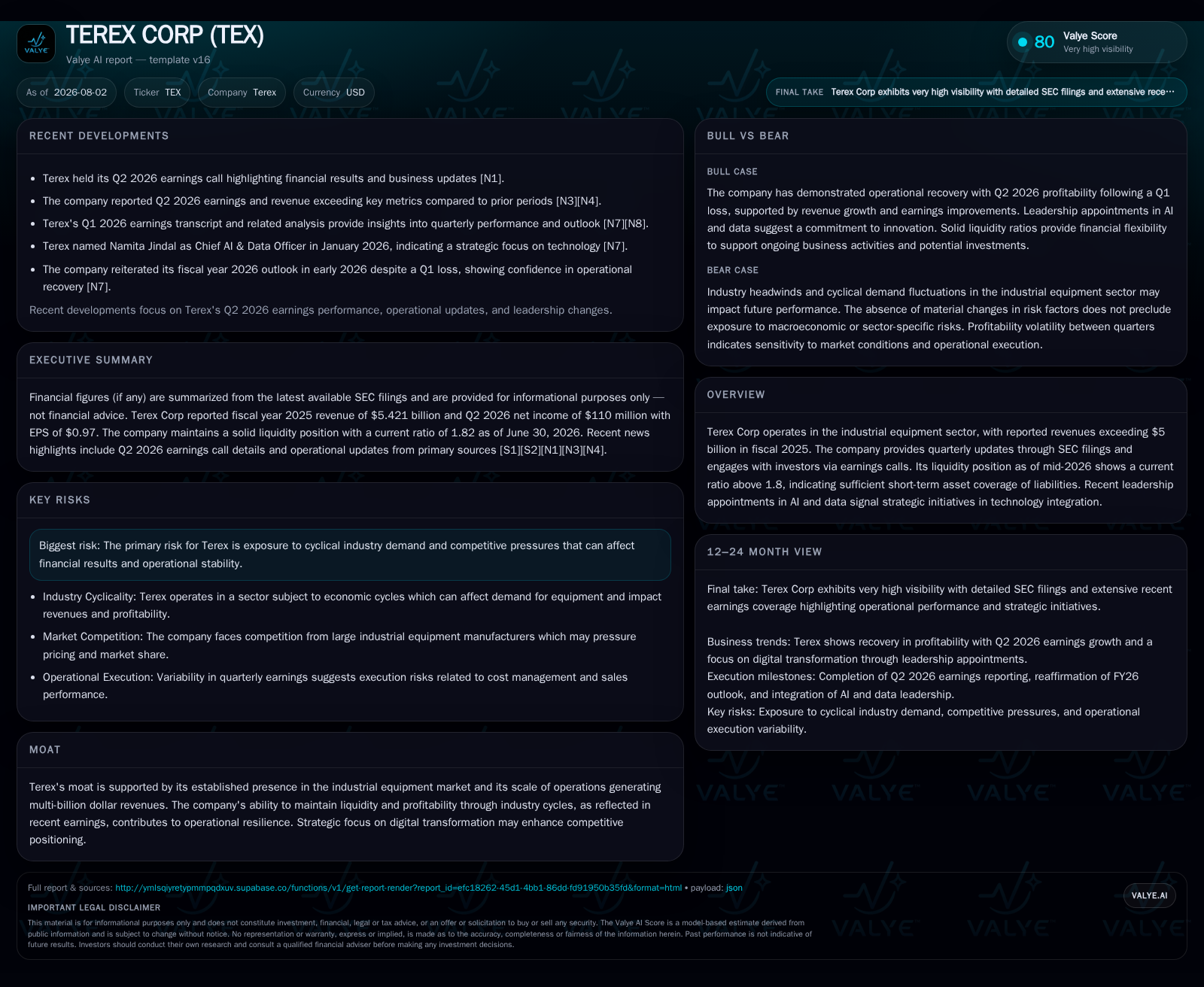
Terex Corp’s latest quarter underscored ongoing assimilation of the February 2026 acquisition of REV Group, with highlighted pro forma disclosures showing combined operational scale. Its liquidity remains solid with a current ratio above 1.8 as of mid-2026, supporting resilience in a sector marked by cyclical demand tied to infrastructure spending. Strategic emphasis on digital transformation and AI integration aims to enhance equipment efficiency and aftermarket services. While industry cyclical pressures persist, Terex’s broad product portfolio and service expansion offer avenues for growth, albeit within competitive heavy machinery markets dominated by peers such as Caterpillar and Komatsu.
Recent Q2 2026 Operating Update
Terex Corporation's second quarter 10-Q filing dated July 30, 2026, anchors the latest view on its operational progress following the strategic acquisition of REV Group completed earlier that year on February 2 [S2][S3]. This acquisition represents a significant augmentation to Terex’s industrial equipment portfolio and market footprint, as reflected by the inclusion of unaudited condensed consolidated financial statements for REV in the post-merger disclosures [S3]. The pro forma combined statements for the six months ended June 30, 2026 provide investors transparency into the enlarged entity's scale, though Terex prudently cautions these results are illustrative rather than predictive.
Liquidity remains robust, with current assets exceeding current liabilities by nearly double at mid-year — specifically $3.38 billion versus $1.86 billion — culminating in a healthy current ratio of approximately 1.82 [F1]. This liquidity sufficiency is critical given the capital-intensive nature of manufacturing heavy construction machinery and material handling equipment, which require sustained investment cycles amidst fluctuating economic conditions.
Management continues emphasizing digital transformation efforts, including newly appointed leadership focusing on AI and data analytics integration aimed at optimizing equipment utilization rates and augmenting aftermarket service capabilities [N1]. These technology-driven initiatives are increasingly important as industrial OEMs seek to differentiate offerings beyond pure physical capital equipment sales.
Business Model Specifics and Strategic Strengths
Terex operates chiefly as an original equipment manufacturer (OEM) producing heavy machinery utilized across construction, infrastructure development, mining, and material handling sectors. Its revenue streams encompass unit sales of capital equipment as well as recurring revenues from aftermarket parts sales, maintenance services, and increasingly service contracts that provide stable annuity-like income streams.[S1] The addition of REV Group expands product breadth and enhances access to adjacent markets, potentially strengthening cross-selling opportunities for aftermarket parts — a higher-margin segment critical for margin expansion.
A distinguishing feature within this sector involves managing production capacity utilization efficiently while balancing working capital tied up in inventory and receivables [S1]. Customer purchasing decisions hinge on replacement cycles influenced by infrastructure spending patterns, regulatory mandates (e.g., emissions standards), as well as broader economic indicators like commodity pricing impacting mining investment
Terex’s scale producing multi-billion-dollar revenues places it among mid-sized players relative to peers such as Caterpillar Inc., which commands superior scale and geographic breadth—factors that foster stronger pricing power and supply chain leverage.[S1] Nonetheless, Terex leverages focused product innovation bolstered by digital tools enhancing customer retention via improved equipment uptime through predictive maintenance.
Industry Structure and Competitive Positioning
The industrial equipment manufacturing industry is characterized by significant cyclicality tied to government infrastructure spending programs (e.g., Infrastructure Investment and Jobs Act), raw material price swings (steel, electronics), and global geopolitical factors affecting supply chains.[S1][S28] In this context, Terex competes on multiple fronts: product innovation including automation capabilities; service excellence via aftermarket parts availability; channel efficiency involving dealer networks; and cost control via supply chain resilience.
Competitors such as Komatsu Ltd. emphasize global footprint expansion coupled with advanced technology adoption across their product lines; Caterpillar remains the benchmark for comprehensive product breadth spanning agriculture through construction; while specialized firms like Hyster-Yale focus more intensively on aftermarket parts revenue growth.[N14] Terex’s recent moves toward AI-powered digital platforms aim to close competitive gaps by improving operational efficiency for end customers—a critical factor sustaining loyalty in high-capital deployment industries.
Growth Drivers
Infrastructure expansion globally driven by urbanization trends provides structural demand support for Terex’s machines used in construction projects.[S1] Additionally, replacement demand emerges from aging fleets — offering steady upgrade cycles especially where new regulations demand cleaner or safer equipment models.[S28]
Technological advancements integrating IoT sensors into machines enable predictive maintenance services increasing aftermarket parts consumption—a faster-growing revenue segment compared to new unit sales alone.[N1] Broadening service contract renewals further incentivizes recurring revenue stability.
Furthermore, synergies realized through the REV acquisition could unveil cross-selling prospects expanding market reach beyond traditional segments.[S3] Capital expenditure monitoring will reveal whether strategic investments align effectively with anticipated demand pick-up or new market penetrations.
Risks and Watchpoints
Cyclical demand remains paramount risk amid macroeconomic uncertainties such as interest rate fluctuations impacting project financing costs or delays in government-funded infrastructure budgets.[S2][S28] Raw material cost volatility—especially steel—and continued supply chain constraints pose operating cost risks eroding gross margins.
Competitive pressures may compress prices where peer innovators introduce disruptive automation or lower-priced Chinese OEM entrants intensify regional competition.[S1] Integrating REV also carries execution risk typical for complex mergers involving systems harmonization without losing focus on operational efficiency.
Monitoring backlog volumes alongside book-to-bill ratios will be crucial leading indicators signaling durable demand vs short-term order pull-ins affected by channel inventory adjustments [N4]
Finally, currency exchange rate fluctuations across Terex’s global sales footprint present profit translation challenges requiring effective hedging strategies [S1]
What To Watch Next
Upcoming quarterly updates should clarify how successfully Terex is converting backlog into shipments while maintaining margin leverage amid input cost headwinds.[N3] The progression of digital tool deployments—including customer adoption rates of AI-based services—will gauge the effectiveness of strategic pivots towards technology-driven differentiation.
Capital expenditure plans outlined in future disclosures will indicate readiness to expand production capacity or modernize facilities aligned with evolving environmental standards [S2]
Equally important will be tracking organic growth contributions against acquisitions amid volatile end-market environments plus any commentary on supply chain normalization or persistent logistics bottlenecks affecting lead times.[N1]
Investors should also monitor renewal rates in service contracts which underpin steady aftermarket revenue streams less vulnerable to cyclicality than outright equipment sales.
Financial Profile Discussion
Terex concluded the first half of 2026 with $407 million cash & equivalents alongside $3.38 billion current assets versus $1.86 billion current liabilities at quarter-end June 30—a net working capital position supporting operational flexibility [F1]. While total debt figures are last reported at approximately $678 million (year-end 2021 vintage), net debt extraction considering cash reduces this burden considerably [F1]. This favorable liquidity profile enables Terex to weather typical industry cyclicality without straining its balance sheet.
Capital allocation priorities currently integrate investments underpinning digital transformation alongside integration costs linked to REV acquisition [S3].
Overall, Terex balances prudent financial stewardship with targeted growth initiatives positioning it competitively within industrial equipment manufacturing’s cyclical milieu.
This analysis is based solely on publicly disclosed information as of August 2026 without access to non-public data. It does not constitute investment advice or research views but aims to provide a structured industry-informed perspective on Terex Corporation's evolving business landscape.
Disclaimer: This is research-only, informational analysis and not investment advice. It may include AI-generated interpretation and general industry context. Always verify important details using primary sources.

Comments