
Nabors Industries Advances Rig Modernization Amid Credit Agreement Flexibility
Nabors reported a mixed Q2 2026 with evolving debt strategies and sustained technology investment reflecting oilfield services sector cyclicality and competitive pressures.
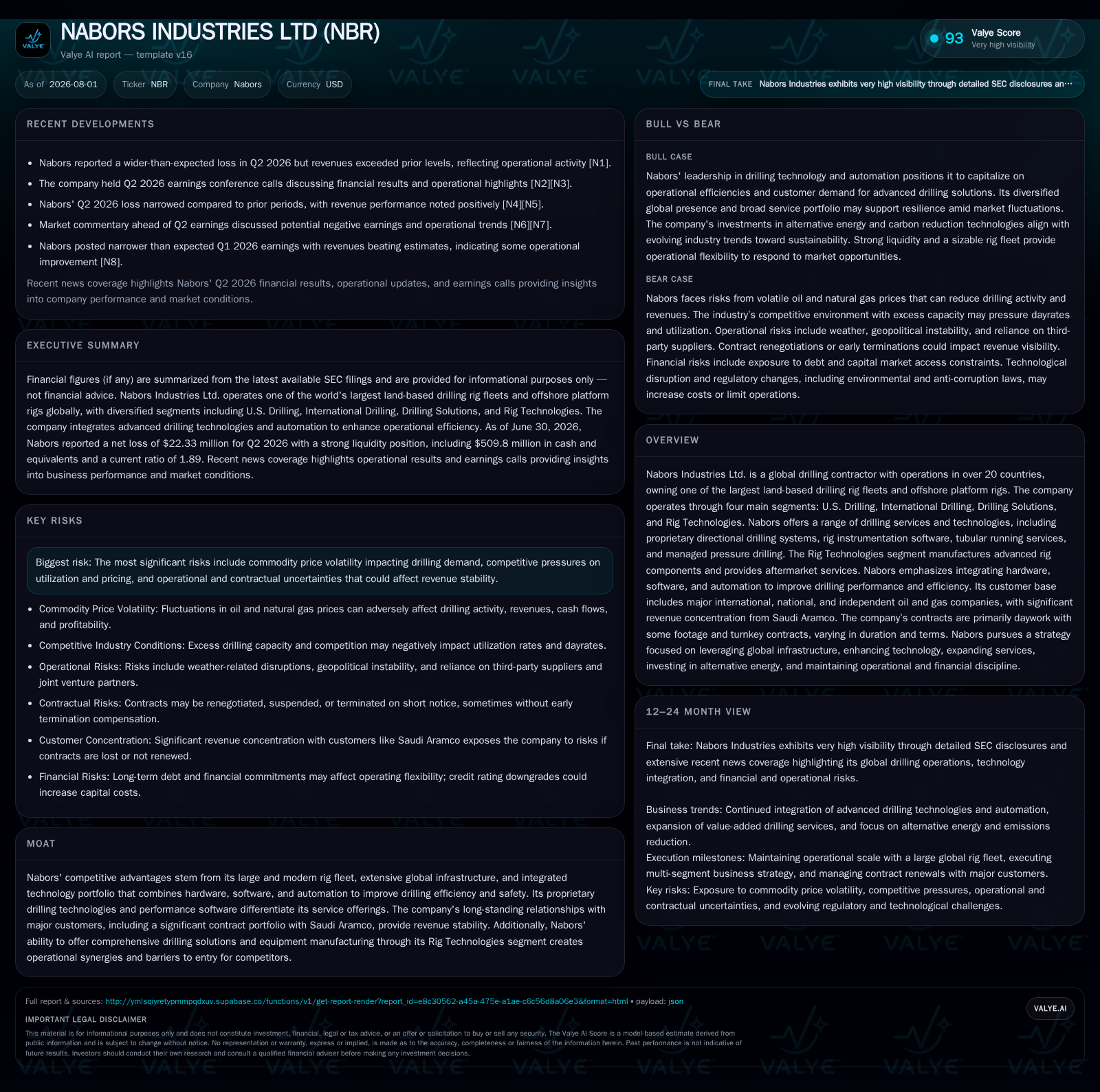
In its latest quarterly filing, Nabors Industries Ltd. detailed ongoing operational dynamics amid a cyclical drilling demand environment characterized by stable rig utilization but pressure on dayrates. The company secured a waiver allowing a partial redemption of high-coupon notes, signaling active capital structure management within tight liquidity constraints. Nabors continues to leverage its integrated offering of land and offshore rigs combined with proprietary drilling technologies to differentiate in a capital-intensive, competitive oilfield services market. However, customer concentration risks remain with Saudi Aramco accounting for a significant revenue share, underscoring contract renegotiation and geopolitical uncertainties as key watchpoints.
Recent Operating Overview
Nabors Industries Ltd.’s Q2 2026 filing reveals an operational environment marked by steady yet cautiously constrained drilling activity [S2]. The company’s average rigs working have held relatively stable compared to prior periods, with no material change indicated in the reported risk factors [S15]. Despite this stability in rig counts, the broader industry context points to ongoing pressure on dayrate pricing given prevailing commodity price fluctuations. This dynamic limits near-term margin expansion even as utilization holds.
A notable financial development is Nabors’ recent waiver obtained on July 23, 2026, allowing the redemption of up to $100 million aggregate principal of its 9.125% senior priority guaranteed notes due 2030 [S3]. Scheduled for August 12, this move underscores Nabors’ active management of its capital structure during a challenging financing landscape typical of capital-intensive oilfield services firms facing cyclicality. Reducing high-coupon debt at this juncture could enhance financial flexibility without sacrificing liquidity.
Business Model Specifics
Nabors operates one of the world's largest land-based drilling rig fleets alongside a sizable portfolio of offshore platform rigs, emphasizing global reach with operations spanning more than 20 countries [S1]. Revenue generation hinges primarily on leasing these rigs under contract to upstream oil and gas exploration and production companies. The monetization model blends multi-well term contracts—with early termination clauses—and single-well contracts often subject to short-notice cancellation or renegotiation [S21]. This model creates an inherent tension between utilization stability and pricing dynamics, shaped heavily by spot market availability and competitor capacity.
Complementing the rig operations are Nabors’ Drilling Solutions and Rig Technologies segments [S1]. These provide proprietary directional drilling systems, managed pressure drilling services, tubular running tools, advanced rig components manufacturing via Canrig (including top drives and robotic systems), rig instrumentation software, and aftermarket support. By integrating hardware with automation software designed to optimize drilling performance efficiency and safety, Nabors seeks differentiation beyond pure fleet scale.
Customer concentration is significant; Saudi Aramco accounted for approximately 30% of consolidated operating revenues in 2025, concentrated mainly in International Drilling [S18]. While this relationship offers revenue predictability—particularly due to SANAD JV contracts—it also represents a concentration risk where contract renewals or negotiation pressures could materially impact utilization or pricing terms. Expansion into additional international markets partially diversifies geographical exposure but does not fully hedge large customer dependency.
Industry Structure and Competitive Position
Within the oilfield services ecosystem, Nabors occupies a dual role as both an integrated drilling contractor (similar in some aspects to peers like Schlumberger) and equipment manufacturer akin to National Oilwell Varco. Its rig fleet modernity compares favorably within the land-based segment relative to peers such as Helmerich & Payne that also compete intensely on automation and high-specification rig offerings.
However, Nabors must contend with excess global rig capacity that tempers pricing power—a persistent theme within industry risk disclosures [S1]. Its scale provides bargaining leverage in bidding processes but cannot fully insulate it from commoditization pressures evident in single-well contract churn. Proprietary technology integration enhances retention rates by demonstrating measurable gains in operational efficiency & emissions control but requires ongoing capital investment amid uncertain ROI timelines.
Growth Drivers
Several structural growth drivers emerge for Nabors: rising upstream exploration activity driven by recovering or elevated hydrocarbon prices; continued demand for enhanced drilling techniques such as managed pressure drilling; modernization imperatives replacing aging rigs with automated designs; and international market expansions targeting underpenetrated regions. The ability to bundle performance software and tubular services alongside traditional rig leasing creates potential cross-selling opportunities enhancing revenue per rig metrics.
Long-term contracts with national oil companies provide stability in bidding cycles though they are vulnerable to geopolitical headwinds. Nabors’ investment in energy efficiency technologies responds not only to regulatory trends but also increasingly ESG-driven customer preferences, which could confer differentiated competitive positioning over lesser-equipped rivals.
Risks and Watchpoints
Key risks remain tightly linked to oil price volatility which directly impacts exploration budgets and consequently rig utilization rates. Excess capacity among competitors sustains downward dayrate pressure risking margin compression despite fixed operating cost bases [S1]. The large customer concentration notably Saudi Aramco adds counterparty risk should contract terms suffer or geopolitical tensions escalate.
Operational risks from weather disruptions or safety incidents can abruptly reduce revenues or damage equipment requiring costly repairs. Supply chain constraints for critical components could delay rig maintenance or new technology rollouts undermining service quality metrics. Additionally, rapid shifts in drilling technology paradigms raise obsolescence risk if capital expenditures fail to keep pace with innovation cycles.
Regulatory risks include compliance demands related to environmental standards especially regarding emissions reduction commitments which may increase operational expenses or require capital upgrades [S1].
What to Watch Next
Milestones deserving close attention include Q3 operational statistics reaffirming any trends in rigs working versus dayrate trajectory that could signal early signs of recovery or further decline [N1][N3]. Renewal outcomes on key multi-year contracts including SANAD JV arrangements would indicate revenue visibility directionally.
Capital allocation decisions around fleet modernization investments versus potential asset sales will also reveal strategic balance between growth expenditure and deleveraging priorities post-partial note redemption [S3]. Moreover, any changes in credit agreement covenants or access lines would materially affect liquidity buffers essential during downturns.
Technology adoption rate progression particularly uptake of automated drilling systems within existing fleet deployments serves as proxy for sustaining competitive advantage relative to peers like Halliburton’s drilling solutions segment or National Oilwell Varco’s equipment manufacturing focus.
Financial Profile Discussion
As of June 30, 2026, Nabors reported cash and equivalents totaling approximately $510 million against total debt of about $2.15 billion, resulting in net debt near $1.64 billion [F1]. Current assets of approximately $1.20 billion exceed current liabilities of roughly $634 million, yielding a current ratio of about 1.89, which suggests adequate near-term liquidity coverage despite substantial long-term leverage typical within drillers’ capital-structure profiles given heavy fixed assets requirements [F1].
The recently negotiated waiver reflects the company’s intention to prudently manage expensive debt maturities by opportunistic coupon buybacks potentially trimming interest costs over time while balancing liquidity needs [S3]. Overall, Nabors displays financial discipline aligned with sustaining core operations amid oilfield service cyclical fluctuations while investing selectively in growth-enabling technology platforms fundamental for future operating margin expansion potential.
Disclaimer: This analysis does not constitute investment advice or research views. It is based solely on publicly available filings and industry context as of August 2026.
Disclaimer: This is research-only, informational analysis and not investment advice. It may include AI-generated interpretation and general industry context. Always verify important details using primary sources.

Comments