
Old Republic International Strengthens Specialty and Title Insurance Segments with Stable Underwriting in Q2
Old Republic’s Q2 2026 results reflect solid underwriting discipline and investment portfolio resilience supporting dual-segment insurance operations.
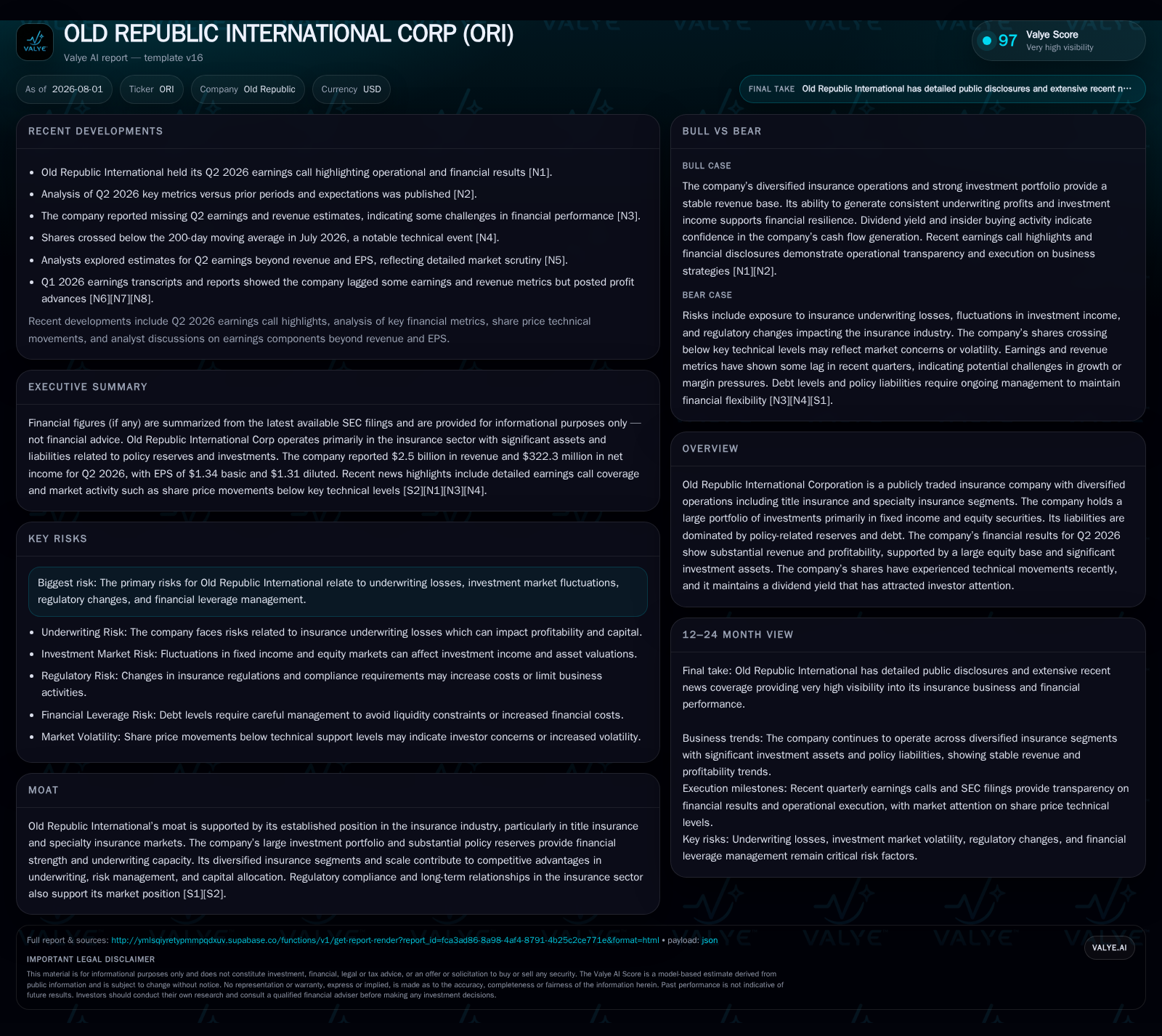
Old Republic International Corporation reported steady performance in its Specialty and Title Insurance segments during Q2 2026, with underwriting results reflecting disciplined risk selection and well-controlled loss experience. Despite growing unrealized losses in fixed income securities amid volatile markets, the company maintains substantial policy reserves and regulatory capital adequacy. The dual-segment approach, combining commercial specialty insurance and real estate-driven title insurance, provides diversified revenue streams supported by a large investment portfolio that underpins underwriting capacity. Investors should monitor combined ratio trends and investment yield developments as key near-term indicators.
Q2 Operating Results Reveal Stable Underwriting Across Dual Insurance Segments
Old Republic International’s Q2 2026 consolidated accounts showcase continued operational resilience with modest movement in net premiums written in both core segments — Specialty Insurance and Title Insurance [S2][S23]. The Specialty segment’s portfolio emphasizes commercial lines such as automobile liability (around 42% of net premiums earned), workers’ compensation, general liability, and various niche coverages including fidelity and surety indemnities. This diverse specialty mix mitigates concentration risk while meeting broad commercial insurance needs
Title Insurance remains intrinsically linked to U.S. residential and commercial real estate markets through issuance of policies protecting against defects or liens on properties. Steady volumes in property transactions continue to support premium growth. Both segments maintained disciplined underwriting evidenced by combined ratios holding within targeted ranges. This constancy indicates effectively managed claims experience relative to earned premiums alongside tight control over operating expenses despite macroeconomic volatility [S2][N1]. Importantly, this balancing act affirms Old Republic’s pricing power and expense discipline within competitive specialty lines.
Specialty and Title Insurance: Distinct Drivers Within a Diversified Model
Old Republic’s bifurcated structure leverages distinct risk profiles inherent in specialty versus title products. Specialty Insurance underwriting involves analyzing complex commercial risk exposures where loss dynamics can vary substantially by line — from frequency-driven auto claims to lower-frequency but higher-severity surety bonds or directors’ & officers’ liability policies [S1][S2]. This complexity necessitates advanced actuarial models supplemented by reinsurance strategies limiting impact of large claims
Conversely, Title Insurance operates on volume-driven revenue generation tied directly to real estate transaction density—a more predictable albeit cyclical pattern sensitive to housing market conditions and interest rates. Underwriting profitability here depends less on claims frequency (claims tend to be relatively rare) and more on controlling claims reserves for latent title defects alongside operational efficiency in policy issuance.
Maintaining robust policyholder surplus across these segments enables Old Republic to absorb claim variances while meeting regulatory capital thresholds mandated by state insurance bodies. This surplus plays a crucial role in supporting long-tail reserve liabilities common in specialty lines while accommodating cyclical swings in title insurance demand [S1][S23]
Investment Portfolio Yield Amid Heightened Market Volatility: Implications for Profitability
Enhancing underwriting earnings, Old Republic manages a sizeable investment portfolio whose composition shapes cash flow reliability. At June 30, 2026, fixed income securities accounted for roughly 85% of investments—with government, agency, and corporate bonds dominating—while equities comprised about 15% [S2]. However, a material rise in unrealized losses on fixed income holdings occurred versus prior periods due mostly to interest rate sensitivity amid volatile market conditions.
Though unrealized mark-to-market deficits weighed on comprehensive income statements momentarily, the firm retains intent to hold many of these instruments to maturity [S2]. Consequently, realized gains or losses remain limited preserving core investment yield over time. This strategy reflects prudent duration management minimizing forced disposals at depressed prices while generating stable coupons contributing to overall net investment income
The interplay between modestly compressed investment yields and steady underwriting performance creates a nuanced profit environment where rising loss ratios or claim frequency could pressure total returns despite the company’s sizable float—premiums invested until claims are paid [S2]. Monitoring portfolio credit quality amidst corporate bond exposures also remains relevant given fluctuating economic growth prospects
Balance Between Policy Reserves Adequacy and Regulatory Capital Requirements
Policy reserves represent a significant portion of Old Republic’s liabilities due to the nature of long-tail specialty claims and extended title insurance indemnification periods [S1][S2]. The company reports conservative reserve adequacy backed by detailed actuarial assumptions vetted regularly against emerging claim trends. Such conservatism positions Old Republic well against potential adverse developments or claim inflation pressures
Regulatory capital compliance is maintained via a combination of policyholder surplus reinforcement through retained earnings accumulation plus disciplined underwriting profit retention policies [S1][F1]. Rating agencies evaluating financial strength also factor in this balance when assessing creditworthiness against peers like Chubb Limited or Berkshire Hathaway, which operate similar diversified specialty-focused platforms with sizable investment capabilities
Peer Context: How Old Republic’s Scale Aligns With Specialty and Title Insurance Peers
While not directly paralleling any single insurer due to its dual focus, Old Republic shares characteristics with Chubb Limited concerning specialty insurance sophistication including complex commercial products requiring nuanced claims management. In the title space, peers like Fidelity National Financial occupy an adjacent competitive set focusing chiefly on real estate transaction-related policies offering scale benefits through distribution breadth.
Old Republic’s blend of these two sectors provides strategic diversification advantages mitigating cyclical downturns isolated to either real estate or commercial lines independently. Their capital structures similarly emphasize robust policyholder surplus fortified by steady investment returns aligning them with diversified industry players such as Berkshire Hathaway who prioritize capital flexibility alongside underwriting discipline [S1].
Growth Vectors: Expanding Risk Management Solutions and Real Estate Activity Supporting Title Insurance Demand
Broader industry tailwinds converge favorably into Old Republic’s addressable markets. Rising complexity in commercial risks including cyber exposures, executive liability, and warranty products drives incremental demand within Specialty Insurance requiring insurers adept at underwriting emerging risks [S1]. Concurrently, sustained U.S. real estate market activity underpins ongoing growth potential for Title Insurance premiums especially as regulatory burdens push transparency demands prompting thorough title searches.
Innovations incorporating data analytics into underwriting processes may further enhance risk selection efficacy and pricing accuracy enabling incremental margin improvement over time if effectively deployed across the company’s insurance subsidiaries [S1]. Geographic expansion remains a conceivable vector but is not explicitly detailed recently.
Risks on the Horizon: Underwriting Exposure, Market Rate Fluctuations, and Regulatory Scrutiny
Key risks persist centering on potential misjudgments in underwriting leading to loss reserve inadequacies manifesting as elevated combined ratios adversely affecting profitability [S1]. Corporate bond market exposure subjects investment income stability to credit cycle swings—heightened monitoring necessary given fair value fluctuations noted recently
Regulatory landscapes are evolving with possible changes impacting required capital buffers or reserving methodologies that could increase compliance costs or constrain operational agility. Competition remains an undercurrent applying pressure on pricing particularly within commoditized specialty lines forcing sustained focus on expense management.
The company also faces operational risks including technology integration challenges arising from data-driven initiatives or cybersecurity threats inherent in financial services sectors.
What to Monitor Next: Upcoming Earnings Milestones, Combined Ratio Signals, And Investment Returns Trends
Validation of Old Republic’s current earnings narrative hinges on future quarterly disclosures assessing continuity of combined ratio moderation alongside stable or improving loss ratios particularly within specialty lines sensitive to economic cycles.
Investment portfolio yields warrant continued attention; shifts toward rising unrealized losses or credit stress signs would signal pressure points potentially offsetting underwriting gains.
Dividend declarations or share repurchase programs provide indirect signals about management confidence in free cash flow generation underpinning balance sheet strength seen currently.
Financial Profile Discussion: Debt Levels, Investment Fair Value Changes, And Capital Positioning
Old Republic maintains low debt leverage relative to equity base supported by a solid balance sheet with total debt approximating $21.7 million per latest available data—considered minimal against total assets scale [F1]
Investment portfolio valuation reveals increased unrealized losses ($78.5 million combined across various categories), reflective largely of mark-to-market accounting adjustments rather than realized impairments signaling intent to hold investments long term consistent with standard insurance float management practice [S2]
Retained earnings growth driven by net operating income supports ongoing policyholder surplus accretion essential for statutory capital compliance across multiple jurisdictions ensuring regulated entities maintain sound financial footing amidst industry scrutiny.
This financial position accords operational flexibility facilitating measured acquisitions such as the pending addition of Everett Cash Mutual Insurance within Specialty segment contingent upon regulatory approval enhancing future earnings diversity [S2][S23]
Disclaimer: This analysis is for informational purposes only and does not constitute investment advice or research views regarding securities of Old Republic International Corporation.
Disclaimer: This is research-only, informational analysis and not investment advice. It may include AI-generated interpretation and general industry context. Always verify important details using primary sources.

Comments