
American Assets Trust Elevates Portfolio Resilience Through Strategic Capital Recycling and Leasing Gains
Steady leasing momentum and focused capital recycling in infill, high-barrier-to-entry markets continue to bolster American Assets Trust's portfolio performance and cash flow.
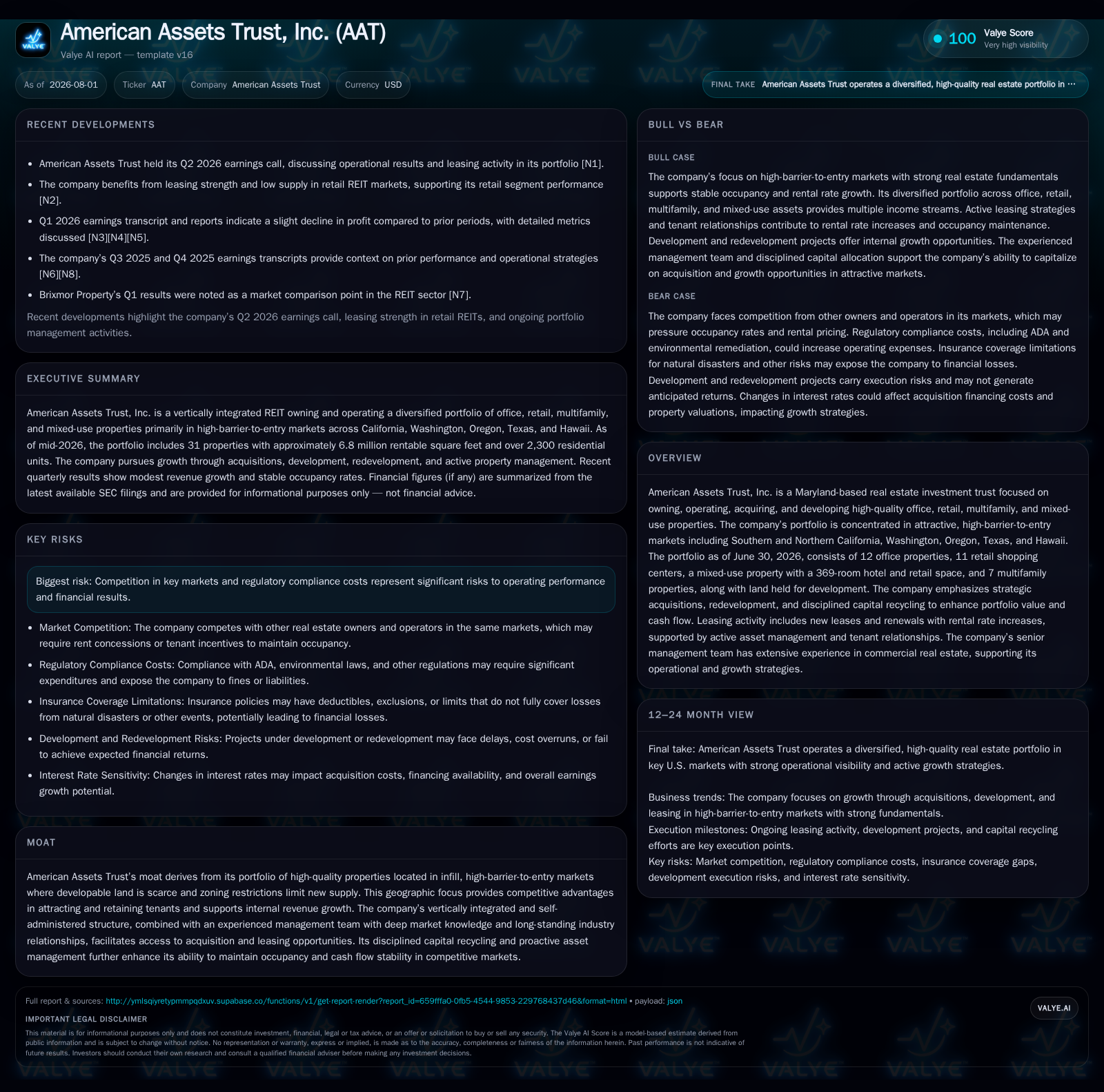
American Assets Trust’s Q2 2026 results reveal continued strength in leasing velocity and rental rate growth across its diversified portfolio of office, retail, multifamily, and mixed-use properties concentrated in key West Coast and Texas markets. The company’s disciplined capital recycling strategy, which balances strategic acquisitions, dispositions, and redevelopment projects, is enhancing portfolio quality and supporting stable same-store net operating income growth despite broader macroeconomic pressures. Operating within high-barrier-to-entry markets where supply constraints favor landlords, American Assets Trust leverages its vertically integrated management to sustain occupancy above market averages and deliver funds from operations resilience. Key risks remain competition for acquisitions and leasing within these attractive markets as well as regulatory compliance cost inflation.
Q2 Operating Momentum Reinforces Portfolio Strength in Targeted Markets
American Assets Trust’s second quarter 2026 filings demonstrate sustained operational momentum characterized by robust leasing velocity spanning new agreements and renewals across their diversified commercial and residential portfolio [S2], [S3]. Key leasing metrics revealed rental rate escalations consistent with market-level supply constraints particularly notable in their office properties situated in Bellevue, Washington, and Southern California. Occupancy rates held relatively steady at approximately 83% for office assets while retail demonstrated even stronger performance near 98%, underscoring effective tenant retention efforts [S2]. Multifamily properties reported occupancy just above 91%, maintaining resilience typically seen in high-demand infill residential markets. The mixed-use property containing hotel and retail components also contributed positively through stable lease renewals. This steady leasing activity feeds into sustainable rental income streams that underpin net operating income (NOI) growth on a same-store basis.
Diversified Asset Base Amid High-Barrier Entry Enhances Income Stability
AAT’s business model centers on owning, operating, acquiring, and selectively developing a portfolio concentrated in high-barrier-to-entry markets such as San Diego, the San Francisco Bay Area, Bellevue-Washington corridor, Portland-Oregon, Texas urban centers, and Oahu-Hawaii [S1], [S2]. These locations feature scarce developable land combined with restrictive zoning laws that collectively constrain new supply, thereby granting pricing power over rents to landlords who maintain high-quality assets. The mix of office (12 properties), retail shopping centers (11 properties), multifamily residences (7 properties), a mixed-use complex including a 369-room all-suite hotel, and land parcels held for future development contributes to diversified revenue streams that soften cyclicality commonly associated with single-sector portfolios [S1]. This diversification allows AAT to capture demand from various tenant segments ranging from corporate office lessees to retail consumers to residential tenants. The geographical focus on affluent neighborhoods within high-barrier metros amplifies tenant demand elasticity and supports above-market rent escalations.
Strategic Capital Recycling Supports Quality and Cash Flow Expansion
term structures—complements these efforts by promoting occupancy retention at favorable terms. This dual approach mitigates risks tied to market cycles or individual asset underperformance.
Leasing Performance Highlights Underpin Sustainable Rental Rate Gains
Leasing transactions recorded during Q2 underscore enduring demand strength evidenced through positive rental rate growth per square foot across all major property types [S2], [N1]. New leases typically incorporate rent escalations aligned with market conditions reflecting limited availability in core submarkets where AAT operates. Renewal negotiations continue demonstrating willingness among tenants to accept moderate rent increases likely due to locational advantages inherent in AAT’s infill assets. Tenant improvement allowances remain judiciously calibrated to preserve overall gross margins on leases while facilitating occupiers’ space customization needs—a subtle balance critical in sustaining net operating income gains without inflating capital expenditures excessively. The portfolio’s average lease term profile suggests an ongoing stable revenue runway with embedded protections against abrupt occupancy declines.
Regulatory Environment’s Influence on Development Pipeline Capacity
Zoning restrictions coupled with environmental regulations characteristic of American Assets Trust’s key markets establish material barriers limiting near-term supply expansion [S1]. While this reduces competitive pressure through constrained new construction pipelines—thus benefiting existing landlords by supporting rental growth—it simultaneously introduces execution risk concerning permitting delays or increased project costs for developments underway or planned. Land parcels held for redevelopment or ground-up construction represent embedded optionality but depend on successful navigation of complex regulatory processes. Such constraints underscore the importance of internal expertise possessed by AAT’s vertically integrated management team who orchestrate timing-sensitive approvals alongside proactive stakeholder engagement.
Growth Prospects Anchored by Market Dynamics and Asset Management Execution
Fundamental demand drivers supporting AAT’s positive outlook include favorable population growth trends combined with robust employment expansion in core West Coast metros along with strong Texas urban dynamics highlighted in recent industry assessments [N5], [S1]. These macro factors provide tailwinds boosting occupancy recovery prospects particularly for office spaces that have faced cyclical headwinds elsewhere. Additionally, multifamily housing continues benefiting from tight regional supply-demand imbalances typical of high-barrier-to-entry residential markets. From an operational perspective, AAT’s asset management execution emphasizes maximizing tenant retention through maintaining building amenities competitive with newer supply alongside tailoring leasing packages aligned with tenant business needs—which further propagates occupancy stability.^The company also pursues prudent disposition timing aimed at rotating capital from maturing assets into higher yield redevelopment or acquisition prospects catering to evolving demand patterns.
Risks From Market Competition and Regulatory Costs Remain Key Watchpoints
Despite solid fundamentals, competitive pressures persist both on the tenant front as multiple REIT peers vie for limited quality occupiers especially in premier submarkets which could cap achievable rent escalations over time [S1], [S2]. Likewise, competition intensifies when sourcing acquisition targets capable of delivering accretive returns given elevated valuations prevalent across real estate sectors. Regulatory cost inflation encompassing compliance requirements regarding environmental mandates or municipal levies adds an additional layer of operational complexity potentially compressing operating margins if not offset by rental increases. These factors necessitate vigilant monitoring as part of risk management frameworks deployed by AAT management.
"What to Monitor": Leasing Metrics, FFO Guidance Updates, Development Progress
To gauge continuing execution efficacy amidst dynamic conditions stakeholders should closely track quarterly leasing velocity data including new lease signings versus renewals consistent with historical pace; observe trends in rental rate per square foot relative to institutional benchmarks; assess updates on funds from operations guidance signaling cash flow stability or improvement [S2], [N1]; scrutinize progress reports on redevelopment projects highlighting milestones met versus schedules; evaluate occupancy trends particularly within office segments where cyclical volatility is more pronounced. Transparent disclosure around capital deployment plans balanced against debt levels will further clarify financial flexibility available for opportunistic investments or buffering economic downturns.
Financial Profile Discussion: Balance Sheet Leverage Supports Strategic Flexibility
This report does not constitute investment advice but serves informational purposes grounded strictly on publicly available factual disclosures supported by referenced filings.
Disclaimer: This is research-only, informational analysis and not investment advice. It may include AI-generated interpretation and general industry context. Always verify important details using primary sources.

Comments