
Amazon’s Logistics and Cloud Fusion Bolster Resilience in Q2 2026
Amazon’s Q2 2026 results underscore synergies between its extensive e-commerce fulfillment network and expanding cloud services, reinforcing its competitive moat amid macroeconomic challenges.
In its latest quarterly filing, Amazon revealed increased investments in digital content alongside durable growth in Amazon Web Services (AWS), emphasizing the integration of retail operations with cloud computing scale. The company’s capitalized video and music content rose notably, reflecting strategic emphasis on subscription engagement. Operationally, improvements in fulfillment efficiency and a broad marketplace ecosystem support margin resilience despite rising costs. However, macroeconomic volatility and supply chain risks persist as key watchpoints. Amazon maintains a strong liquidity position supporting ongoing capital deployment for infrastructure and AI initiatives.
Q2 Operational Highlights Signal Strengthening Competitive Advantages
Additionally, Amazon disclosed derivative energy contracts securing electricity supply for its vast operational footprint extending up to twenty years, aiming to stabilize input costs across fulfillment centers and data facilities [S2]. These derivative instruments reflect proactive financial risk management consistent with protecting margin durability amid volatile commodity cycles.
Integrated Business Model: E-Commerce Meets Cloud Computing Scale
Details from the February 2026 annual filing provide structural context for how Amazon balances multiple revenue engines: direct product sales through its e-commerce platform, third-party marketplace fees from seller ecosystems, digital content subscriptions, membership programs such as Prime, and AWS cloud computing services [S1]
The diversification between retail goods—with its inherently lower margin but massive volume nature—and high-margin cloud infrastructure services creates a resilient revenue mix insulated partially from economic cyclicality impacting consumer spending [S3]. AWS contracts include recent expansions involving chip supply performance obligations which enhance long-term cloud capacity scalability and reinforce competitive positioning against peers like Microsoft Azure or Google Cloud
This diversified approach enables Amazon to leverage its technology platforms efficiently while benefiting from scale effects: e.g., software development for both commerce personalization and cloud service optimization shares underlying technical innovation investments.
Marketplace Ecosystem and Fulfillment Network Efficiency Driving Margins
Amazon operates one of the world’s largest proprietary logistics networks supporting last-mile delivery capabilities critical to conversion rate improvements and average order value uplift [S1], [S2]. Fulfillment cost per order is a key operational KPI since rising labor or transportation expenses materially pressure margins when spread over large GMV volumes.
Despite elevated costs noted in Q2 filings due to inflationary pressures on logistics inputs, investments in logistics optimization—including automation enhancements—provide margin relief potential over time [S2]. The extensive marketplace ecosystem also expands selection without inventory risk by third-party sellers paying fees on gross sales volumes; this marketplace fee model offers higher incremental margin than direct product sales.
Scale advantages here create barriers for competitors lacking such integrated fulfillment networks.
Investment in Digital Content Fuels Subscriber Engagement Growth
Capitalizing nearly $21.3 billion in video/music intellectual property assets supports subscriber retention within Prime Video and Amazon Music offerings—subscription businesses vital for stable recurring revenues that complement transaction-based retail income streams [S2], [S1].
Subscription renewal rates here serve as critical KPIs reflecting engagement quality; higher renewal strengthens revenue visibility amidst capital spending on content licensing or original programming.
This pivot signals Amazon’s deepening commitment to platform engagement that sustains free cash flow despite heavy upfront capex burdens associated with content development.
Emerging Risks: Macroeconomic Volatility and Supply Chain Pressure
The February annual report flags macroeconomic uncertainties—like inflation spikes or geopolitical tensions impacting global trade flows—as principal risks potentially disrupting inventory turnover rates or delivery punctuality [S1].
Dependence on suppliers with global footprints combined with regulatory scrutiny on data privacy and labor practices further complicate operational execution amid intense competition requiring aggressive customer acquisition spending.
Signs to watch would include deteriorating shipping times or rising customer acquisition costs that could compress margins.
Growth Catalysts: AI Innovation, Emerging Markets & Subscription Expansion
Recent market commentary highlights how Amazon leverages AI-driven personalization technologies enhancing conversion rates while reducing customer acquisition cost—both crucial KPIs for e-commerce platforms competing on user experience efficiency [N4], [N5].
Simultaneously, expansion into emerging economies with growing internet penetration represents structural GMV growth potential beyond mature markets.
Cloud segment revenue growth remains fueled by increasing enterprise adoption of AWS services; new chip contract arrangements emphasize focused infrastructure buildup supporting higher-margin long-term growth relative to retail operations.
Subscription service expansions catalyzed by exclusive digital content amplify steady income streams underpinning margin resilience.
Pending Milestones: Monitoring Operating KPIs and Capital Deployment
Investors should monitor several leading indicators unfolding over coming quarters: GMV trends across domestic and international markets; subscription renewal statistics influencing recurring revenue quality; fulfillment cost per shipment reflecting logistics efficiency progress; and AWS quarterly revenue trajectory evidencing cloud market share expansion [S2], [S3], [F1].
Capital deployment commitments exceeding $220 billion over long horizons—including commitments linked to AWS chip production—highlight ongoing heavy infrastructure investment essential to maintaining technology leadership and e-commerce speed advantage.
Maintaining net debt near $50 billion amid large contractual outlays underscores liquidity management importance as sustained earnings partially offset investment scale.
Financial Profile Discussion: Balancing Liquidity Against Capital Commitments
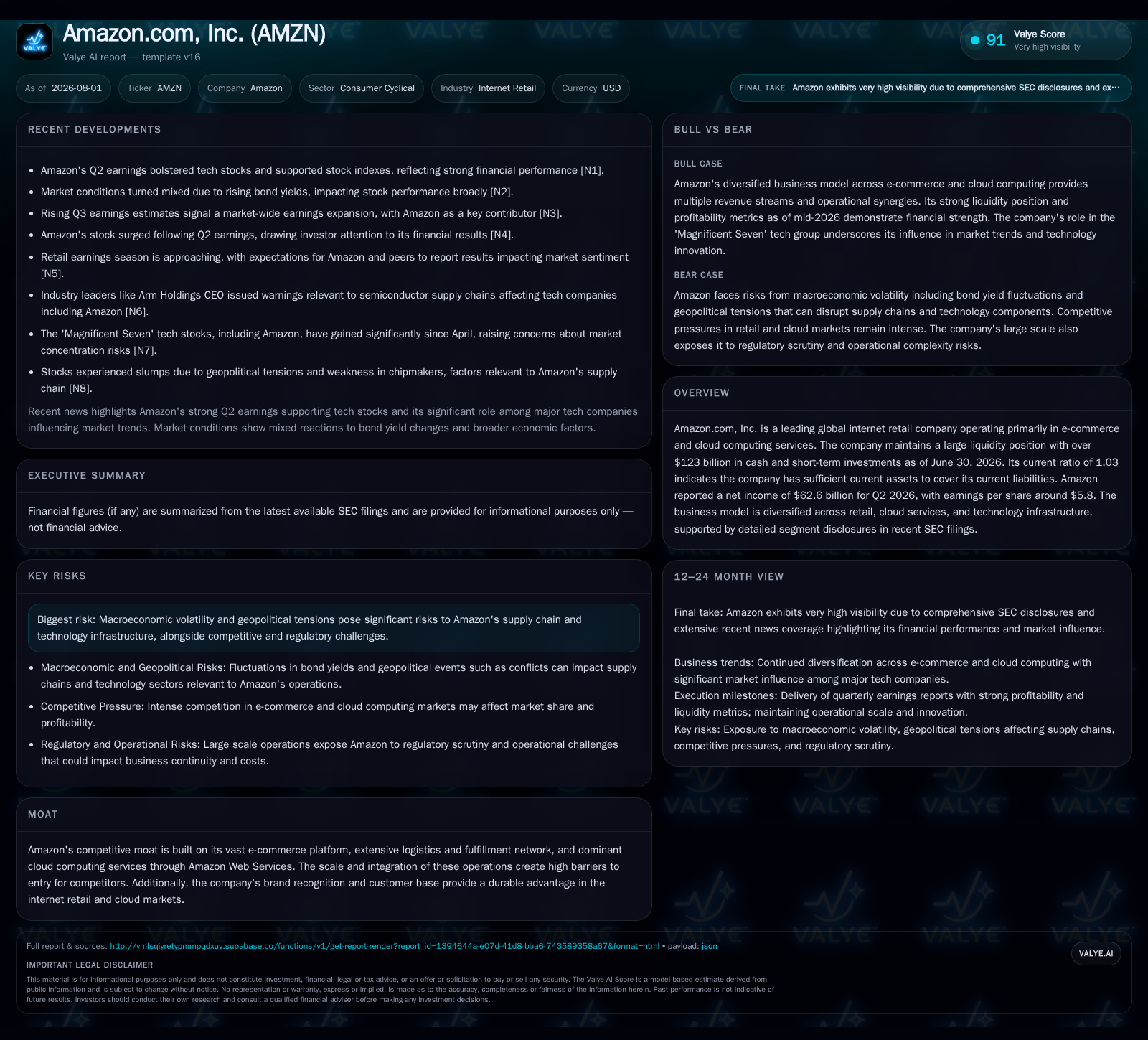
As of June 30, 2026, Amazon held approximately $78.2 billion in cash and equivalents compared with total debt nearing $128.9 billion—translating to net debt around $50.7 billion—with a current ratio close to parity at 1.03 indicating adequate short-term liquidity coverage for liabilities [F1]. This liquidity buffer is critical given contractual commitments surpassing $220 billion weighted toward long-term maturities plus operating lease obligations recorded near $116 billion [S2].
Q2 net income hit about $62.6 billion reflecting strong profitability that supports continued asset investment without overreliance on external financing [S2]. Capitalized content investments pushing up intangible asset balances signal sustained cash consumption but also platform differentiation toward subscription revenue durability.
This analysis focuses strictly on the latest available SEC disclosures highlighting Amazon’s expansive business model balancing consumer cyclical e-commerce with high-growth cloud technology services supported by sizable investments in digital content platforms. The detailed view emphasizes both opportunities from integrated logistics-cloud operations driving margin improvements alongside watchpoints tied to macroeconomic uncertainties and capital allocation intensity inherent in maintaining competitive moats.
Forward-looking signals will center on GMV momentum, fulfillment efficiency metrics, subscription engagement trends, AWS contract rollouts, and liquidity management indicated within subsequent quarterly disclosures.
Disclaimer: This is research-only, informational analysis and not investment advice. It may include AI-generated interpretation and general industry context. Always verify important details using primary sources.

Comments