
EMCOR Group Strengthens Earnings and Expands Contract Backlog with Acquisition-Fueled Growth
EMCOR’s Q2 2026 results demonstrate continued momentum through acquisition integration, diversified segment growth, and a record contract backlog despite emerging operational safety risks.
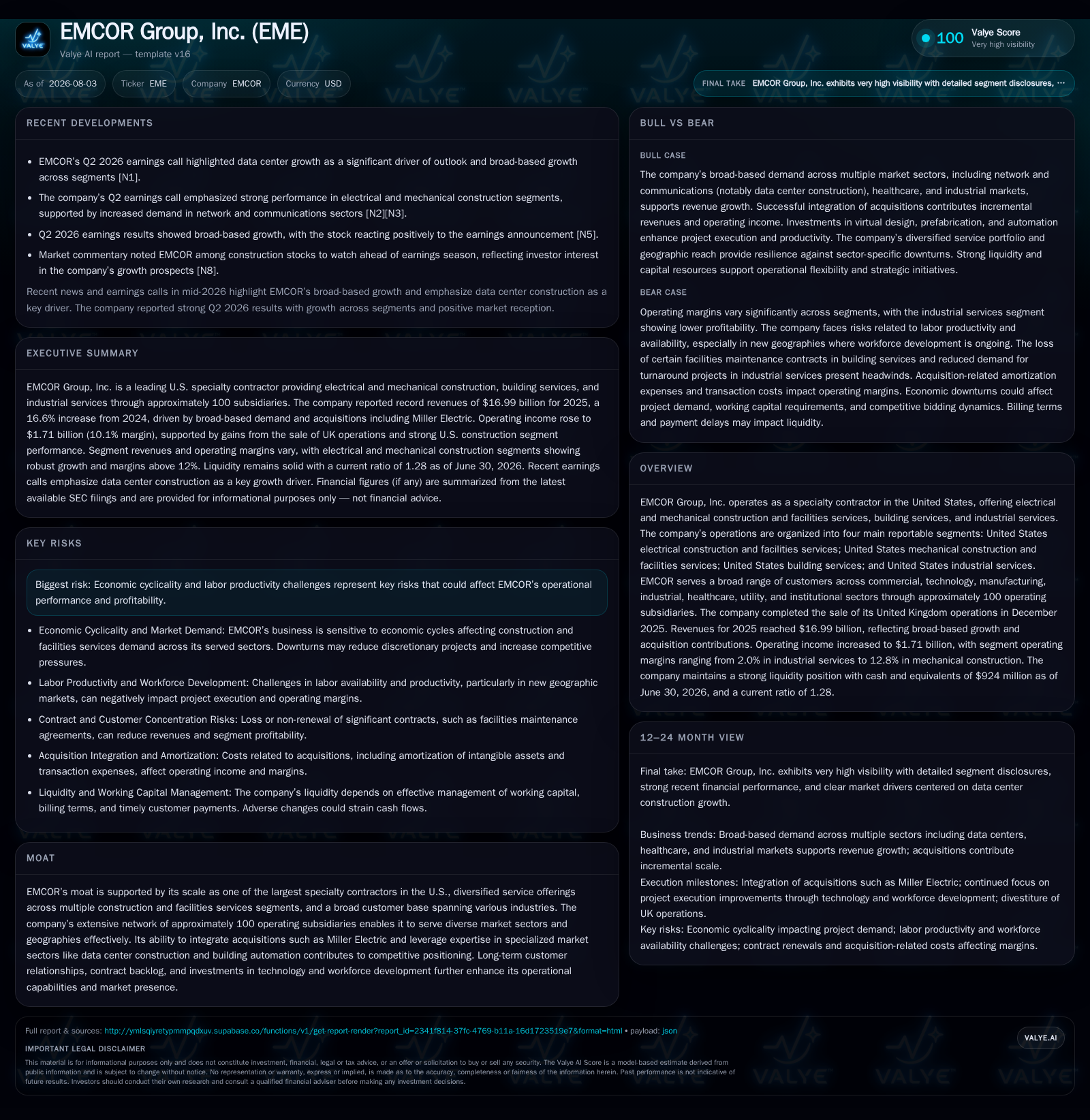
In its latest Q2 filing, EMCOR Group, Inc. reported robust revenue growth with notable acquisition contributions, expanded contract backlog across its specialty contracting segments, and improved operating margins reflecting effective leverage amid heightened operational risks including a recent MSHA safety order. The company’s diversified U.S.-focused electrical, mechanical, building, and industrial services support resilience against economic cyclicality while acquisitions remain instrumental in scaling capabilities and geographic reach. Labor productivity challenges and regulatory scrutiny warrant vigilance but have yet to materially disrupt execution. EMCOR’s strong liquidity position underpins ongoing investment capacity as it pursues growth in data centers, long-term government contracts, and building automation markets.
Q2 Operating Momentum Highlights Acquisition-Driven Scale and Backlog Expansion
EMCOR Group’s consolidated results for Q2 2026 reveal continued strength as evidenced by broad-based revenue growth bolstered by recent acquisitions. Management credits enhanced operating income margins to effective integration of newly acquired companies alongside underlying demand strength across its main business segments: electrical construction and facilities services, mechanical construction and facilities services, building services, and industrial services [S2]. This buoyancy is reflected in a record-setting contract backlog that signals healthy forward visibility. Despite this positive momentum, an emerging operational risk surfaced when the Mine Safety and Health Administration (MSHA) issued an imminent danger order on July 28, 2026 to EMCOR’s wholly-owned MOR PPM subsidiary related to welding work conducted at height in Texas—though there were no injuries reported [S3]. This event underscores the importance of rigorous safety compliance given statutory enforcement risks.
The dual effect of organic growth coupled with acquisition-fueled expansion differentiates EMCOR within the specialty contracting space. Progress billing on fixed-price projects predominantly employs the cost-to-cost input method for revenue recognition to reflect transfer of control as costs incur during project execution [S2]. This accounting methodology stabilizes revenue recognition pattern notwithstanding inherent fluctuations in project timing or mix.
Specialty Contracting Model: Diverse Segments and Revenue Recognition Dynamics Anchoring Growth Quality
EMCOR operates through four core U.S.-based segments delivering specialized electrical construction, mechanical systems installation and maintenance, comprehensive building services including HVAC management, and tailored industrial services targeting utilities and manufacturing clients [S1]. The company’s emphasis on fixed-price contracts combined with cost-to-cost progress measurement aligns incentives for efficient completion while enabling predictable revenue flows tied closely to project milestone achievements.
Following divestiture of its United Kingdom operations at year-end 2025, EMCOR sharpened its geographic focus exclusively on the U.S., reinforcing concentration on markets benefiting from sustained commercial real estate activity, industrial modernization, healthcare infrastructure development, technology sector data center expansions, and institutional customer investments [S1]. This geographic consolidation enhances operational focus though increases exposure to U.S. economic cycles.
Acquisition integration remains pivotal to EMCOR’s business model scalability. The addition of Miller Electric in early 2025 along with nine other smaller entities has cumulatively contributed over $1.27 billion of incremental revenue for fiscal 2025 while enriching service capabilities across key segments [S1][S22]. Such inorganic growth complements organic demand shifts often tied to customer capital expenditure cycles.
Competitive Landscape: Peer Scale Benchmarks and Service Integration Spotlight Operational Leverage Opportunities
Within the competitive universe of U.S. specialty contractors — which includes large peers like Quanta Services, Comfort Systems USA, and MYR Group — EMCOR stands out for its breadth of service offerings spanning electrical, mechanical, building automation, and industrial maintenance segments. This diversification reduces sensitivity to downturns concentrated in any single end market segment while enabling cross-selling synergies across national accounts.
Operationally, labor productivity management and efficient contract backlog conversion remain critical levers as labor shortages industry-wide raise execution complexity. EMCOR’s sizable network of approximately 100 operating subsidiaries provides localized expertise facilitating tailored project delivery that is harder for smaller peers to replicate at scale. Successful integration capabilities are a moat driver given the ongoing consolidation trend within specialty construction where scale translates into negotiating power on materials procurement and talent acquisition.
Growth Drivers: Data Center Expansion, Long-Term GSA Contracts, And Building Automation Adoption Fuel Forward Demand
Emerging demand vectors underpinning EMCOR's growth include robust pipeline expansion of data centers driven by hyperscale cloud providers requiring specialized electrical/mechanical infrastructure [N1]. These projects often feature complex specifications with high uptime requirements supporting sticky customer relationships.
Government Services Administration (GSA) contracts contribute stable long-term revenue streams through maintenance agreements that exhibit favorable renewal rates aligned with regulatory requirements. Additionally, adoption of smart building automation technologies accelerates new service opportunities as customers seek energy efficiency upgrades integrated with IoT-enabled controls within existing facilities.
Acquisitions strategically reinforce these thematic areas by augmenting workforce capabilities and geographic penetration into fast-growing submarkets [S1]. Contract backlog growth tracked during Q2 indicates sustained booking strength consistent with these expansion vectors.
Operational Risks: Labor Productivity Constraints and Mine Safety Incident Implications for Execution Vigilance
While demand fundamentals appear solid, labor availability remains a persistent industry constraint threatening timely project delivery and margin preservation. Workforce development initiatives thus are crucial to maintain labor productivity gains amidst competition from other contractors aiming to attract skilled tradespersons.
The July 2026 MSHA imminent danger order issued to MOR PPM flags explicit safety compliance vulnerabilities posing reputational risks alongside potential operational interruptions [S3]. Although no injuries resulted from the cited incident involving welding work at height on site platforms supported by forklift lifts, such regulatory scrutiny necessitates intensified internal audits and training enhancements.
Failure to address these risks comprehensively could undermine bid competitiveness or trigger further enforcement actions impacting contract awards or renewals.
What to Watch: Contract Renewal Rates, Backlog Milestones, Integration Progress, And Quarterly Guidance Updates
Key metrics to monitor include stabilization or improvement in service contract renewal rates which reflect customer satisfaction amid competitive bidding pressures. Incremental changes in contract backlog size provide leading signals for revenue trajectory given billing schedules tied closely to project progress milestones.
The pace of successful acquisition integration impacting margin retention or expansion provides insight into management execution effectiveness especially given substantial deal activity in recent years [N1]. Finally, quarterly guidance updates will clarify management expectations regarding macroeconomic headwinds or tailwinds including inflationary pressures on material costs.
Financial Profile Discussion: Liquidity Strength Underpinning Strategic Investment Capacity
EMCOR’s balance sheet at Q2 2026 signals robust liquidity adequacy reflective of conservative leverage positioning supportive of both organic growth funding needs and acquisition capital deployment. Cash and cash equivalents stood at approximately $924 million as of June 30, 2026 against negligible direct debt outstanding [F1][S2], resulting in a net cash position near $921 million.
This strong financial footing permits flexible working capital management accommodating longer-billed construction projects alongside upfront invoicing arrangements typical within facility service maintenance contracts [S1][S4].
Prudent liquidity management is essential given potential cyclicality effects on working capital demands linked to project timing variances or slowdown scenarios impacting receivables collections rates.
This analysis synthesizes facts from recent SEC filings with broader specialty contracting industry context without expressing investment advice or price-target commentary. All figures cited correspond directly to validated company disclosures or public industry knowledge frameworks.
Disclaimer: This is research-only, informational analysis and not investment advice. It may include AI-generated interpretation and general industry context. Always verify important details using primary sources.

Comments