
FTI Consulting Advances Revenue Growth Across Segments Despite Margin Pressures
Strong segment revenue gains offset by rising costs and leverage challenges shape FTI's mid-2026 trajectory.
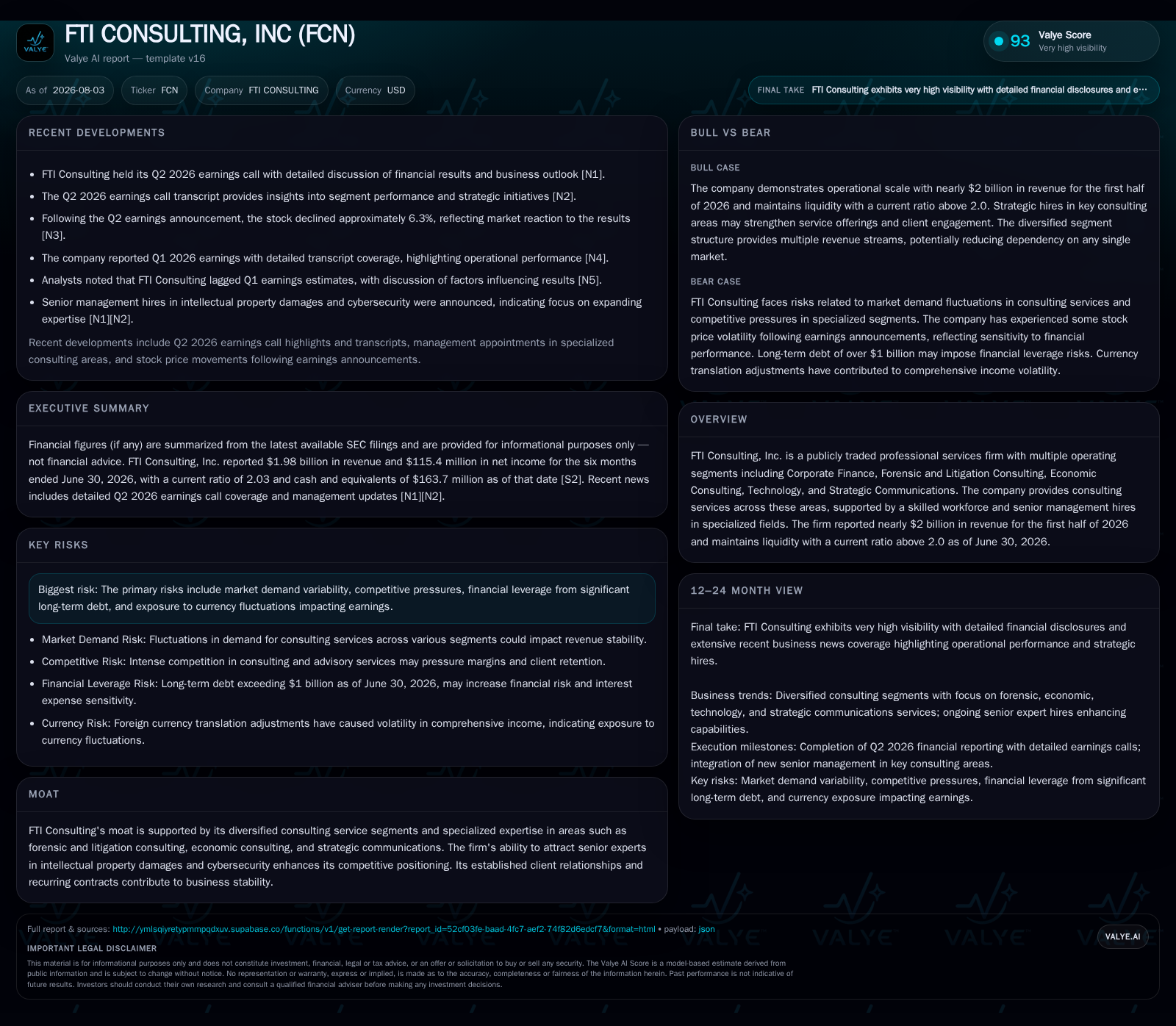
In Q2 2026, FTI Consulting reported a 5.3% revenue increase driven by its Corporate Finance, Technology, and Forensic & Litigation Consulting segments, reflecting sustained demand for specialized advisory services amid a complex economic environment. However, net income declined 19.4% primarily due to higher direct expenses, increased SG&A, and elevated interest costs linked to nearly $1 billion in debt as of mid-2026. The company’s diversified consulting model with its fee-based billing and recurring contracts provides resilience against cyclical volatility but margin compression highlights cost pressures and competitive challenges. Liquidity remains healthy with a current ratio above 2.0, supported by robust operating cash flow generation despite net debt of approximately $856 million. Key near-term watchpoints include managing rising expenses while sustaining utilization rates and securing high-value client engagements across segments.
Recent Operating Update: Q2 2026 Financial Results
arter included $6.6 million of extraordinary litigation-related expenses excluded from adjusted EPS calculations [S16]
Business Model: Multi-Segment Fee-Based Professional Services
FTI Consulting operates as a diversified business advisory firm providing specialized consulting services across five primary segments: Corporate Finance & Restructuring (corporate finance advisory services), Forensic & Litigation Consulting (forensic consulting and litigation support), Economic Consulting (economic analysis for regulatory and litigation contexts), Technology (technology consulting including cybersecurity), and Strategic Communications (corporate communication strategies) [S1]. Each segment monetizes primarily through fee-based billing structures that combine hourly rates with project-based fees.
Revenue depends heavily on client engagements from corporations, financial sponsors, law firms, governments, and creditor groups facing issues like restructuring, litigation disputes, regulatory investigations, or strategic transformations [S1]. The firm's ability to retain recurring clients via long-term contracts provides revenue stability uncommon among smaller boutique specialists reliant on transactional work alone.
A critical aspect of FTI’s business model is its heavy reliance on highly skilled professionals including senior experts in niche areas such as intellectual property damages or cybersecurity incident response which underpin premium pricing power and client trust. These human capital assets differentiate it within a fragmented market where competitor strength varies significantly based on depth of expertise and client relationship history.
Industry Structure and Competitive Position
The professional services consulting industry is populated by diverse players ranging from global management consultancies like Deloitte offering broad service lines to specialized boutiques focused on forensic accounting or economic testimony (e.g., AlixPartners or NERA Economic Consulting). FTI straddles this middle ground as a multi-segment firm melding broad advisory capabilities with deep specialization across its five segments.
Competitive advantages stem from its wide service scope combined with recognized expertise enabling cross-selling opportunities that enhance client retention—a durable moat amid sector fragmentation where many competitors operate narrowly defined practices.[S1] This breadth also buffers FTI against cyclicality affecting individual segments differently.
Similar firms face challenges such as intense competition for top talent driving compensation inflation and the need to continuously innovate services (e.g., adopting AI tools for data analysis). Moreover, pricing pressure amid economic uncertainty can constrict margins; FTI’s recent EBITDA margin contraction illustrates these dynamics [S16]
Growth Drivers
Several structural factors sustain FTI’s expansion prospects:
- Elevated corporate restructuring activity amid volatile markets continues fueling Corporate Finance advisory demand.
- Legal landscape complexity bolsters need for forensic consulting and litigation support involving intricate financial analyses or cybersecurity investigations.
- Regulatory scrutiny intensifies demand for economic consulting particularly around antitrust or tax matters.
- Growing cybersecurity threats accelerate Technology segment engagements providing advisory on risk mitigation frameworks.
- Crisis-driven environments increase reliance on Strategic Communications to manage reputational risks.
- Globalization presents cross-border engagement opportunities requiring localized expertise with broad geographic reach.
Hiring senior specialists in emerging fields enhances service differentiation supporting premium billing while expanding footprint into fast-growing categories such as cybersecurity incident response.[N1][N2]
Risks and Watchpoints
Chief risks center on typical professional services vulnerabilities:
- Revenue sensitivity to economic cycles may impact discretionary spending on advisory services causing volume volatility.
- Persistent competition from both global consultancies armed with scale advantages and nimble boutique firms specializing deeply in niche areas can erode market share or margin.
- Client retention depends critically on maintaining relationships with senior experts who are costly to replace if lost.
- Rising salary costs coupled with investments required for technology adoption risk compressing profitability further unless offset by pricing discipline or productivity gains.
- Currency fluctuations especially given multinational footprint can negatively impact reported earnings.[S1]
- Substantial financial leverage — total debt rose sharply to approximately $1 billion at June 30, 2026 — elevates interest burden and refinancing risk should credit conditions tighten.[F1][S15]
- Reputation management risk inherent in high-profile litigation engagements could have broader consequences if outcomes turn unfavorable.
Operationally, sustaining utilization rates—the percentage of consultant hours billed—and average billing rates are paramount KPIs; declines could foreshadow demand softness or price resistance [N2]
What To Watch Next
Key next milestones include quarterly updates on segment-level revenue trends which will indicate whether recent growth momentum sustains beyond cyclical bursts benefiting restructuring or litigation practices.[N1] Monitoring adjusted EBITDA margin trajectory will reveal management effectiveness in navigating wage inflation while investing to maintain competitiveness.[N2] Attention should also be paid to continued senior talent acquisition announcements that could underpin longer-term service innovation strategies. Liquidity metrics alongside any changes in debt levels will clarify capital structure sustainability given the sizable incremental term loan raised earlier this year.[F1][S15] Client contract renewals within strategic communications amid ongoing geopolitical complexity may signal risk management spend appetite.[N1] Lastly, developments around foreign currency exposures warrant attention given potential earnings volatility stemming from global operations.[S1]
Financial Profile Discussion
At quarter-end June 30, 2026, FTI Consulting held cash equivalents totaling approximately $164 million against total debt of about $1.02 billion resulting in net debt near $856 million[F1][S2]. The net leverage has increased notably following issuance of a $300 million incremental term loan during Q1 2026[S15], raising interest expense burdens—as evidenced by expense increase contributing materially to profit decline this quarter.[S16] Liquidity remains ample as reflected by a current ratio of around 2.03 meaning current assets comfortably cover liabilities which should support operational needs without strain[F1].
Disclaimer: This is research-only, informational analysis and not investment advice. It may include AI-generated interpretation and general industry context. Always verify important details using primary sources.

Comments