
Rithm Capital Strengthens Fee Growth Amid Disciplined Mortgage Asset Management
Q2 2026 results reflect sustained AUM expansion, incentive income realization, and prudent leverage management in mortgage-focused asset management.
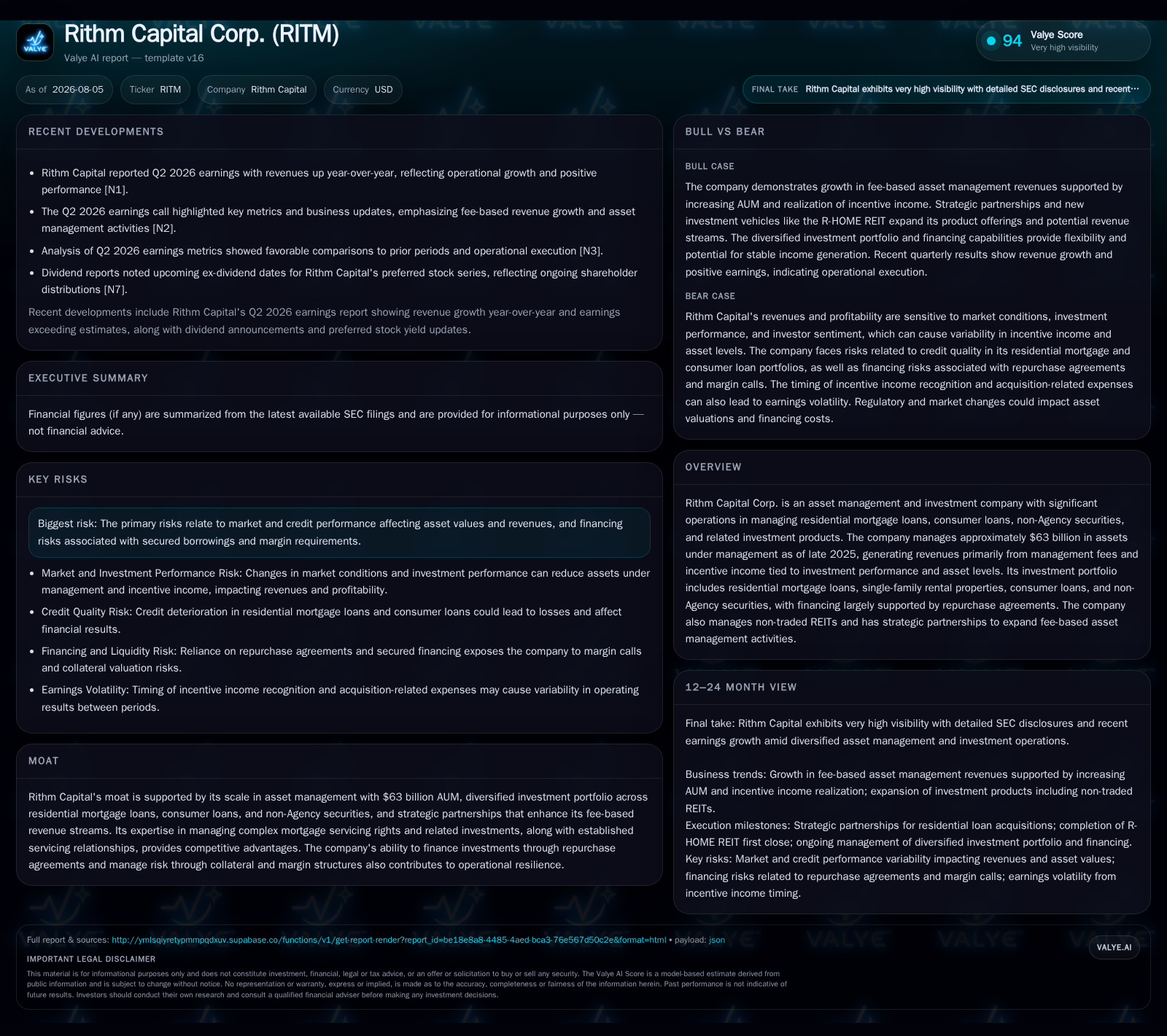
Rithm Capital Corp. reported strong operating performance in Q2 2026, with total assets under management near $63 billion as of late 2025 supporting robust management fee growth and incentive income recognition. The company’s portfolio diversification across residential mortgage loans, consumer loans, and non-Agency securities underpinned fee revenue stability despite market variability. Strategic partnerships and non-traded REIT launches contributed to fee-based revenue expansion, offsetting inherent cyclicality of incentive fees. Financing remains predominantly secured via repurchase agreements with margin controls balancing leverage and liquidity risks. Monitoring incentive fee timing, asset quality, and refinancing execution will remain key to sustaining earnings momentum.
Recent Operating Update: Q2 2026 Review
Rithm Capital’s 10-Q for Q2 2026 highlights continued operational progress characterized by solid revenue generation driven primarily by management fees tied to assets under management (AUM) and recognized incentive income from investment performance [S2]. As of year-end 2025, the company managed approximately $63 billion in AUM—a figure that anchors its recurring revenue base derived from a percentage of these assets across various investment vehicles [S1]. While incentive income remains inherently lumpy due to contractual provisions like hurdle rates and high-water marks influencing recognition timing, recent quarters have benefited from strategic portfolio expansions anchored in institutional partnerships [S1,S2,N1].
This quarter’s earnings release indicated revenues exceeding prior period levels, underscoring effective monetization of both scale growth and improved fee composition during evolving market conditions that affect underlying asset valuations [N1,S2]. Such results demonstrate the firm’s ability to navigate fluctuations in investment returns while gradually building a more stable core of fee-related earnings.
Business Model: Fee Revenue Mechanics and Portfolio Focus
Rithm Capital operates as an asset manager specializing in mortgage-related assets including residential mortgage loans (performing and non-performing), consumer loans, single-family rental properties, and a significant allocation to non-Agency securities [S1]. Its business model monetizes through two primary types of fees: asset-based management fees calculated quarterly as a fixed percentage of AUM or invested capital within governed structures; plus performance-based incentive income calculated on realized investment profits net of management fees [S1]. This dual revenue stream provides both stable cash inflows from ongoing asset management activities and episodic boosts linked to successful investment exits or revaluations.
Management fees tend to be prorated for investor inflows or redemptions during quarters, ensuring fees closely track the capital base under advisement. Incentive fees are more volatile due to structural features such as hurdle rates that require profits to surpass specified thresholds before triggering performance payments, catch-up mechanisms limiting downside drag, and high-water marks preventing repeated payouts on recycled gains [S1]. These complexities result in uneven periodic recognition patterns—meaning quarter-to-quarter variability is normal yet can amplify total segment operating leverage.
Revenue is also supplemented by net interest income on financed assets and servicing fees less related costs [S1,S16]. The company manages servicing rights through subsidiaries such as Newrez, where servicing revenue correlates with loan portfolio size and efficiency in collection operations
Industry Structure and Competitive Position
Within the specialized mortgage asset management sector, Rithm Capital aligns alongside peers such as Blackstone Mortgage Trust, Annaly Capital Management, and AGNC Investment Corp., which also combine sizable mortgage-related portfolios with secured financing strategies. What distinguishes Rithm is its diversified asset mix extending beyond traditional Agency RMBS into residential transition loans and consumer credit investments coupled with a strategic emphasis on fee diversification via institutional partnerships and non-traded REIT vehicles [S1,S16].
Its scale—$63 billion AUM—and integrated service platforms offer competitive advantages in sourcing proprietary deal flow and managing complex loan servicing functions [S18,S8,S7]. However, the company shares common structural risks including sensitivity to market interest rates impacting collateral values; regulatory capital requirements influencing financing availability; margin call exposure from pledged collateral fluctuations; and inherent cyclicality in incentive fee realizations tied to credit cycles and broader economic trends
Growth Drivers
Key growth vectors for Rithm include expansion of AUM through capital inflows fueled by established institutional partnerships that invest in targeted segments like residential transition loans [S1,S16]. Enhancements to asset management capabilities—evidenced by launches such as the R-HOME non-traded REIT focusing on U.S. household credit investments—contribute incremental fee income streams less sensitive to market volatility than performance fees alone [S1]
Moreover, robust investment performance serving as a catalyst for incentive income crystallizations can materially lift revenues when realized. The company’s capacity to finance these assets at attractive terms using repurchase agreements further leverages capital efficiency enabling acquisition opportunities during market dislocations [S5,S6]. Finally, advances in servicing operations underpin recurring income stability while creating value-added differentiation versus pure-play asset managers.
Risks / Watchpoints / Growth Constraints
Despite recent positive trends, Rithm faces several structural risks warranting close attention. Market risk drives fair value fluctuations in collateral securing borrowings; declines trigger margin calls necessitating cash or equivalent postings that can constrain liquidity if prolonged or severe [S7]. Financing risk remains notable given reliance on short-term secured facilities subject to renewal uncertainty amid tightening credit conditions or regulatory turmoil [S4,S6].
Credit risk persists across residential transition loans and non-Agency securities; deterioration here reduces asset values directly impacting both earnings volatility and borrowing capacity [S18]. Incentive fee timing irregularity complicates earnings predictability since significant portions accrue later in fund life cycles or upon material gain realizations [S1]. Regulatory capital frameworks impose elevated liquidity buffers especially relevant for affiliated servicer entities subject to FHFA/Ginnie Mae standards; compliance must be maintained to avoid adverse operational restrictions [S8,S20]. Furthermore, competitive pressures for capital allocation could limit fundraising prowess during risk-off environments.
What to Watch Next
Investors should track quarterly changes in total AUM alongside net inflows or redemption patterns signaling demand sustainability or pressures affecting the core management fee base. Monitoring realized incentive income amounts relative to backlog estimates will shed light on earnings quality given historical unevenness in recognition timing [N2,S2]. Financing metrics including secured borrowing balances versus collateral values inform margin call sensitivity amid interest rate movements.
Progress integrating strategic partnerships into recurring fee streams represents an important execution milestone supporting revenue diversification beyond transactional gains. Operational KPIs from servicing platforms such as portfolio delinquency rates or cost efficiencies influence profitability but require disclosure granularity often limited publicly. Finally, upcoming maturity schedules of debt tranches highlight refinancing needs pivotal for liquidity continuity; successful renewals at attractive pricing will mitigate financial constraint risks.
Financial Profile Discussion
As of June 30, 2026, Rithm held approximately $1.66 billion in cash and equivalents providing a cash cushion against near-term obligations while supporting margin call capacity if needed [F1]. Although explicit current total debt figures were not updated past 2014 levels in public filings available here ([F1] shows $6.06 billion at 2014 year-end), prior disclosures indicate material outstanding secured financing arrangements exceeding $13 billion as recently as December 31, 2025 complemented by senior unsecured notes totaling over $1 billion with staggered maturities spanning through the decade’s end [S5,S7,S19].
Reported net interest spreads hovered around 0.4% during calendar year-end 2025 reflecting funding cost pressures balanced by asset yield dynamics within its non-Agency securities portfolio markedly composed of both floating (approximately 24%) and fixed-rate (76%) instruments providing partial interest-rate risk mitigation benefits [S29]. Maintaining compliance with regulatory capital requirements imposed by FHFA/Ginnie Mae remains essential given their direct implications for dividend distribution capacity inherent in REIT tax status compliance frameworks maintained by the firm’s operating subsidiaries responsible for servicing activities [S20]. Robust liquidity buffers identified within servicer subsidiaries provide an additional margin of safety against operational contingencies.
In aggregate, Rithm Capital demonstrates prudent financial stewardship amidst leveraging complex securitized loan portfolios financed through short-duration repurchase agreement markets requiring active collateral valuation monitoring. Sustained growth hinges on disciplined balance sheet management aligned with evolving regulatory expectations.
This analysis is based solely on information from publicly available SEC filings up to August 4, 2026, alongside contemporaneous market disclosures. It avoids speculation beyond supported evidence; readers are encouraged to consider official filings directly for comprehensive details.
Disclaimer: This is research-only, informational analysis and not investment advice. It may include AI-generated interpretation and general industry context. Always verify important details using primary sources.

Comments