
Bed Bath & Beyond’s Acquisition Strategy Tests Operational Resilience and Liquidity
The company’s Q2 2026 update reveals mounting liquidity pressures alongside integration challenges from recent mergers, complicating its path to sustainable growth.
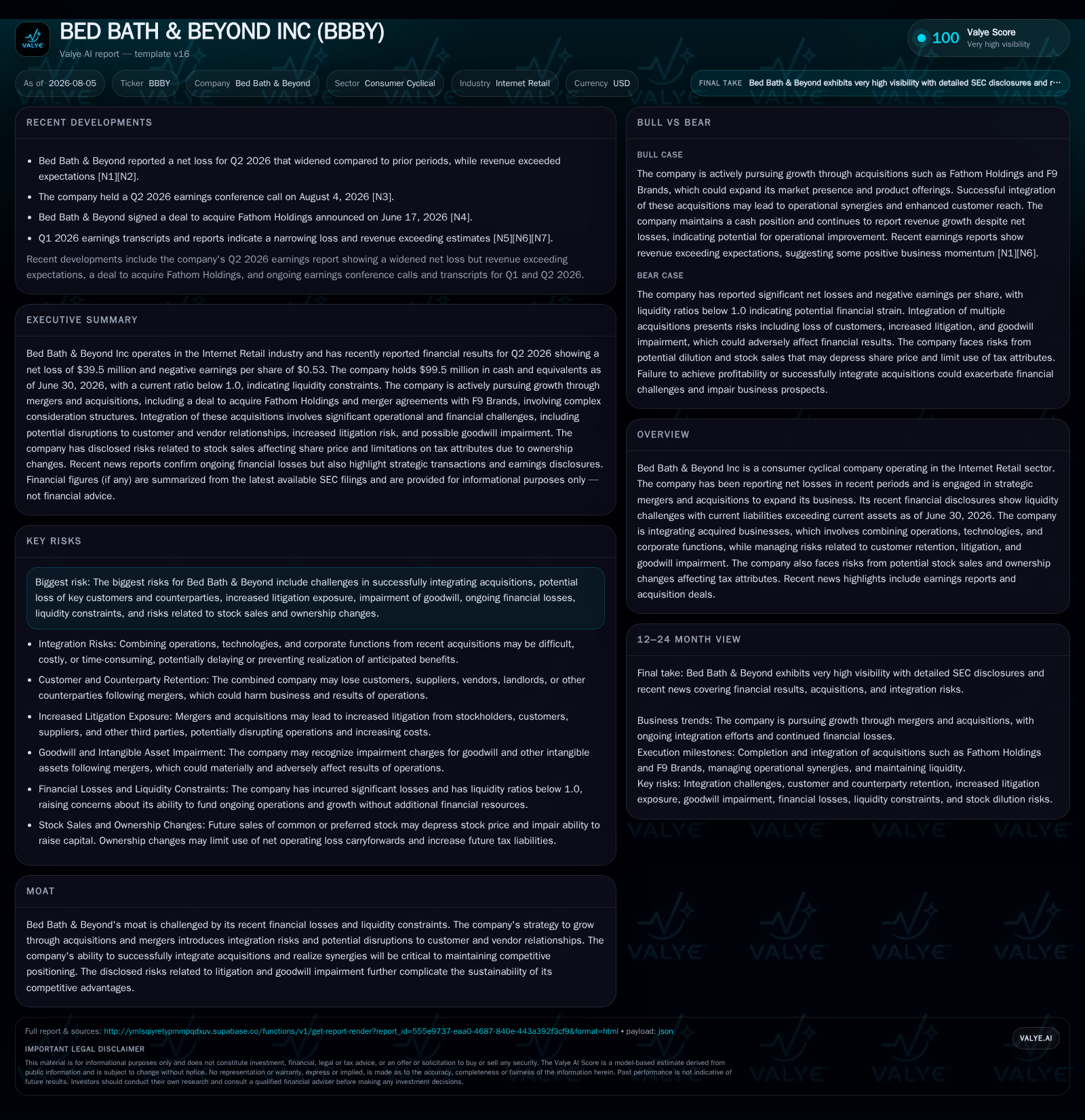
In its Q2 2026 report, Bed Bath & Beyond posted revenue exceeding expectations but deepened net losses amid the ongoing integration of acquisitions. The company faces a strained liquidity profile, with current liabilities notably exceeding current assets at quarter-end, underscoring tight operational flexibility. Growth ambitions hinge on successful melding of acquired entities into a cohesive omnichannel platform, yet risks related to customer retention, goodwill impairment, and litigation remain prominent. The company operates in a fragmented Internet Retail sector where competitive dynamics pit it between pure-play e-commerce specialists and larger omnichannel retailers.
Recent Quarterly Developments Challenge Operational Continuity Amid Acquisition Moves
Bed Bath & Beyond’s Q2 2026 filing reveals a nuanced operating picture. While top-line revenue surpassed consensus estimates—reflecting gross merchandise volume growth fueled by expanded online sales—the net loss widened relative to prior quarters [S2][N1]. This outcome evidences intensifying costs tied to acquisition integration efforts. The company explicitly noted operational disruptions during the quarter as it combined recently acquired businesses’ inventory management systems, fulfillment logistics, and marketing platforms. Such transitional complexities also pressured customer retention metrics given shifting product assortments and service level variances [S2]. Meanwhile, balance sheet scrutiny uncovers liquidity stresses: current liabilities totaled $312 million against current assets of $237 million as of June 30, 2026 equating to a current ratio of 0.76—below the conventional threshold for healthy short-term financial safety [F1]. These factors underscore immediate concerns about the company's ability to fund ongoing operations without supplementary capital inflows or improved cash conversion.
Business Model Stress-Tested by Integration Complexities in E-Commerce and Omnichannel Sales
Bed Bath & Beyond operates a direct-to-consumer model principally through e-commerce channels supplemented by legacy physical retail components that contribute to omnichannel fulfillment capabilities. The recent acquisitions have markedly broadened its product assortment, particularly increasing private label penetration—a strategic lever aimed at enhancing average order value (AOV) and margin profiles. However, this expanded assortment introduces inventory turnover pressures requiring adjustments in supply chain agility and markdown cadence to manage shrinkage and return rates effectively [S1][S2]. Customer acquisition costs (CAC) remain elevated as promotional activities ramp to onboard new customers post-merger amid competitive digital marketplaces. Fulfillment center adaptation is underway to handle diversified inventories and distribution footprints serving both online demand spikes and physical store replenishment channels. These structural complexities test BBBY’s ability to maintain seamless customer experience while generating operating leverage.
Competition and Industry Structure: Balancing Pure-Play Internet Retailers Against Traditional Giants
Within Internet Retail’s evolving ecosystem, Bed Bath & Beyond straddles competing forces: pure-play internet retailers like Wayfair specialize in home goods with technologically sophisticated interfaces and streamlined logistics; meanwhile, large omnichannel incumbents such as Target combine integrated physical stores with growing e-commerce platforms providing strong product visibility and consumer convenience [S1]. This bifurcation places BBBY at a crossroads in pricing strategy and customer retention efforts since consumers can compare ease of access, delivery speed, and product breadth across these alternatives. Inventory turnover ratios typically favor category specialists with optimized assortments whereas fulfillment efficiencies highlight competitive pressure from Amazon’s vast logistics network. Sustainability of Bed Bath & Beyond’s offering depends on consolidating M&A gains into a cohesive digital-first approach that narrows these gaps while managing operational cost structures heightened by acquisition-related complexity.
Growth Vector Analysis: Unlocking Demand via Acquisitions Versus Organic Channels
Bed Bath & Beyond leverages strategic acquisitions as a primary growth engine by accelerating expansion into new product categories and customer segments without solely relying on organic user traffic improvements. These mergers augment gross merchandise volume (GMV) by integrating complementary inventories and cross-selling opportunities. Digital transformation initiatives accompanying these transactions aim at improving conversion rates through personalized marketing and enhanced website/navigation experiences [S1][S2]. Nonetheless, these growth vectors face headwinds from the company’s disproportionately high CAC relative to customer lifetime values during integration periods. Liquidity constraints further limit investments in advertising or fulfillment capacity expansions that would otherwise catalyze organic growth acceleration.
Key Risks: Liquidity Constraints, Customer Churn, and Goodwill Impairment Traps
The risk environment is layered: liquidity mismatch arising from current liabilities surpassing assets constrains operational flexibility for working capital or opportunistic marketing spend [F1]. Integration-induced disruption increases vulnerability to losing key vendor contracts or customers critical for sustained revenue streams. The concentration of goodwill on the balance sheet from acquisitions invites impairment risk should anticipated synergies remain unrealized or revenue trajectories falter post-merger [S2]. Litigation exposure linked to acquisition processes compounds financial uncertainty as legal contests may divert resources or deter partners. Additionally, potential stock sales or shifts in ownership trigger tax-related limitations under Internal Revenue Code Sections 382/383 on utilizing net operating losses that could otherwise offset taxable income—diminishing fiscal options for restructuring or reinvestment funding [S2].
Next-Phase Milestones: Integration Progress, Cost Synergies, and Revenue Inflection Points
Investors will monitor several critical execution benchmarks forthcoming from management alongside quarterly results calls. Evidence of cost synergy realization through streamlined supply chains or consolidated corporate functions will signify tangible progress beyond headline revenues reported last quarter [N2][S3]. Improvements in CAC efficiency coupled with rising average order values or conversion rates would indicate positive customer engagement trends validating strategic direction. Conversely, any deterioration in same-store sales among legacy outlets might highlight gaps in omnichannel consistency or inventory alignment needing corrective action. Timing around these milestones remains fluid given ongoing integration complexity.
Financial Profile Discussion
Disclaimer: This is research-only, informational analysis and not investment advice. It may include AI-generated interpretation and general industry context. Always verify important details using primary sources.

Comments