
CF Bankshares Strengthens Liquidity and Navigates Interest Rate Reset on Subordinated Debt
The company sustains capital flexibility through diversified liquidity sources and manages rising debt service costs amid a shifting interest rate environment.
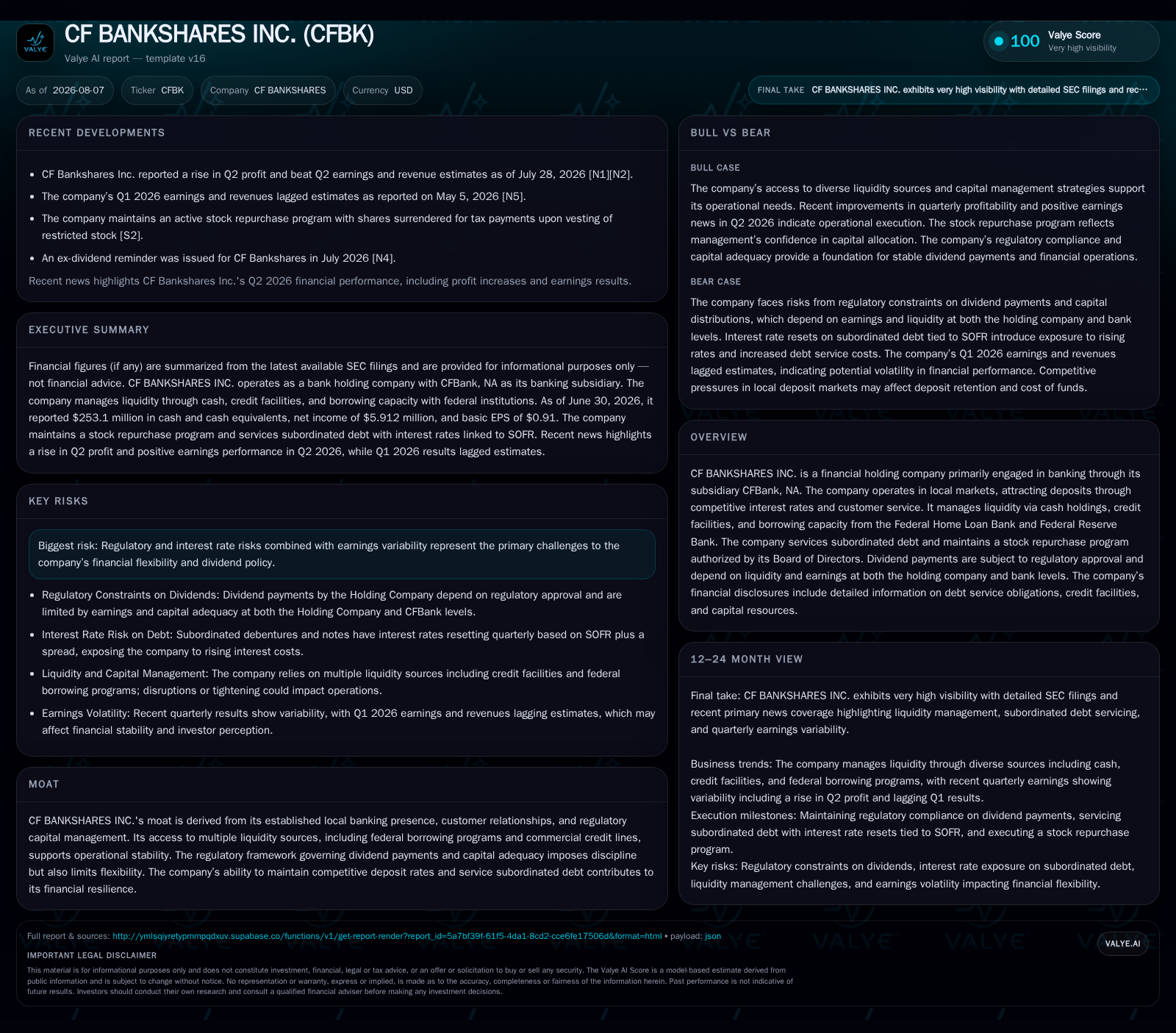
CF Bankshares Inc. reported robust liquidity supported by $253 million cash and a $41.2 million credit facility at June 30, 2026, while subordinated debt interest costs are rising alongside SOFR increments. The firm’s dividend payments remain contingent on regulatory constraints and dividend inflows from its banking subsidiary, CFBank. Maintaining local deposit competitiveness and prudent capital management underpin CF Bankshares' operational resilience in the regional banking landscape.
Recent Operating Update
Such rising financing costs driven by SOFR and prime-linked resets underscore ongoing interest rate risk exposure inherent in this regional bank's capital structure.
Business Model
CF Bankshares operates as a financial holding company principally through its banking subsidiary CFBank, NA. Its core profit engine is net interest margin (NIM) derived from an asset-liability spread between lending activities to local individuals and businesses versus deposit costs [S1]. Deposits form the foundational funding base sourced predominantly from local markets where competitive interest rates and customer service cultivate stable relationships that reduce pricing pressure volatility.
Revenue mechanics emphasize dynamic interest income augmented by fee revenues from ancillary banking services while controlling credit risk prudently across the loan portfolio [S1]. This model reflects standard regional bank archetypes reliant on maintaining capital adequacy ratios compliant with regulatory mandates.
The holding entity manages liquidity via cash holdings exceeding $253 million at Q2-end combined with access to borrowing capacities from Federal Home Loan Bank (FHLB) and Federal Reserve Bank (FRB) programs [F1], [S2]. These diverse sources allow responsive asset-liability management balancing profitability against regulatory and market risks.
Dividend distribution capacity is structurally linked to receiving dividends from CFBank constrained by well-capitalized status maintenance rules limiting payout size without prior approval [S2]
Capital allocation policies include authorized stock repurchases under board-approved programs extended through March 2027, reflecting measured shareholder return strategies aligned with liquidity availability [S2]
Industry Structure and Competitive Position
CF Bankshares functions within the regional banking sector characterized by intense competition for local deposits from peer banks, community institutions, and credit unions that collectively influence deposit pricing power. Unlike large national banks whose scale affords diversified fee income streams and technological investments amplifying client stickiness, smaller regional banks like CF depend heavily on localized relationship banking expertise.
Access to federal liquidity providers such as FHLB and FRB is critical given limited wholesale funding alternatives available locally. Interest rate risk management emerges as a salient feature given resets embedded in subordinated debentures and revolving credit pricing linked to fluctuating market benchmarks like SOFR and prime rates. This scenario is common among mid-sized regional banks balancing cost-effective funding raising against rising market rates influencing net interest margins negatively if loan repricing lags deposit cost increases.
Regulatory oversight enforcing capital adequacy ensures solvency but can constrain profitable dividend payouts restricting cash returns despite earnings growth [S13]. This governance framework aligns CF with peers such as Regions Financial Corporation or Fifth Third Bancorp operating under similar prudential standards.
Growth Drivers
Key growth catalysts for CF Bankshares revolve around continued expansion of its deposit base fueled by competitive pricing combined with high-quality customer service fostering retention in local markets [S1]. Economic growth within these communities can stimulate increased loan demand from consumer segments and small-to-medium enterprises (SMEs), expanding earning assets while generating incremental fee income streams.
Interest rate environments favorable for net interest margin expansion—specifically when lending rates rise faster than deposit costs—directly enhance profitability though this dynamic carries counterparty uncertainty through potential credit quality deterioration during economic downturns.
Ongoing capital injections such as the second-quarter Tier 1 infusion via the added revolving credit line augment lending capacity enabling measured balance sheet growth [S25]. Strategic stock repurchase programs also signal management confidence in long-term value creation aligned with shareholder interests.
Lastly, operational efficiency improvements through technology adoption or process streamlining can mitigate cost pressures prevalent in regional banking frameworks enhancing overall returns on assets (ROA).
Risks and Watchpoints
Rising interest rates evidenced by increasing SOFR attach a progressively higher cost burden on adjustable-rate subordinated notes exposing CF Bankshares’ earnings to compression absent commensurate loan repricing actions [S2]. Closely monitoring net interest margin trends alongside loan growth composition will be essential going forward.
Dividend policy remains tightly coupled with regulatory approval processes contingent upon maintaining well-capitalized status within CFBank subsidiaries constraining discretionary capital deployment especially under volatile earnings conditions or unexpected losses [S2]
Liquidity constraints could emerge if pledged collateral degrades or if economic stress impairs borrowing capacity from FHLB or FRB sources critical for daily operations [S6]. Competition for deposits may intensify locally requiring vigilant pricing strategies ensuring retention without margin sacrifice.
Non-performing asset ratios and loan loss provisions require ongoing surveillance given their direct effect on profitability and available distributable earnings affecting shareholder returns broadly across comparably sized regional banks.
Operational risks including cybersecurity threats also require proactive mitigation given increasing digital dependency in banking infrastructure though no specific incidents noted recently for CF Bankshares.
What to Watch Next
Earnings releases reporting quarterly net interest margin evolution and credit quality metrics will illuminate whether recent rising debt financing costs offset corresponding revenue strength [N1]. Capital adequacy reports will indicate continued compliance enabling dividend declarations without external approvals.
Monitoring utilization trends of revolving credit lines alongside changes in SOFR or prime lending benchmarks provides insight into evolving interest expense pressures institution-wide [S2]. The pace of share repurchases under existing authorization levels serves as a barometer for board confidence amid prevailing liquidity positions.
Debt servicing obligations stemming from subordinated instruments exhibit sensitivity to interest rate shifts; the blended annual cost burden near $1.17 million evidences increased expense versus prior periods correlating with elevated SOFR benchmarks influencing quarterly resets [S2]
Credit facility terms encompassing conversion from fixed rates to floating market-linked variables post-May 2026 accentuate exposure yet offer potential advantages should prime rates stabilize or decline temporarily offering manageable borrowing costs within strategic thresholds set by management.
It does not constitute investment advice but aims to provide an informed perspective grounded strictly in disclosed financials and industry-standard evaluation metrics.
Disclaimer: This is research-only, informational analysis and not investment advice. It may include AI-generated interpretation and general industry context. Always verify important details using primary sources.

Comments