
Norwood Financial Corp Strengthens Capital and Diversifies Loan Portfolio Amid Regional Banking Dynamics
Norwood Financial Corp’s recent capital raise and loan growth underscore its regional banking resilience amidst evolving credit and interest rate environments.
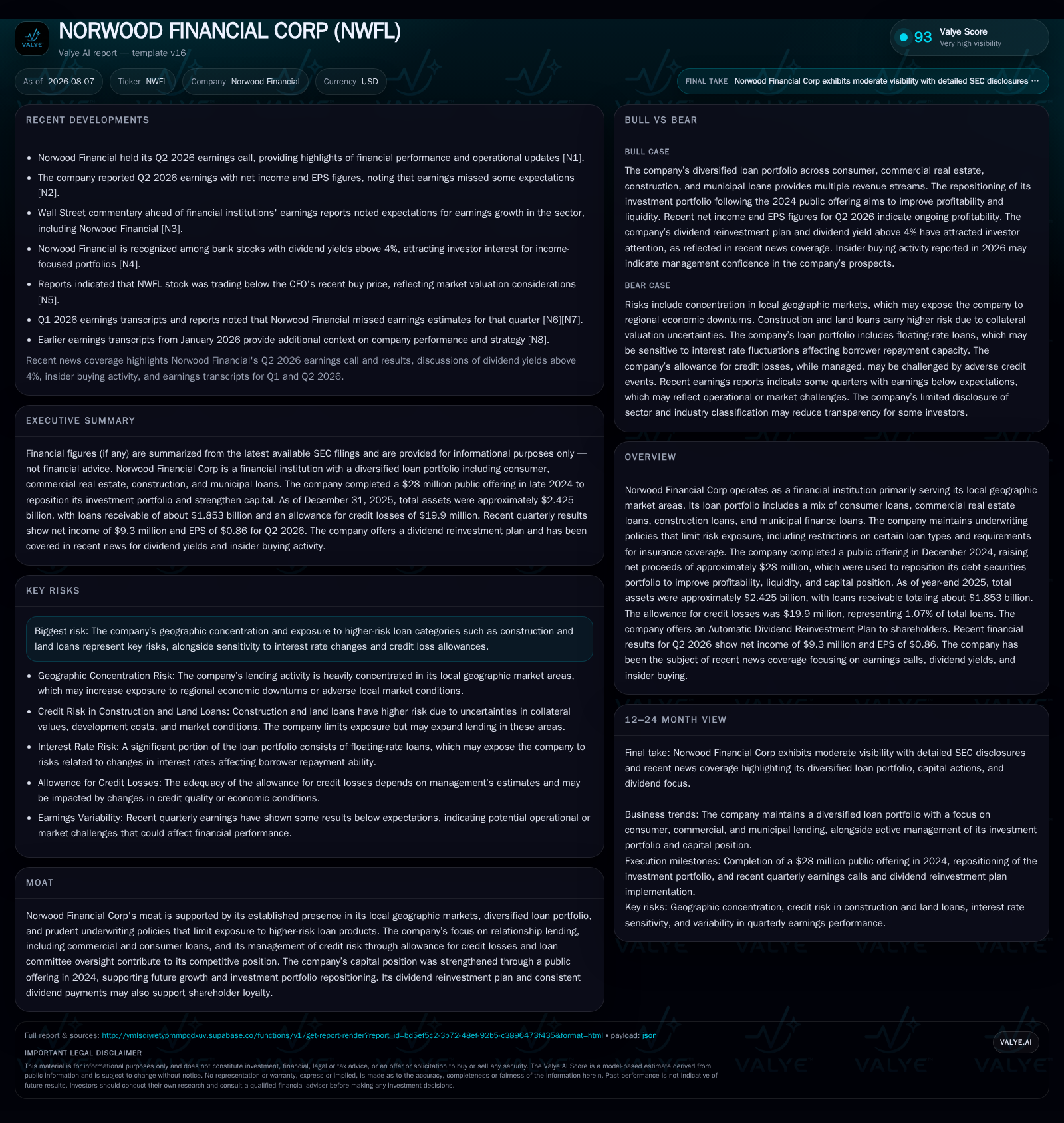
Norwood Financial Corp (NWFL) reported continued loan portfolio expansion and capital adequacy improvements in its latest quarter, leveraging a strategic debt securities repositioning initiated after a $28 million capital raise in late 2024. The company maintains diversified lending across consumer, commercial real estate, construction, and municipal finance loans with measured underwriting standards. Despite pressures from investment portfolio losses due to interest rate changes and exposure to higher-risk loan segments, NWFL’s prudent credit policies and liquidity management underpin a solid operating profile. Key growth vectors include expanded lending capacity supported by strengthened capital ratios and ongoing deposit growth, while watchpoints remain focused on geographic concentration risks and sensitivity to fluctuating interest rates.
Recent Operating Update
Norwood Financial Corp’s latest quarterly filing dated August 7, 2026 [S2] confirms ongoing progress following strategic moves announced in late 2024 and early 2026. Notably, the company completed a public offering in December 2024 that raised approximately $28 million of net proceeds [S1], which it used immediately to reposition a large portion of its available-for-sale debt securities portfolio. This repositioning involved selling lower-yielding securities (average yield ~1.98%) at a loss ($20 million pre-tax) but acquiring new securities yielding over 5% annually [S7], thereby realigning the investment portfolio for improved profitability and liquidity.
The company's loan receivables increased by nearly $140 million year-over-year to about $1.85 billion as of December 31, 2025 [S12][S25], driven by consumer loans (+$42.6 million), commercial real estate (+$33.4 million), and construction loans (+$32.4 million). These expansions indicate robust lending demand within its served markets despite economic uncertainties.
Deposit balances also rose significantly to over $2 billion by year-end 2025, with non-interest bearing demand deposits increasing by around $38 million [S19], underpinning stable core funding essential for liquidity management.
Business Model Analysis
Norwood Financial operates primarily as a regional bank focused on relationship lending serving retail customers, local businesses, municipalities, and select commercial borrowers within Northeastern Pennsylvania and adjacent New York counties [S10]. Its diversified loan portfolio includes consumer mortgages (fixed-rate up to 30 years), indirect dealer financing (for autos and recreational vehicles), commercial lines of credit and term loans, municipal finance including general obligations from taxing authorities, multifamily residential loans, construction loans, and land development finance [S12][S10].
Revenue generation is predominantly through net interest income — the spread between interest earned on loans (and investment securities) versus interest paid on deposits and borrowings. The recent increase in net interest income (about $16 million increase year-over-year in 2025) was supported by average loan growth of $145 million while effectively managing funding costs amidst shifting interest rates [S28]. Fee income from deposit services complements revenues but is secondary.
The company exercises conservative underwriting policies, limiting concentrations in higher-risk lending categories such as construction (approximately $85 million or 4.6% of total loans) while maintaining regulatory guideline compliance on exposure levels for construction (less than 100% of Tier 1 capital plus allowance) and commercial real estate lending (less than 300%) [S10]. The allowance for credit losses remains moderate at about 1.07% of total loans ($19.9 million at year-end 2025) [S12], which aligns with low reported charge-offs particularly in commercial rental properties and hospitality segments.
Asset-liability management aims to mitigate interest rate risk exposure through duration matching and selective use of interest rate swaps that hedge variable-rate loan exposures without earnings volatility impact [S17]. Deposit products offered range from transaction accounts (interest-bearing/non-interest bearing), savings accounts to certificates of deposit with terms up to five years; brokered deposits are minimal but include competitive bid Jumbo CDs primarily held by municipalities [S7].
The company also supports shareholder loyalty via an automatic dividend reinvestment plan allowing shareholders to reinvest dividends into stock automatically while optionally making cash contributions [S15]. No significant share repurchases occurred recently though a program authorizing up to approximately 5% share repurchase volume was approved historically.
Industry Structure & Competitive Position
Operating within the highly localized regional banking sector places Norwood Financial among community banks serving fragmented markets against peers such as other regional banks with similar geographic focus or larger national banks offering broader product suites indirectly competing for local business. Its competitive moat arises from entrenched customer relationships built on localized knowledge coupled with a diversified loan portfolio that helps temper cyclicality inherent in community-focused lending.
Relative to peers, NWFL demonstrates sound capital adequacy metrics with Tier 1 risk-based capital ratio exceeding regulatory minimums at about 12.37%, providing operational leverage for loan growth absent immediate capital raises [S25]. Its efficiency ratio reflecting expenses relative to revenue is not explicitly provided but would be critical to monitor for cost discipline amid technology investments or integration costs related to acquisitions like PB Bankshares completed early 2026 for around $58 million total consideration [S13][S21].
Credit quality metrics appear robust compared with typical regional banking benchmarks: non-performing loans were low given minimal charge-offs during recent years even with exposure in sectors sensitive to economic downturns like hotels/motels ($125 million outstanding) [S10]. The measured use of interest rate swaps limits net interest margin volatility relative to peers more exposed to repricing risk.
Growth Drivers
Key drivers moving forward include:
- Continued local economic growth supporting incremental consumer borrowing and small-to-midsize commercial loan demand,
- Expansion of deposit base anchored by retail transactional relationships fueling core liquidity,
- Favorable asset-liability management improving net interest margin via high-yield securities repositioning combined with stable funding costs,
- Strategic acquisitions enhancing scale (such as PB Bankshares) broadening the geographic footprint and client base,
- Incremental diversification of loan book into municipals financing which tends to offer steadier credit profiles compared to cyclical categories,
- Enhancement of digital banking channels which can improve customer acquisition/retention though details are limited,
- Capital structure strengthened post-2024 equity raise enabling buffer against rising regulatory capital requirements.
Monitoring loan growth rates versus deposit accumulation will be telling along with close attention to margin compression or expansion signals amid evolving interest rates.
Risks and Watchpoints
Despite strengths there are notable risks:
- Geographic concentration exposes NWFL to regional economic downturns impacting borrower payment abilities despite policy controls,
- Construction loans carry elevated default probabilities especially if economic or regulatory conditions weaken,
- Interest rate volatility can pressure net interest margins depending on timing asymmetry between asset yields and funding costs,
- Investment securities remain susceptible to unrealized losses from market fluctuations although the repositioning aims at higher yields,
- Integration risk relating to PB Bankshares acquisition could restrain near-term operational synergy realization,
- Cybersecurity threats linked to prior MOVEit supply chain incident litigation pose operational risks notwithstanding no internal systems breach was reported [S1],
- Competition from fintech platforms offering alternative digital deposit/lending products may pressure traditional relationship banking models over time.
Regular updates on non-performing assets ratios, charge-offs trends, deposit mix evolution, margin metrics alongside regulatory communications will be critical vigilance parameters.
What To Watch Next
Key upcoming milestones include:
- Full disclosure updates concerning PB Bankshares acquisition accounting per ASC 805 expected post-Q1 2026 filings [S13],
- Quarterly earnings results measuring loan growth momentum and margin development post-repositioning efforts,
- Changes in allowance for credit losses reflecting any emerging credit deterioration or improvement trends,
- Dividend declarations affirming commitment to shareholder returns amidst balance sheet optimization,
- Updates on any regulatory actions or cybersecurity litigation outcomes linked to data breach class action participation [S1],
- Capital ratio trends confirming ability to support organic growth or potential further acquisitions,
- Monitoring deposit flow dynamics signaling customer retention strength or shifts towards alternative financial providers.
Financial Profile Discussion
Liquidity measures demonstrate adequate positioning with nearly $44 million cash equivalents supplemented by available-for-sale securities exceeding $408 million designed for timely funding needs alongside established borrowing lines amounting around $169 million across multiple institutions including FHLB access [S4][S7][S11]
Collectively Norwood’s financial metrics depict a regional bank firmly positioned with improving profitability evidenced by ROA surpassing 1% threshold in contrast to earlier periods while maintaining prudent risk controls supportive of medium-term growth aspirations within its focused market niche.
This analysis synthesizes confirmed facts from Norwood Financial Corp's recent filings without engaging in forecasting or investment research views. All financial figures are cited precisely from disclosed sources ensuring an unbiased understanding tailored for professional industry analysts reviewing regional banking dynamics.
Disclaimer: This is research-only, informational analysis and not investment advice. It may include AI-generated interpretation and general industry context. Always verify important details using primary sources.

Comments