
UL Solutions Strengthens Market Position with Segment Reorganization and Expanding Software Portfolio
UL Solutions reports solid Q2 results anchored by global TIC leadership and growing software-enabled compliance services.
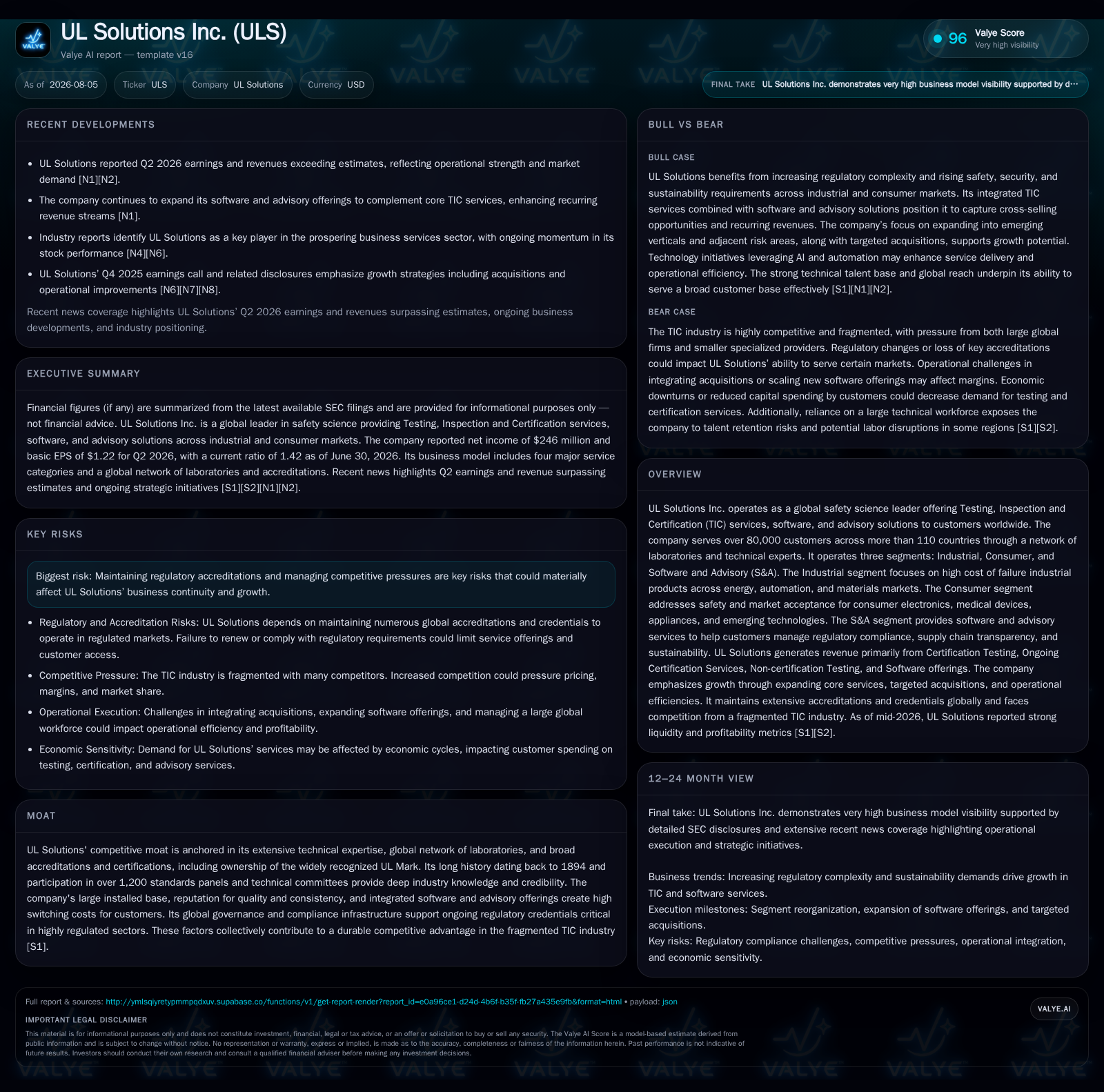
In its latest quarterly filing, UL Solutions highlighted strategic segment reorganization aligning with executive oversight, enhancing clarity on the growing role of software and advisory services within its traditional Testing, Inspection, and Certification (TIC) operations. The company serves a broad customer base across industrial, consumer, and software segments with a globally recognized UL Mark. Its competitive moat is supported by extensive accreditations, technical expertise, and a large installed base. While the TIC industry remains fragmented and subject to regulatory complexity, UL's integration of software solutions positions it well for organic growth and margin expansion. Risks focus on accreditation maintenance and competition. Financially, UL Solutions exhibits strong liquidity with a current ratio of 1.42 and a net cash position as of mid-2026.
Recent Operating Update
UL Solutions’ latest quarterly report filed August 4, 2026, confirms no material changes to previously disclosed risk factors but highlights operational progress including an important segment reorganization effective Q1 2026. This reorganization shifts the Advisory business from the Software & Advisory (S&A) segment into the Industrial segment, while renaming S&A to Risk & Compliance Software to better reflect executive oversight structure and strategic priorities. The reshuffle also reallocates corporate costs across segments but does not affect consolidated financial results [S2],[S16].
The company’s Q2 earnings release attached to the 8-K filing reinforces continuing revenue momentum driven by both core TIC services and burgeoning software solutions that help customers navigate complex regulatory environments globally [S3],[S9],[N2].
Business Model Deep Dive
UL Solutions fundamentally operates as a global Testing, Inspection and Certification (TIC) leader serving customers across industrial markets (energy, automation, materials), consumer products (electronics, medical devices, appliances), and software-enabled advisory services addressing compliance, supply chain transparency, and sustainability needs [S1],[S13],[S18].
Revenue arises principally from four categories: Certification Testing (approximate weight ~28% of total pre-2026 revenue), Ongoing Certification Services which drive recurring income streams by maintaining certifications over product lifecycles, Non-Certification Testing & Other Services including inspection engagements beyond certification scope, and Software licensing/subscription fees linked to regulatory risk management platforms [S1],[S10].
This mix reflects UL’s strategy to move beyond traditional third-party physical testing into value-added digital solutions that embed deeply into customer workflows. The flagship software brand ULTRUS™, launched in early 2024, unites multiple compliance tools for tracking regulatory changes globally while enabling clients to operationalize ESG initiatives—an increasingly critical demand vector given rising sustainability reporting expectations among retailers and manufacturers [S10]
The company's differentiated offering benefits from its extensive laboratory network distributed worldwide to deliver timely testing aligned with thousands of global standards. Its ability to certify against over 4,000 standards demonstrates breadth unmatched by many smaller regional peers that lack both scale and accreditation breadth [S1].
Industry Structure and Competitive Position
The global TIC market is notably fragmented with many small regional players lacking comprehensive accreditations or technical expertise necessary for rigorous safety compliance testing demanded in industries such as energy or medical devices. UL Solutions as North America's largest TIC provider by revenue leverages its legacy dating back to its founding in 1894 under Underwriters Laboratories to maintain deep credibility.
Owning the proprietary UL Mark—a widely recognized certification logo appearing on billions of products worldwide—creates durable switching barriers by combining brand trust with technical rigor. UL’s participation in more than 1,200 standards panels further cements influence within regulatory ecosystems that competitors find hard to replicate quickly [S1]. This positions the company not only as a testing provider but also as an essential partner in standard-setting.
Peer companies like Intertek Group plc, SGS SA, Bureau Veritas, TÜV SÜD, Dekra SE, and Applus+ compete on geography coverage breadth or specialization but often lack UL’s integrated software-advisory capabilities that cross-sell alongside testing revenues.
Growth Drivers
Several structural trends underpin UL’s prospects:
- Rising regulatory complexity: Increasing safety rules globally force manufacturers to engage trusted third parties for certification.
- Emerging technologies: New product categories require novel testing protocols not yet commoditized.
- Global trade expansions: Market access certifications become prerequisites for multi-jurisdictional distribution.
- Consumer safety & sustainability awareness: Brands seek certifications assuring product safety while meeting ESG commitments.
- Digitization: Software adoption facilitates ongoing regulatory compliance monitoring tied closely to physical inspection results.
- Acquisitions: The fragmented industry offers multiple bolt-on targets for capability extension or geographic penetration.
UL’s transition towards cloud-based risk management platforms addresses supplier demand for end-to-end lifecycle visibility beyond point-in-time physical testing. Approximately 65% of their strategic accounts use cross-purchased software/advisory solutions reinforcing wallet share expansion potential [S10].
Operational strategies focusing on service delivery excellence—speed, cost-efficiency—and infusion of new technology into test workflows aim to widen margins even as volumes grow organically or via acquisition integration [S1].
Risks and Constraints
Maintaining critical regulatory accreditations globally remains fundamental; any loss can materially impair the ability to offer certain certifications or penetrate key markets. Regulatory shifts that either raise barriers or legitimize competing players could impact pricing power or volume.
Competition persists not only from established regional laboratories but also emerging platforms digitizing parts of the conformity assessment process. Additionally, market volatility affecting manufacturer capital expenditures could influence periodic demand cycles.
Customer concentration is managed across diverse end markets but losing key accounts would pressure revenues due to lower switching frequency associated with long-term certification cycles.
Geopolitical tensions impacting global operations or currency fluctuations are ongoing external risks commonly facing multinational TIC players like UL Solutions.
Cybersecurity remains an important concern especially for their growing SaaS offerings where data privacy breaches could damage trust.
What To Watch Next
Critical milestones will include how well UL executes ongoing acquisitions aimed at scaling capabilities in adjacent risk areas or new geographies announced recently via agreements like Eurofins’ electrical/electronics division acquisition earlier this year [S22] and how quickly they convert integrated software offerings into higher recurring revenue percentages reflecting deeper customer adoption.
Operating KPIs such as number of certifications issued per quarter, customer retention rates especially among top strategic accounts cross-buying software modules, laboratory utilization rates indicating capacity leverage improvement post any restructuring initiatives taken since late 2025 should be monitored closely.
Further margin trajectory influenced by delivery model innovations including enhanced automation in test labs will indicate success in operational strategies outlined in their annual filings [S1]. Updates on any shifts in regulatory approval landscapes across key regions will signal demand sustainability.
Financial Profile Discussion
As of June 30, 2026, UL Solutions maintains $434 million in cash & equivalents against total debt approximating $303 million translating into an effective net cash position of about $131 million [F1]. This financial flexibility supports ongoing acquisition activity indispensable for growth in this highly fragmented industry.
Liquidity suffices to fund bolt-on transactions supplementing organic initiatives without excessive leverage strain—a critical balance given the cyclical nature underlying some end markets served.
This analysis integrates recent SEC filings up to August 2026 augmented by sector expertise without providing investment opinions or price targets.
Disclaimer: This is research-only, informational analysis and not investment advice. It may include AI-generated interpretation and general industry context. Always verify important details using primary sources.

Comments